

by Florence Pia G. Yu
Published: Sun Star Weekend
Cebu City, Philippines
January 28, 2001
Pages 6-7
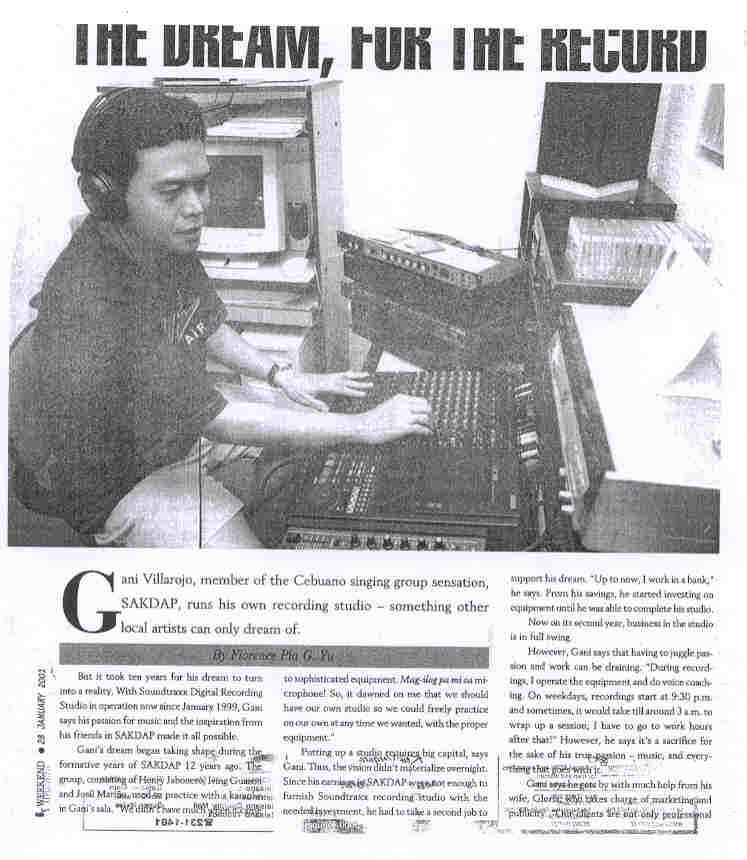
Gani Villarojo, member of Cebuano singing group sensation, Sakdap, runs and owns a recording studio--something other local artists could only dream of.
But it took ten years of his dream to turn into a reality. With Soundtraxx Digital Recording Studio in operation now since January 1999, Gani says his passion for music and the inspiration from his friends in Sakdap made it all possible.
Gani's dream began taking shape during the formative years of SAKDAP some 12 years ago. The group, consisting of Henry Jabonero, Irving Guazon and Josil Mari�o, used to practice with a karaoke in his sala. "Samok kaayo, daghang mo-labay labay! (It was messy, there were too much distractions)). And we didn't have much when it came to sophisticated equipment. Mag-ilog pa mi sa microphone! (We had to fight over the microphone) So, I got to thinking that we should have our own studio so we could freely practice on our own at any time we want, with the proper equipment."
Since his earnings in Sakdap was not enough to furnish Soundtraxx with the needed investment, he had to take a second job to support his dream. "Up to now, I work in a bank." From his savings, he started investing on equipment until he was able to complete his studio.
Now in its second year, business in the studio is in full swing.
However, Gani says that having to juggle passion and work can be a little draining. "During recordings, I man the equipment and do voice coaching. On weekdays, recordings start at 9:30 p.m. and sometimes, it would take till around 3 a.m to wrap up a session; I have to go to work hours after that!" However, he says it's a sacrifice for the sake of his true passion--music, and everything that goes with it.
Gani says he gets by with much help from his wife, Gloria, who takes charge of marketing and publicity. "Our clients are not only professional singers but those who come and record just for the love of singing," he reveals. He says he is pushing for Cebuano music, and providing venue for local singing talents.
What is the hardest thing about running a studio?
Oras ra gyud. Kanang pressured ko sa office dayon daghan kong apasonon diri. Pero, dili ko mo-mind sa time, basta lang mahuman ang recording (Time. When I'm pressured in the office and I still have things to finish here. But I don't mind the time as long as the recording gets finished). I'm very meticulous about quality recording. I give voice coaching to every client whenever they are recording. I always suggest how they should deliver a certain song. I'm particular about placement and expression.
How are your clients doing?
Elmer Cabahug is among them. Also, most local singers have their demo tapes done here so that they could send it to Manila. Calamba Joe the Album was recorded here. Five entrees that made it to this year's Cebu Pop Festival were recorded here. Then, recordings for Channel 7's Singgit Cebu. The theme song for Alas Diyes Na was recorded here. About 100 tapes of the winning entry for the Millennium Anthem contest were also produced here.
You say you're offering the cheapest fee in the market?
I want to make people feel that recording doesn't have to be expensive. You don't have to be a professional singer and spend a lot of money to record your song. In fact, our clients are not only the professional singers but ordinary music lovers.
How do you assess Cebuano music?
I have a vision that someday Cebuano music would rival Tagalog music. Come to think of it, Cebuano artists have already infiltrated the national market: Vina Morales, Chad Borja, Ana Mari Fegi.
But why is there a smaller market for Cebuano music?
Because of the public support--murag dili pa kaayo ingon ana ka supported ang Cebuano songs. However, I think people are warming up to Cebuano music. Last Christmas, Cebuano songs in SAKDAP's Christmas album were played in radio stations.
How can we give Cebuano music a competitive edge?
We have to update our kind of music to meet the current musical taste of the public. There are beautiful Cebuano songs, but these didn?t make it to the programming format of FM stations. There are rock stations, jazz, pop; the idea is to come up with Cebuano songs that would blend with their style of programming.
How far should we bend in order to blend?
We have to retain our style, of course. Bag-ohon ang sound, pero Bisaya gihapon.. (We'll change the sound, but the lyrics will still be in Bisaya)
How is Sakdap promoting Cebuano music?
Right now, we are working on another album. We are trying to revive old Cebuano songs and composing new song arrangement. We need the "punch" so that the songs could make it to the playlist of radio stations. We're also practicing for our act in the 2nd Glory Song Writing Contest at the SM Tradehall this February 4. We're doing everything here at Soundtraxx.
Any expansion plan for the studio?
Actually, I am visualizing Soundtraxx as a production company, not just a recording studio. We will be producing shows, managing talent--all in line with entertainment. Right now, we can only operate the recording studio for now.