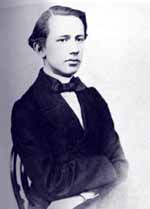
 PiotrTchaikovsky
Born in Kamsko-Votkinsk on May 7 1840, Tchaikovsky
started to show hisappreciation for music at the tender age of 5.
He showed remarkable gifts and talents while
playing the piano. Althoughhe has a loving family, his childhood got affected
by an abnormal sensitivity. He was sent the School
of Jurisprudenceat St. Petersburg when he was ten. His mother died when
he was 14. He took it very painfully and from
testimony, might havestimulated him to composed music. At 19, he took a
post at the Ministryof Justice, regardless of a long journey he took to
western Europe to increaseinvolvement in music. He moved to Moscow 3 years
later with a professorshipof harmony at a new conservatory where he worked.
His First Symphony hada good public reception in Moscow in 1868. When working
on The Voyevoda,he though it was a failure so he abandoned it and reapplied
it for hisnext, The Oprichnik. Balakirev, who was a harsh critic, suggested
thathe writes a work on Romeo and Juliet. It was re-written again and againto
meet Balakirev's criticisms. The Oprichnik won some success at St. Petersburgin
1874. Tchaikovsky's Second Symphony also won approval. The two stringquartets
which is the first if the source of the famous Andante Cantabile(song like
sweet). Vakula the Smith and one of First Piano Concerto, clearlyfired
him. It was originally intended for Nikolay Rubinsten, head of MoscowConservatory
who had much encouraged Tchaikovsky but he dedicated to Hansvon Bulow(
he gave its premiere in Boston). Rubinsten was furious and rejectedit as
an unfit-
composed and unplayable. The carefully written
Third Symphony and SwanLake written in 1875, threw Tchaikovsky in a set
of deep depression becausehe could not accept his homosexuality. To bring
his hopes up, he wrotethe Fantasia Francesca da Rimini. He started to get
contacted by a wealthywidow, Nadezhda von Meck, but they never met. Tchaikovsky
saw marriageas an answer toward his sexual problems. He got a hold of a
young womannamed Anotonina Ivanovna Milyukov who idolized his music. After
first rejectingher, he immediately proposed to her. The marriage was a
disaster. He wentthrough states of nervous collapses, attempted suicide
and went aboard.Nevertheless, this was the time of 2 of his greatest works:
the FourthSymphony and Eugene Onegin. Between 1878-84 came a time of productive
structuralthought. He left the conservatory. Balakirev energized Tchaikovsky
to writehis Manfred symphony. Over the next three years, he composed the
exquisitelyembodied Sleeping Beauty and the more ornamental Nutcracker
and the operathe Queen of Spades. Working on his Sixth Symphony in 1893,
he made a plan.The first movement was to be related with activity and passion;
the second,love; the third, disappointment; and the final, death. It was
a deeplygloomy piece of work.
It was performed October 28 1893. He died nine
days later of choleraalthough some testimony say he committed suicide.
BACK to index