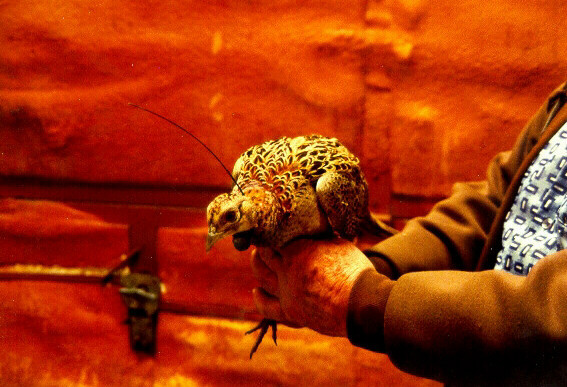
A female hen pheasant fitted with a 15 gram necklace transmitter and ready to be put in a release box.
In November of 1997 I packed up my things and moved to north central Kansas where there are no trees and the cows out number the people. This is also the place where a towns claim to fame is the world's largest ball of twine, but I was finally getting to do what I had wanted to work as a wildlife biologist. So what does a wildlife biologist do well they freeze their asses of in winter, get eaten by flies and mosquitos in the spring, and sweat their asses off during the summer.
Now came the fun part after moving half way across the country, I had to do something I had really never done figure out how to catch the ring-necked pheasant (Phasianus colchicus). The true test now was did I learn anything after spending 4 years in college. Furtuantely I had the help of some seasoned veterns and some not so seasoned. All told we came up with about 10 different ways to try and capture the wiley hen pheasant. Although most were more of a pain in the ass to set up, then they were effective in capture anything at all. First we tried gill nets stretched across a corn field (not my idea). So what happened with this method as we walked toward the net we forced the birds to run and in theory get caught in the net. Well what we got was a lot of pheasants flushing into the air and one or two running into the net and bunching off. Ok so maybe that wasn't a good idea. Then came the use of mist nets, which are large nets with very thin threads making up the netting the bird hits them and gets tangled up. Ok this had been tried before maybe it would work. Well same principle as before we pushed the birds toward where the nets where setup and.............. Ok they caught song birds but no pheasants instead the pheasants flew over or ran under the nets. To fix the running under we set a couple nets low to the ground. This time pheasants ran into them got tangled for a few seconds and then once untangled flew over them or ran into them a couple of more times before flying over.
So our first couple of methods didn't work, we had several more to go. We used one of the more trusted means for capturing wildlife, the bait trap. this did work, but ended up capture more roosters then hens and if we were going to capture 80 or more birds this would take forever. We continued to use the bait traps throughout February March, and a couple of weeks in April. Normal these types of traps are said to be biased toward captureing hens. I guess not in our case instead we kept recaptureing roosters again and again and again. Several times roosters where taken several miles away and released because they had become so trap happy.
After we had one way that could at least capture a few birds we tried a
couple of more drive traps these consisted of  chicken
wire leads in the shape of a V across a weedy fallow field and a
trap at the neck of the V. Well this didn't work when the birds where
being pushed instead it was more effective if left set up and checked every
once in a while. The we tried this same method with a canopy stretch
out over the lead. The reasoning for this was that in the other attemps
the birds would flush right in front of the lead instead of following it.
The canopy idea worked but once again only a few birds could be captured
under the canopy. It wasn't very effective because it took 3 to 5
people a day to setup and required numerous rolls of chicken wire.
chicken
wire leads in the shape of a V across a weedy fallow field and a
trap at the neck of the V. Well this didn't work when the birds where
being pushed instead it was more effective if left set up and checked every
once in a while. The we tried this same method with a canopy stretch
out over the lead. The reasoning for this was that in the other attemps
the birds would flush right in front of the lead instead of following it.
The canopy idea worked but once again only a few birds could be captured
under the canopy. It wasn't very effective because it took 3 to 5
people a day to setup and required numerous rolls of chicken wire.
During this time we also tried at night a tried and true method that has been done successful for several years, nightlighting. In nightlighting a vehicle is equiped with spot light and a person with a night riding on a platform in front of the vehicle at night scanning the area for pheasants or whatever you looking to capture. Once found a spotlight is shined on the animal to temporarily blind it so that the netter can run up on it and throw a net over it. In order for this to work it needs to be over cast and in most cases very cold. So here I am riding around on the front of a truck in -10 degree temperatures (freeze your ass off until you can't feel or fingers or toes) through weeds that are 8 feet or taller in height. This idea worked good the first time we spotted a rooster in a short wheat stubble feild, he didn't have a chance. It was however one of the few times when it did work because most of the birds on the wildlife area weren't in the short sparse vegetation they where in the dense tall stuff that you either couldn't see them in until they flushed or that if you did throw the net over them they just ran out under neath it. The other problem with this method was that frozen ground is like rough lumpy concrete when you dive for a bird.
So far we had only captured less then a dozen birds and April was coming
up fast. We tried several other methods a drop net for turkeys (never got
the birds under the net) 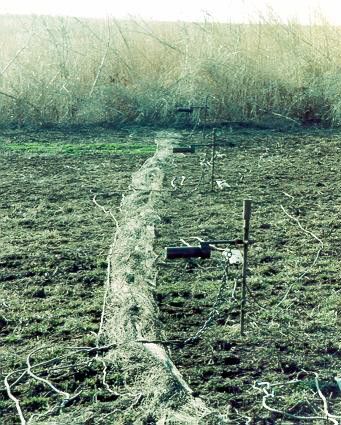 and
a rocket net. Now this was the ticket it took one person a couple of hours
to bait several sites and then when they were being used by pheasants set
the net up and wait for however many birds you wanted to be in the area
of the net. With this method we were above to capture more
then enough pheasants the first year of the study. This was also
the most fun of all the other methods. When else can you sit in a
nice warm vehicle while the snow and window blows around you and then the
time comes set of three rockets in a big bang and cloud of smoke.
and
a rocket net. Now this was the ticket it took one person a couple of hours
to bait several sites and then when they were being used by pheasants set
the net up and wait for however many birds you wanted to be in the area
of the net. With this method we were above to capture more
then enough pheasants the first year of the study. This was also
the most fun of all the other methods. When else can you sit in a
nice warm vehicle while the snow and window blows around you and then the
time comes set of three rockets in a big bang and cloud of smoke.
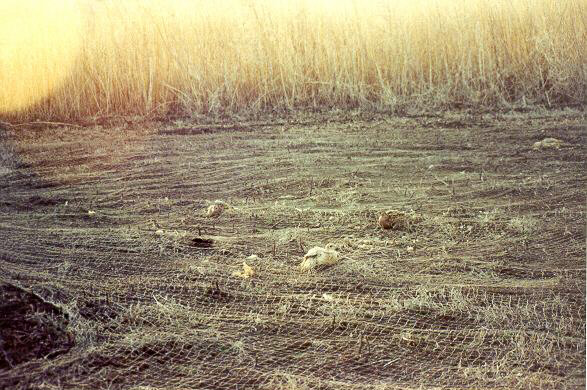
Five hen pheasants captured under a rocket net
Well with the hard part out of the way the rest of the research should have been easy. Well not exactly try tracking 90 pheasants equipped with transmitters 5 days a week. Then have them slowly start disappearing a few weaks after being released. This is where my philosophy of wildlife research paricularly field reseach comes from and for all you aspiring undergrads and graduate students don't get discouraged when "shit happens". As all seasoned researchers know, " When conducting field work plan for everything and anything to go wrong, and if it doesn't happen right away it will happen eventually".
So what happened to my all my disappearing birds, did they just leave the study area or did some mysterious black hole just swallow them up? Well to the best of my knowledge the transmitters kept failing until in August I had no more birds. I still got some data but nothing like I should have.
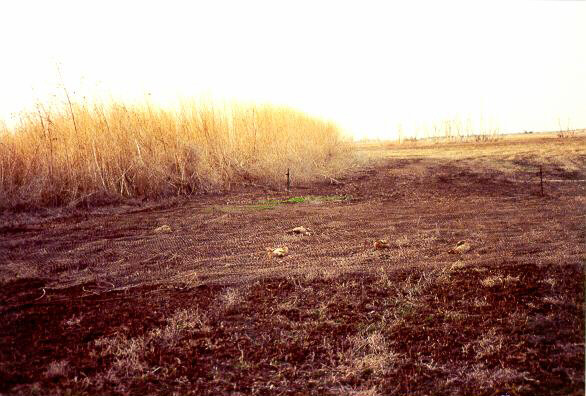
Ok so one field season down the next year should just get easier and better YEA RIGHT who are we kidding. Well at least this time we know how to capture them so two brand new rocket nets where purchased solely for captureing pheasants. First things start off bad the nets weren't ordered soon enough so the amount of time to capture birds is shortened. Then after a couple of weeks of trapping and birds getting captured things start looking up. Well until one net is set on mowed dry wet stubble in an area with a large flock of pheasants. Once again plan for anything and everything to happen, the net is set off by one of the guys helping me while I sit on the other net. I guess we should have thought more about the fact that the wheat stubble was dry and that the rockets when set off just might start a fire. So part of a net is burned and I blow out a tire on the way to help put out the fire. The burned net was a slight set back but we where only going to capture half as many hens this year and release them all in one area.
We still ended up captureing plenty of birds by the first week in April
and were off to a desent start with the brand new necklace style transmitters.
So everything should go good from this point on, guess again. After a week
I began losing birds only this time I was finding the remains of the bird
as well as the transmitter. So now are loses are due to predation
not transmitters. This should be a good thing you would think, well
until mid May comes around and you are losing birds daily. By the
middle of June one bird was left and within a week it to was dead.
I guess I should have focused more on predation then on habitat.
Hmm or is it because they area was a sink habitat for pheasants and a source
for predators. Like I said before plan for everything and anything
to go wrong, cause sooner or later it will.
Home Past Research Current Research
Photographs
Wildlife
Links
GIS
Links

Last modified August 5, 2001