|
Observations of Planetary Transits
A planetary transit is a sort of eclipse, where the planet passes across the disk of the Sun. As seen from Earth, only transits of Mercury and Venus are possible. Transits of Mercury occur about thirteen times per century on average. Those of Venus are much less frequent, occurring in pairs separated by about eight years at intervals of either 105.5 years or 121.5 years.
A great deal of interesting information on Mercury and Venus transits can be found on Fred Espenak’s website at http://sunearth.gsfc.nasa.gov/eclipse/transit/transit.html
Mercury
Since I started observing in the mid 1970’s, there have been four transits of Mercury: November 1986, November 1993, November 1999, and May 2003. The 1986 and 1993 transits occurred after sunset in the eastern U.S. My first opportunity to see a transit was therefore in 1999. This transit occurred between 21:15 and 22:06 UT (16:15 and 17:06 EST) on November 15. Since sunset for New York on November 15 is around 16:38, this provided only a small window to see the transit with the sun very low on the horizon. The conditions were not exactly ideal. Good luck was with me, however, as I was scheduled to attend a business meeting in San Diego on afternoon of the 15th. I therefore arranged my travel to arrive in San Diego early enough on the 15th to see the transit which would occur between 13:15 and 14:06 PST while the sun was riding high in the sky.
When I arrived in San Diego, I headed for Balboa Park,
home of the Ruben Fleet Planetarium where I was sure telescopes would be set
up to show the transit to the public. Sure enough, the San Diego
Astronomical Society had a number of telescopes set up outside the
planetarium ranging from a 5 inch ETX to a 10 inch Meade LX something or
other. I got there around mid transit and Mercury was quite close to the
sun's limb. This transit was nearly grazing, so
Mercury remained close to the sun’s limb throughout the event. For the
same reason, the transit was of relatively short duration since Mercury’s
path was a relatively short chord across the solar disk. I observed the
transit through a number of instruments. The most striking thing to me
was
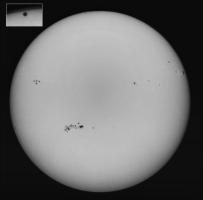
Image of Mercury transiting in front of the Sun Taken on November 15th 1999 by Dr. Bill Livingston, using the Kitt Peak Vacuum Telescope. NSO/AURA/NSF
The next opportunity to see a Mercury transit occurred on May 7, 2003. In the northeast, this transit occurred during sunrise, once again making observing the event a challenge. This transit was much more central than the one in 1993, so its duration was more than five hours. Unfortunately, only very end of the event occurred after sunrise which occurred at 5:53. Last contact would occur only about a half hour later at 6:31. Seeing any of this transit would require good weather and a site that provided a clear view of the horizon.
My friend Steve Walters and I decided to try observing the transit from a commuter parking lot on Telegraph Hill in Holmdel, New Jersey. The night before the transit, the Clear Sky Clock predicted clear skies at sunrise, so we were hopeful. We arrived at the site at 6:00 am. I brought my 90mm Meade ETX with a Baader solar filter. Upon arrival, there was some ground fog and haze that attenuated the sun enough to prevent us from seeing it in the scope/filter. We were finally able to see the sun at 6:15, giving us a 15 minute window to observe the end of the transit. Obviously, Mercury was very near the sun’s edge at this time. We used 48X which provided enough magnification to show a noticeable disk of Mercury. Like the 1999 transit, seeing the planet against the disk of the sun resulted in the illusion that it was much larger than it really is. A large sunspot near the center of the sun also provided a nice backdrop. We were able to observe third and fourth contact, with the transit ending right on schedule around 6:31.
An animation of the 2003 Mercury transit can be found on the National Solar Observatory website at the following link: http://gong.nso.edu/mercury_transit03/transit_animation.html
Venus
The two transits of Mercury were good warm-ups for the transit of the century, the June 8, 2004 transit of Venus. The last Venus transit occurred in 1882, a time when observation of the event was still of scientific importance. Accurate timings of the transit from several points on the earth, and the time difference due to parallax, could be used to derive an accurate earth/sun distance, thus establishing an accurate scale for the solar system. Unfortunately a phenomenon known as the “black drop effect,” in which Venus appears to deform and cling to the limb of the sun, would adversely affect the accuracy of timings, limiting the usefulness of such observations. Nevertheless, the adventures surrounding the various expeditions to observe the handful of Venus transits that have occurred since the invention of the telescope are fascinating. The popular book, “June 8, 2004 – Venus in Transit,” by Eli Maor describes the history surrounding the transits of Venus in great detail, and is a fun and informative read.
Like the 1999 transit of Mercury, the Venus transit of 2004 would be in progress for east coast observers at sunrise. This time, the geometry was little more favorable providing a two hour window between sunrise at 5:24 and the end of the transit at 7:25. Since I have good visibility of the morning sun from my home in June, I decided to observe the transit from my driveway. Again, I used my ETX90 with the Baader solar filter. The sun was up above the trees by 5:45 giving me a relatively long and leisurely view of the transit. The visual experience was very enjoyable. The disk of Venus was quite large, and only it and a very small sunspot group near the center of the sun were visible against the sun’s disk. I observed third contact without seeing any black drop effect. The only distortion visible was a slight flattening of Venus near the sun’s limb. It was difficult determining the exact point at which fourth contact occurred due to the blurring effect of turbulence at this time.
Steve Walters observed the transit from the boardwalk in Long Branch and photographed the event. A great sequence of photos pieced together as a movie clip is available on his website here. A great source for professional grade images of the transit, including several movies is the Swedish Institute for Solar Physics.
Future Transits
WARNING: OBSERVING PLANETARY TRANSITS MEANS OBSERVING THE SUN WHICH, IF DONE IMPROPERLY, CAN CAUSE PERMANENT EYE DAMAGE OR BLINDNESS. METHODS FOR OBSERVING THE SUN SAFELY CAN BE FOUND AT THIS LINK.
Mercury: Nov 8, 2006 (Missed this one…)
This
transit is a five hour event that begins at 19:12 UT (14:12 EST) and ends
at 00:10 UT (19:10 EST). Sunset in New Jersey on Nov 8 is at
approximately 16:46 EST, so only the first half of the event will be
visible. Complete information on this transit can be found
at: http://sunearth.gsfc.nasa.gov/eclipse/OH/transit06.html Venus: June 6, 2012
This transit is the second of the pair of Venus transits occurring this century. The transit begins at 23:03 UT (19:03 EDT) with the Sun/Venus at an altitude of 24 degrees in New York. Only the beginning of the transit will be visible since sunset on June 6 occurs at about 20:24 EDT. Complete information on this transit can be found at: http://sunearth.gsfc.nasa.gov/eclipse/transit/venus0412.html
|