Occultation of 28 Sagittarii by Saturn – July 3, 1989
On July 3, 1989 an occultation of the 5.4 magnitude star 28 Sagittarii by the planet Saturn was observed by myself and several other members of the S*T*A*R Astronomy Society from our observing site at Huber Woods Park in Middletown, New Jersey. An occultation occurs when a non-stationary body such as the moon, planet or asteroid moves directly into the line of sight between an observer on the earth and a star, thus blocking the observer’s view of the star. While occultations by the moon occur frequently due to its large angular size which subtends a sizeable area of sky, occultations of stars by the much smaller planets are much less common, especially those involving bright stars such as 28 Sagittarii. The occultation of 28 Sagittarii was particularly favorable since the ring plane of Saturn in 1989 was close to its maximum open angle. The passage of the star behind the rings provided a good opportunity to measure fine scale ring structure. See figure 1. The occultation was visible over a wide area of the Americas, southwestward to New Zealand and Australia. Observers in a region from Europe to Southwest Asia saw the star occulted by Saturn’s moon Titan.
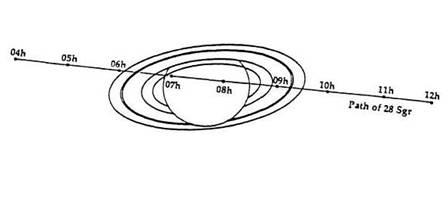
Figure 1. Apparent path of 28 Sagittarii behind Saturn and it’s Rings
The observing conditions for the occultation in Middletown on the morning of July 3 were fair, with the transparency affected by a typical summer haze. Seeing was relatively steady at the beginning of the event, but deteriorated considerably by the end. Observers and their instruments included the following:
Frank Loso (FL) 6 in. f/8 Newtonian Refl. (150X)
Gary Romans (GR) 4.25 in. f/10 Newtonian Refl. (225X)
Kay Sears (KS) 6 in. f/8 Newtonian Refl. (100X)
Alan Sheiness (AS) 8 in. f/10 Meade Schmidt Cass. (300X)
Peter Rathmann 6 in. f/8 Newtonian Refl.
Ed Shrum 8 in. f/10 Celestron Schmidt Cass.
Kevin Regan Inst. unknown
Debbie Rich Inst. unknown
Don Pitman Inst. unknown
During the observation, observers’ verbal comments were recorded on an audio tape along with a continuous time signal from the National Bureau of Standards radio station WWV. Later, I transcribed the tape and reduced the observations to a plot indicating the visibility of the star as a function of time. The plot is shown in figure 2, and the full transcript is available through the link at the end of this page. Only those observers with initials after their names are identifiable on the tape. Simultaneous comments by multiple observers are indicated by the addition of their initials in parentheses after the comment in the transcript.
The plot of results has the time scale folded in order to cover the time period of 0558 to 0650 on a single page. Each line of the plot is a three minute strip starting with the time indicated on the y-axis. Times indicated are in Universal time (EDT+4 hours). For each time strip, a “high” indication on the graph represents the star being visible through the rings, “low” represents invisible. Intermediate intensities and episodes of sudden short term brightening (“flare-ups”) or dimming are indicated on the plot as up or down arrows respectively. It should be noted that the graph shows the observations of the group as a whole. Since not all of the events shown were always seen or recorded as being seen by all observers, there are almost certainly some inaccuracies in the plot. The intermediate brightness levels may be especially inaccurate as an absolute measurement, but should give a fairly accurate indication of the overall trend. Sudden flare-ups and dimmings are generally reported by only one observer, and could very well be the result of poor seeing conditions or observer fatigue.
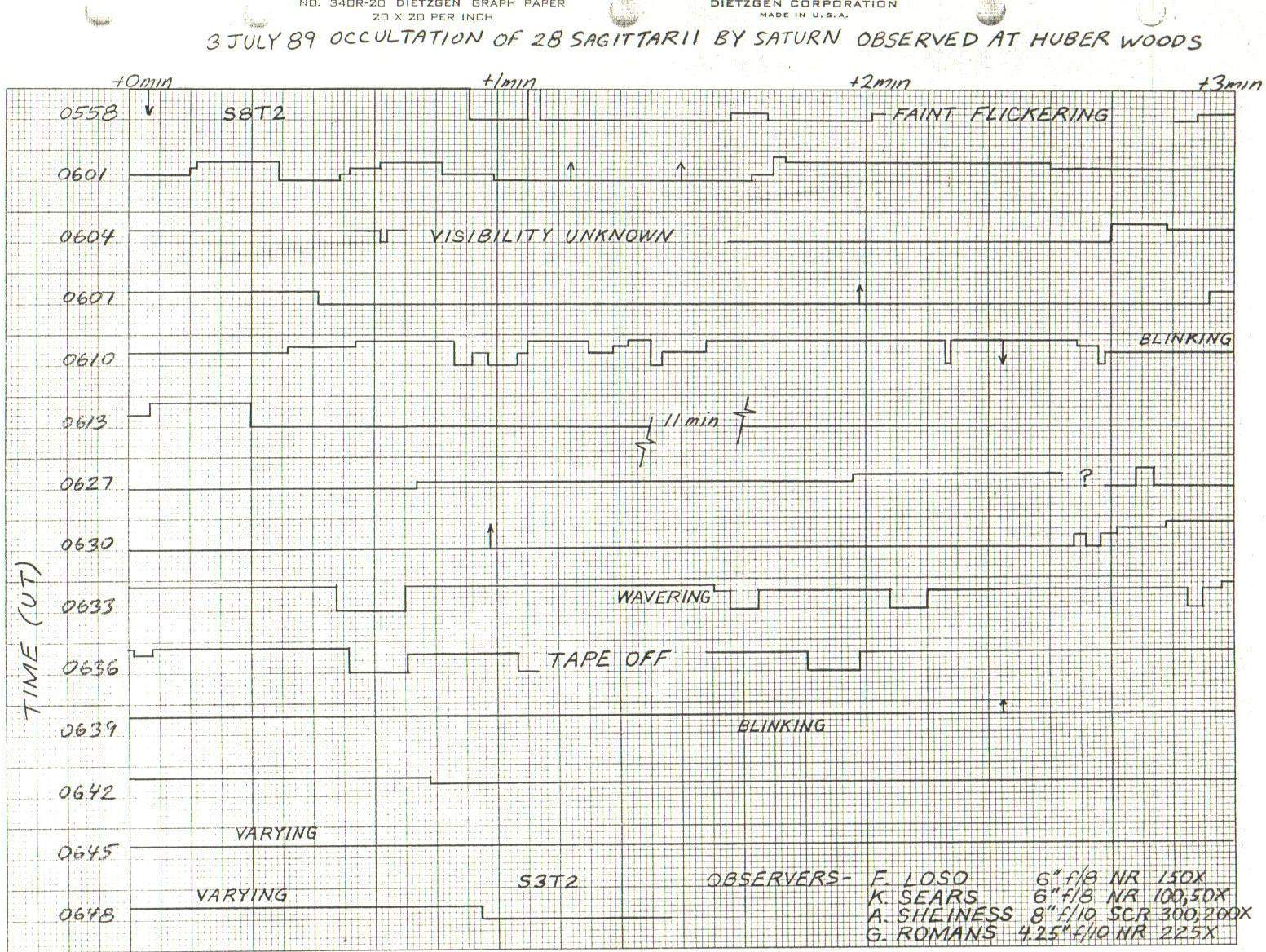
Figure 2. Plot of Observation
The plot appears to give a good overall indication of the ring structure of Saturn, and agrees quite well with the predicted events published in the June issue of Sky and Telescope (page 641). The period from approximately 0559 to 0610 shows the star’s passage through the A ring with considerable blinking near the outer edge. The star is more or less invisible from 0605 to 0610. At 0610 the star begins its passage through the Cassini division, and blinks on and off wildly until it enters the outer edge of the B ring at about 0613. It is invisible for most of its passage through the B ring until around 0632 when it enters the very thin C ring. Here it shines through faintly with a few block-outs and fadings. From the inner edge of the C ring to the limb of the planet, the star shines faintly but fairly steadily. Although the seeing had deteriorated by this point making the star barely visible, it was observed until its disappearance behind the limb of Saturn at 0648:57.5 (predicted time 0648:23).
This data was submitted to the International Occultation Timing Association (IOTA). Our results are also consistent with a report of the occultation by Julius Benton of the Association of Lunar and Planetary Observers (ALPO), “The July 3, 1989 Occultation of 28 Sagittarii by Saturn, Its Ring System, and Titan: A.L.P.O. Visual Observations.” This report can be downloaded from the Smithsonian/NASA Astronomy Abstract Service for free, and provides an excellent description of the event. Note that times in the report differ from times in our data by several minutes since the report reduces the set of worldwide data to geocentric coordinates.
Link to Transcript of Observation