Part 1 – Moonwatch

In 1952 the International Council of Scientific Unions proposed a comprehensive series of global geophysical activities to span the period July 1957-December 1958. The International Geophysical Year (IGY), as it was called, was intended to allow scientists from around the world to take part in coordinated observations of various geophysical phenomena that would help to improve our knowledge of the earth as a planet. Similar international activities to study the physics of the earth were conducted during the International Polar Year in 1882, a period of peak solar activity, and again in 1932, although these activities focused primarily on the north polar region. Originally intended to be repeated every fifty years, the next IPY would have taken place in 1982, however after lobbying by the U.S. National Academy of Sciences (NAS) the period was shortened to twenty five years in order to take immediate advantage of the unprecedented advances in technology that had taken place during and since WWII.
American participation in the IGY was charged to a US National Committee (USNC) appointed in March 1953 by the NAS. Technical panels were formed to pursue work in the areas that included aurora and airglow, cosmic rays, geomagnetism, glaciology, gravity, ionospheric physics, longitude and latitude determination, meteorology, oceanography, rocketry, seismology, and solar activity. As planning for IGY took shape, the U.S. gradually introduced the idea of launching satellites as a tool for geophysical research as part of the IGY studies. A formal proposal to use satellites during the IGY was adopted by the ICSU in October 1954.
In support of the IGY satellite program, in June 1955 the U.S. Army Chief Signal Officer, Lt. Gen. J. O’Connell, directed the Army Signal Research and Development Laboratory (SRDL) at Fort Monmouth to generate proposals for the development of satellite scientific instrumentation, components, and systems for telemetry, tracking, and ground support based on the expectation that the Army’s Orbiter program would be selected by the DoD committee reviewing proposals for launching the first satellite. A set of proposals was produced by the SRDL, which included the concepts of using satellites for communications, weather forecasting, and intelligence gathering. When the Navy’s Vanguard program was ultimately selected over the Army’s Orbiter however, the SRDL proposals were shelved. Later in January 1956, another proposal by SRDL to develop a capability of obtaining satellite imagery of cloud cover was accepted and funded by the NSF. One of engineers involved in the SRDL satellite activities was Dr. Hans Ziegler, an engineer who had joined the lab in 1947 as part of Project Paperclip, the post WWII initiative that recruited a number of top German scientists and engineers, which included Werner Von Braun, to emigrate to the U.S. After joining SRDL, Ziegler established himself as one of the foremost experts on satellite technology and became the laboratory’s Chief Engineer. He would later also become involved in S*T*A*R.
As preparations for IGY progressed, the Smithsonian Astrophysical Observatory was assigned the responsibility of leading an optical tracking program for the satellites launched as part of IGY. SAO Director, Fred Whipple, and astronomer J. Allen Hynek developed a concept which would use two separate but coordinated groups - one to acquire or "find" the satellite, and another to perform precision tracking. Tracking would be accomplished by a worldwide network of twelve large aperture Baker-Nunn cameras operated by professionals. Acquisition would be the responsibility of the group to be known as Project Moonwatch. A “Moonwatch” Division was established at SAO, and astronomer Armand Spitz was named as its Director. At the time, little was known about the upper atmosphere other than what had been learned from brief probings using sounding rockets, so the overall SAO optical tracking program would be crucial to the effort to predict the satellite orbits, and to obtaining a better understanding of the physics of the atmosphere.
It was in this climate that the Society of Telescopy Astronomy and Radio (S*T*A*R) was established. Both the scientific community and the public were charged with the excitement of space exploration, a new and exciting endeavor of which Fort Monmouth was a part, and which was now also open to participation by interested amateurs through Moonwatch. So in May 1957, S*T*A*R was formally organized at Fort Monmouth. A short notice in the November 1957 issue of Sky and Telescope announced the formation of the club and listed its officers as Frank K. Priebe, President; Herbert D. Tanzman, Treasurer; and Mrs. Thomas B. Richey, Secretary. The notice indicated that the club had 33 members. While the exact makeup of the club at this time is unknown, a member list from several years later (1963) shows a diverse group 43 members including scientists and engineers, technicians, and clerical personnel from Fort Monmouth. About a third of the membership at this time was from the local community.
As for the officers, nothing is known of Mr. Tanzman or Mrs. Richey. Frank Priebe, the club’s first president, remained active in S*T*A*R up to his death in 1982 at the age of 81. Frank was born in Germany and emigrated to the U.S. before WWII. He came to work as an electrical engineer at Fort Monmouth by way of Berlin, New Hampshire. When asked where he was from, he often answered with his wry sense of humor, and in his pronounced German accent, that he was from “Berlin.” Frank was a genuinely nice guy who was always full of ideas and was universally liked both personally and professionally.
Frank had a keen interest in astronomy, which he maintained to the end. He was also an avid mirror maker who produced some of the finest optics I have had the pleasure of looking through. The primary in my 8” f/7 was made by Frank at one of the S*T*A*R mirror making classes in the 1970s (more on this later). Take a look through it the next time I have it out! In later years, Parkinson’s Disease made Frank less active physically, but he continued to enjoy the hobby through correspondence with German amateurs on telescope making and astronomy, and endlessly translated articles from German language astronomy magazines such as Sterne und Weltraum, and Orion into English to share with members of S*T*A*R.
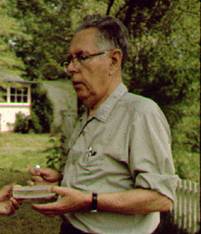
Frank Priebe circa 1970
Most importantly in terms of this article, Frank Priebe was the organizer of S*T*A*R, and its leader for many years. While Moonwatch was definitely a major impetus to forming the club, as the name “The Society for Telescopy, Astronomy and Radio” implies, its purpose was always intended to be more diverse, and was driven by Frank’s enthusiasm for astronomy and telescope making. Moonwatch was an interesting and relevant project in which the club could participate and contribute meaningfully to the advancement of scientific knowledge. As for origin of the club’s name, the words “telescopy” and “astronomy” are pretty straightforward. The intent of the word “radio,” however, other than completing a cleaver acronym, is not so obvious. According to Dr. Gernot Winkler, a friend of Frank’s and a charter member of the club who left in 1966 to become the Director of Time Services at the U.S. Naval Observatory, “radio” served a good political purpose in Frank’s effort to obtain support for the organization from the Command at Fort Monmouth. In addition to the SRDL activities related to satellites described earlier, the Laboratory had also been involved in research loosely related to radio astronomy since the mid 1940s. This work included obtaining the first radar return from the moon using the “Diana” radar at Camp Evans in Wall Township in January 1946, and of meteors during the Draconid shower in October of the same year. The lab continued to use the moon as a target during research to measure the electron density of the ionosphere through the early 1960s, a project that was under the direction of Dr. Winker. While there was no specific plan for S*T*A*R to engage directly in radio astronomy, it was good politics to work this connection into the name of the group. So, Frank obtained the support of Dr. Harold Zahl, Director of Research at Fort Monmouth, who became a patron of the club, supporting not only its formation, but also the use of Fort Monmouth facilities and the acquisition of equipment to facilitate the observation of satellites during Moonwatch.
Satellite observations became the focus of the early activities of S*T*A*R. The club registered with the Moonwatch program sometime around July 1957. The SAO Bulletin for Visual Observers of Satellites for that month makes note of the registration of a Moonwatch station in Red Bank with a Mr. Marvin Bernstein as the station leader. At this time there were about 80 stations registered with the project in the U.S. While the name “S*T*A*R” is not used in any of the first eight SAO bulletins, which is all I have been able to find, it is nevertheless clear from the SAO archives that the club and the Red Bank Moonwatch group are one in the same.
The SAO bulletins are quite interesting in their own right. They describe the recommended methods for setting up a station and making observations, provide ideas on instrumentation, report on observations, and generally provide a good chronology of the program. Throughout the bulletins, the seriousness of the program and the importance of accuracy in the observations are continually emphasized. While the exact methodology of making observations was left to the discretion of the station leader, the general object was to set up a group of wide field telescopes (12 degree field of view was recommended) and point them at the meridian in a manner so the fields overlapped, covering an arc of sky oriented north to south. Typically, a north-south line was laid out on the ground, and the telescopes were set up along this line with the observers seated side by side, their telescopes pointed sideways to cover their respective pieces of the meridian arc. The altitude and time that the satellite would cross the meridian was not known (at least not with good accuracy), so the concept was to set up a “fence” that the satellite would have to cross in its passing across the sky. The exact time and position of meridian crossing could therefore be measured accurately by listening to time signals from radio station WWV while making the observation. The time the satellite entered the field of view (of the telescope that happened to be pointed at that part of the meridian), crossed the center, and left the field of view would be noted. The station leader would then convert the measurement into a position (altitude) and time of meridian crossing, and submit this data to the SAO where it would be combined with the data from other stations and used to compute an orbit.
While there was no official standard telescope that was universally used in Moonwatch, a commonly used instrument is the so-called “Apogee” telescope designed by astronomer George Van Biesbroeck. The telescope itself was a wide field 5-inch aperture spotting scope originally built by Bausch and Lomb for the military. The novel feature was a mounting that placed the telescope in a downward looking position pointing into a flat mirror that would direct light from above into the telescope. This arrangement allowed observers to sit at a table looking comfortably into the telescope, as they would a microscope, while observing an area of sky above. While the Apogee scope may have been considered one of the optimal instruments, the many Moonwatch groups used whatever instruments could be scrounged. A variety of instruments appear to have been used by S*T*A*R including both telescopes and large aperture Army issue binoculars, a number of which were supplied to the group by Fort Monmouth with the help of Dr. Zahl.
During the months leading up to the expected launch of the U.S. Vanguard satellite, Moonwatch teams refined their observing techniques, practicing on high altitude aircraft that were flown for this purpose. After the surprise launch of Sputnik by the Soviet Union in October 1957, the Moonwatch teams were ready and were called into action.
A typical observing session of the Fort Monmouth / S*T*A*R Moonwatch group is described below. This is an excerpt from an interview of Ms. Anne Stommel, a member of the club in 1957. The interview was conducted in April 2000 by the Monmouth County Library as part of an oral history project entitled “Remembering the 20th Century: An Oral History of Monmouth County.” Ms. Stommel, who passed away in 2003, was 74 at the time of the interview.
“Around 1957, I guess, I was so fantastically interested in the space age, and of course, I never was in Florida, and never saw the rockets go up, but I belonged to an organization, the Armed Forces Communications and Electronic Association, and it still exists. I'm an honorary life member. I was made that in 1974. But we had lecture programs, and one time Doctor Wernher von Braun spoke, in April 1953. One of the scientists at Fort Monmouth knew about Doctor Wernher von Braun down in Huntsville, Alabama, and von Braun came and he talked about space travel. The rocket would go up a hundred miles in space. It would be traveling eighteen thousand miles an hour. It would make a trip around the world every two hours, and of course, the Earth was revolving underneath that orbit so that it would cover a different space on Earth every two hours. I was on the Moonwatch team at Fort Monmouth. And the Moonwatch team spotted, by the human eye, the satellites that were up in space before our radar could detect them. And we were on the roof of the Hexagon Laboratory building, which is over in Tinton Falls. It's there now in the year 2000. But we had, up on the roof, almost like a picnic bench, a two-by-four suspended by seats on both sides, wooden seats on both sides, and on each two-by-four were telescopes, angled so that they would cover different portions of the sky. And we had a radio from WWV in Washington, D.C. that would give the time signals. "At the return of the signal it will be exactly 4:51am da da da da da!" There were six people, three on each side of the two-by-four. They'd sit on the bench and they'd look in the telescopes, and if one saw a satellite coming into the telescope, he or she would say, "Coming into the scope now, reaching the center now, leaving the scope now." The time signals were recorded from WWV at the Naval Observatory in Washington. They'd hear our voice saying, "Now." They knew where the telescopes were pointed and we'd send that information to the Smithsonian Institution. So that the Moonwatchers made a big contribution toward establishing the orbits of space satellites.
Ms. Stommel, who worked as a field manual writer for the Army Signal Corps remained a member of S*T*A*R through at least 1963. Her recollection of the data recording and reduction appears a bit sketchy, but the strong impression made on her by participation in Moonwatch and attendance at the Von Braun lecture (most likely widely attended by the members of S*T*A*R) is obvious nearly half a century later.
As noted earlier, the typical Moonwatch group reduced its observations to an altitude and meridian crossing time for submission to the SAO. S*T*A*R, however, did a bit more as indicated by an obituary in May 1976 for one of the club’s charter members, Peter Ross, which makes note of him being the “first orbit computer of S*T*A*R during the time of artificial satellites, particularly the Sputniks.” The obituary also credits Mr. Ross as being a pioneer in the development of Radar at Fort Monmouth before WWII, and with being involved in the first radar observations of meteor showers, probably as part of the Draconid observation project described earlier. This accomplishment, incidentally, was documented in a cover article in the March 1947 Sky and Telescope.
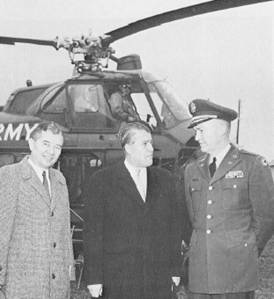
Dr. Hans Ziegler (L) and Col. H. McD Brown (R) with Dr. Wernher Von Braun during a visit to Fort Monmouth
S*T*A*R’s participation in Moonwatch is documented in the SAO archives as having continued through the year 1960. The SAO actually continued to sponsor the program through 1975. After 1960, however, the members of S*T*A*R decided to devote their energies to other more astronomically relevant activities and dropped out of the program. In any event, the club’s participation in the early years of the Moonwatch made a contribution to science and closely tied us to the beginning of the space program. It also established S*T*A*R as an organization with an interest in serious observing that could contribute to science. This focus would continue through participation in several other observing projects through at least the late 70s as will be described in the next part of this history of the club. (To be continued…)
© Frank Loso, January 2005