
| General Appearance | Courtship and Breeding | Predators | Hunting and Feeding | South Polar Skuas and Humans |
| In The Media |
|
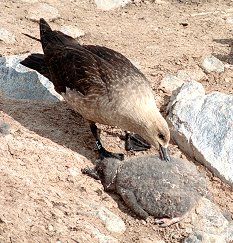
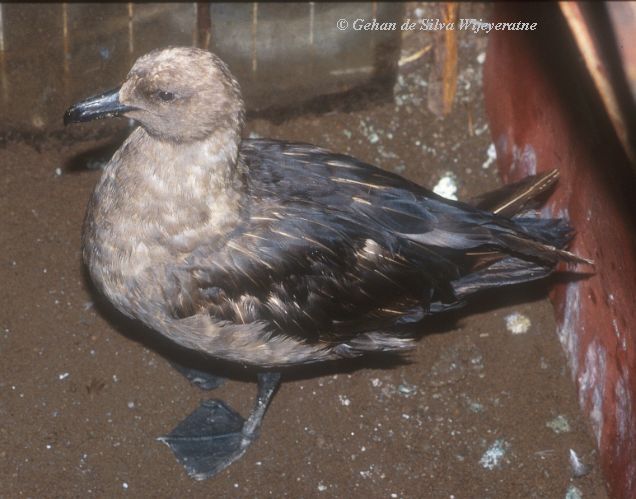
Skuas, in general, are sometimes known as 'Seabirds of Prey'. South Polars look like rather large, brownish gulls (With an occasional light and dark morph), but behave like eagles and falcons. These birds are about 53 centimeters in length, or about 2 feet. They have a large hooked beak and clawed webbed feet. They have a white pattern on their wings and a heavy muscular chest.
|
 |
|
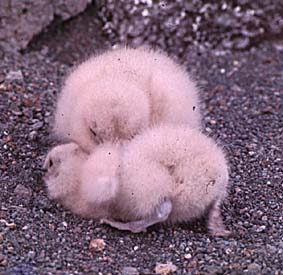
These skuas breed in the Antartic during the winter, making it one of the few that does such a thing. Other winter breeding birds are Penguins and Snow Petrels. They nest near Adelie penguin colonies, where there's an abundant food source. The male skua displays and calls to attract a mate. They are monogamous, as in they mate with only one partner. The females are larger than the males. Two chicks are usually born but only one will most likey survive. The older chick will harass it's younger sibling right out of the nest, where it will be preyed on by Giant Petrels and other skuas, not to mention attacked by penguins. Parent skuas are very protective of their young. Anything that gets to close to the nest, even humans, will be dive-bombed and attacked. South Polar skuas make very loving parents and will do anything to keep their child safe. The chicks fledge and become independant at three months old. Average lifespan is approximately 11 years.
|
 |
|
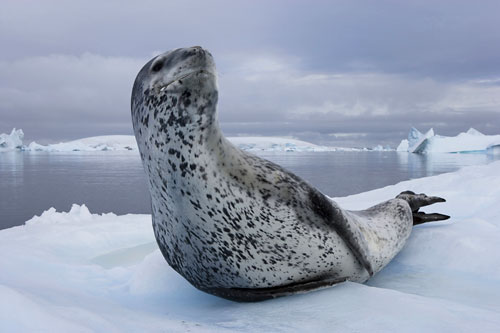
South Polar Skuas are among the top predators of the Antartic. But they themselves are preyed upon by various things. Leopard seals, like the one in the picture, will eat a skua if giving the chance and skuas often annoy the seals by pecking them as they sleep. Giant Petrels are also dangers, as they prey on chicks and kill adults during food assualts. Skuas also face threats from penguins, who will stomp the skua's nest and eggs and can greatly injure an adult skua by swatting the seabird with their strong, bony flippers, which can easily break a skua's wing. Even other skuas are dangerous, as they will feed on the eggs and young. And fights between adults will often go to the death.
|
 |
|
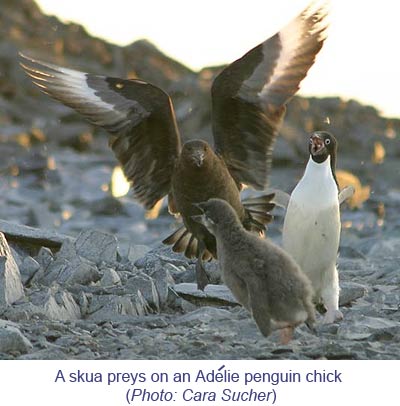
South Polar skuas feed mainly on fish and krill, some of which they steal from other seabirds. They practice a piratical behavior, attacking and harrassing the other bird to release it's catch. While most skuas use speed for such things, South Polar skuas prefer brute force. Killing the other bird is not uncommon. They will even prey on small petrel species, such as the beautiful snow petrel and the blue petrel. These powerful seabirds also feed in penguin rookeries, mostly from Adelie penguins. There, they hang around looking for unguarded eggs and lost chicks. They adapt several tactics to obtain their meal. Pulling a sleeping adult penguin right off the nest is common. The skuas grabbed the penguin's tail feathers and yank the other bird off. They then climb over the parent and swipe their prize. A couple of skuas may work together. While one skua distracts the protective penguin, the other will steal the eggs or chicks. Baby penguins who strike out on their own won't last long, for a skua will be upon it in a short time. If it's prey is small enough, the South Polar skua will swallow the chick whole. Much larger pengun chicks will suffer a much slower death. Once dragged away from the other penguins, the chick will be mercilessly pecked into submission as the skua predator tries to break through the baby's tough, protective skin. Once the seabird of prey succeeds, it'll proceed to eat the chick from the inside out. While this method sounds cruel, it's more efficient than trying to break the skin again and again for each bite. South Polar Skuas are also scavangers, cleaning up the remains of those who died, from drowned adult penguins and bull elephant seals that die from their wounds to beached whales.
|
 |
|
Since the time explorers first arrived in Antartica, they regarded skuas as vermin. They shot the birds and even used dynamite on their nests. Even today, there are sadistic people who torment the local skuas. Tourist sometimes got skuas to eat cigarette butts and laughed when the birds got hurt and aggitated. A person's first view of a skua is usually at a penguin colony, where they prey on chicks and eggs. Many think of these seabirds as evil and aggressive. But they only do what's natural. And what else would they eat? Why waste time going out to fish when an unlimited food supply (the penguins) is right in front of them? And who'd risk leaving the chicks for the long period of time it takes to fish? But not all things are negative about skuas. Scientists spending time in the Antartic agreed that South Polar Skuas are intellegent and curious birds that will often drop by to see what you're up to and maybe get some free food. When scientists took walks outside, the skuas weren't far behind and would even land on or beside them. Here's an artical quote from one scientist (see Cool Antartica link in Resources, and I DON'T own this): "If you were out nearby they (skuas) would sometimes come to see if they could get any free food, squawking and hovering above you. If you lent over forwards, then sometimes one would land on your back and look quizzically sideways at you as if to say "Now what?". I also had one of them once try to land on my back-pack as I was walking along. Unfortunately it was a purpose made back pack that consisted of a frame with two large open top cans attached. The first I knew what was happening was when Mrs. Blue (name of a female skua) fell into one and with much scrabbling and panic managed to get out of it before settling nearby and giving me a haughty stare." Many people have mixed opinions about these majestic birds. Most think they're pests. Some like them enough to put them in a children's movie. What's yours? |
 |
|
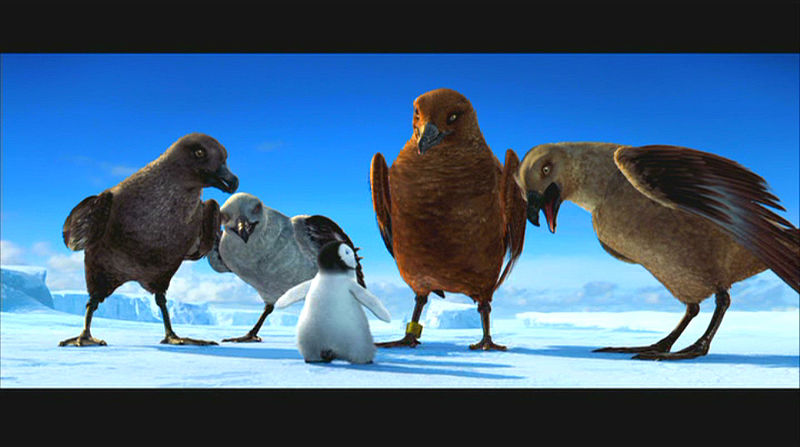
South Polar Skuas (with all the color morphs) had found a place in one of the most popular movies, Happy Feet. In this movie, Baby Mumble is menaced by four of these skuas: The Boss Skua {Anthony LaPaglia}, with an identification band, and his posse: Dino {Danny Mann}, Frankie {Mark Klastorin}, and Vinnie {Michael Cornacchia}. Other minor skuas appear throughout the movie, one scene showing the skua's piratical behavior, fighting with the main character for a fish. They're also showed to have vulture-like behavior. All these skuas speak in a Mafia-like accent. |
 |
Resources |
 |