Panavia Tornado
More pics
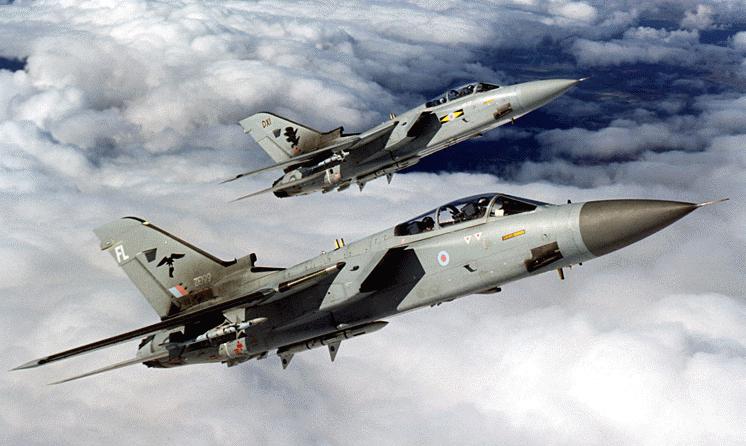
The Tornado multi-role aircraft is operational in five different forms: Tornado GR 1 interdictor/strike aircraft for close air support; counter air attack and defence suppression; GR 1A tactical reconnaissance aircraft; Tornado GR 1B long-range maritime attack aircraft; and Tornado F3 long-range air defence fighter. The GR 4 is a mid-life update of the GR 1. The Tornado entered service in 1980 and ceased production in 1998. The Tornado was manufactured by Panavia, a consortium of BAE Systems, EADS (formerly Daimler-Chrysler Aerospace) and Alenia.
TORNADO GR 1 INTERDICTOR/STRIKE AIRCRAFT
Tornado GR 1 Interdictor/Strike (IDS) aircraft are in service with the German Air Force and Navy (290), Italian Air Force (90), UK Royal Air Force (186) and the Royal Saudi Air Force (96). The aircraft is equipped with an advanced sensor and defensive aids suite for low-level, deep-penetration missions in all weathers by day and by night.
The aircraft is fitted with two 25mm cannons on each side of the fuselage. The aircraft is equipped with a wide range of weapons. For close air support and interdiction, the aircraft is typically equipped with iron bombs, cluster bombs and laser-guided bombs. In the defence suppression role, it is equipped with anti-radar missiles.
The comprehensive suite of navigation equipment includes a Raytheon Systems terrain-following, ground-mapping radar, Decca Doppler Type 72 radar and BAE SYSTEMS FIN1010 three-axis digital inertial navigation system. Tornado has a multi-mode APFD AutoPilot and Flight Director from BAE Systems The aircraft's TACAN (Tactical Air Navigation) system is the AD2770 from BAE Systems or the Alcatel SEL AG Sector-TACAN. The instrument landing system is the Cossor.CILS75/76.
RAF TORNADO GR 4 MID-LIFE UPDATE
142 of the Royal Air Force GR 1 Tornados are being upgraded to Tornado GR 4 configuration by the year 2003, under the RAF Tornado Mid-Life Update programme. The first entered service in 1998 and the GR 4 received operational clearance in April 2001. 100 upgraded aircraft had been delivered by October 2001. The new systems are being developed by BAE SYSTEMS. The programme involves advances in systems, stealth technology and avionics. A digital avionics bus links the new systems and fully integrates the aircraft's improved defensive aids suite. The weapons bus is configured to control the release of a wide range of weapons and can adapt for future weapon types through the system's missile control and weapon programming units. The upgraded navigation systems, including a global positioning system (GPS), BAE SYSTEMS Terprom digital terrain-mapping system and Honeywell H-764G laser inertial navigation system (INS), are integrated into the aircraft's main avionics system.
The GR. 4 is fitted with a pilot's head-up display, multifunction head-down display and a digital map. The BAE SYSTEMS Thermal Imaging Laser Designator (TIALD) pod, which provides high-accuracy autonomous guidance for laser-guided weapons, is being integrated on the upgraded aircraft. The GR 4 is equipped with a forward-looking infrared (FLIR). The thermal image is projected onto the pilot's head-up and head-down displays.
The GR 4 has been cleared to carry Enhanced Paveway bombs, with GPS/INS (Global Positioning System/Inertial Navigation System) guidance and from 2002 will carry Brimstone anti-armour and Storm Shadow cruise missiles when these enter service.
The GR4 can also deploy the Goodrich Raptor reconnaissance pod which replaces the current Vinten VICON system. Raptor provides real-time day and night targeting with a range of 72km (electro-optic) and 36km (infrared).
TORNADO GR 1A RECONNAISSANCE AIRCRAFT
The low-level, high-speed reconnaissance Tornado GR 1A is in service with the air forces of Germany, Italy and Saudi Arabia. The aircraft provides real-time reconnaissance, with facilities for in-flight review of reconnaissance data, recording for post-flight analysis and instant ground access to recorded imagery.
The electro-optical suite comprises three internally mounted infrared sensors linked to a video recording system, providing 24-hour, horizon-to-horizon surveillance coverage.
TORNADO GR 1B MARITIME ATTACK AIRCRAFT
The GR 1B Maritime Attack Tornado is in service with the Royal Air Force. The aircraft is equipped with up to four Sea Eagle anti-ship missiles. It can strike at a distance over 400 miles from base and is able to launch the missiles at stand-off range.
TORNADO F3 AIR DEFENCE
The F3 Air Defence Variant (ADV) Tornado is armed with short-range and medium-range air-to-air missiles. A typical weapons payload would include four Sidewinder short-range missiles and four Skyflash medium-range missiles. Tornado F3 aircraft are the first to be fitted with the short-range MBDA ASRAAM air-to-air missile which entered service in January 2001 and was declared ready for operational deployment in Spetember 2002. 100 RAF F3 Tornadoes are being upgraded to carry AIM-20 AMRAAM air-to-air missiles, a Raytheon IFF 4810 SIFF (Successor Identification Friend or Foe) system and a Honeywell laser inertial navigation system. EADS selected I-Logix's Statemate MAGNUM as the systems engineering tool for RWE and the new computing facility. The upgrade programme is to be completed in 2003.
The aircraft is equipped with a BAE SYSTEMS Foxhunter radar, which provides long-range search capability and enables the aircraft to engage targets at beyond visual range.