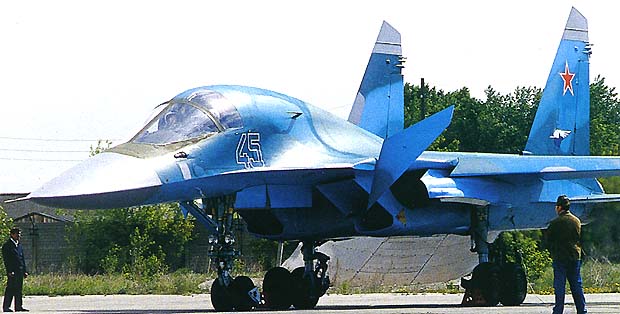
SU-34 Platypus
More pics
The Su-34 (also known as Su-27IB) fighter bomber has been developed by the Sukhoi Design Bureau Joint Stock Company in Moscow and the Novosibirsk Aircraft Production Association at Novosibirsk in Russia. First deliveries of the fighter bomber are expected to begin in 2005 and it is planned as a replacement for Su-24 and Su-25 aircraft. Su-34 is one of a number of Russian aircraft (Su-27, Su-30, Su-33 and Su-35) which have been given the NATO codename Flanker.
The Su-34 fighter bomber is a derivative of the Su-27 fighter aircraft. The aircraft design retains the basic layout and construction of the Su-27 airframe, with a conventional high-wing configuration and a substantial part of the onboard equipment. The Su-34 has a changed contour of the nose section to accommodate an advanced multi-mode phased array radar with terrain following and terrain avoidance modes. It has a two-seat rather than single-seat cockpit. The capacity of the internal fuel tanks has been increased with a resulting increased take-off weight. Changes have been made to the central tail boom for a rear-facing radar.
COCKPIT:
The cockpit has two K-36DM zero/zero ejection seats side by side for the pilot and copilot. The seats are supplied by Zvesda Research and Production Enterprise Joint Stock Company, Moscow. The multifunction displays in the cockpit show the flight parameters, the operational status of the aircraft units and tactical data.
WEAPONS:
The Su-34 is armed with a 30mm GSh-301 gun and 180 rounds of ammunition. The gun has a maximum rate of fire of 1,500 rounds per minute and the muzzle velocity is 860m/sec. The gun is supplied by the Instrument Design Bureau in Tula.
The aircraft has ten hardpoints for weapon payloads and is able to carry a range of missiles including air-to-air, air-to-surface, anti-ship and anti-radiation missiles, guided and unguided bombs, and rockets. The aircraft is fitted with a target designator.
The R-73 (NATO codename AA-11 Archer) short-range air-to-air missile is supplied by the Vympel State Engineering design Bureau in Moscow. The R-73 is an all-aspect missile capable of engaging targets in tail-chase or head-on mode. The missile has cooled infrared homing. The R-73 attacks the target within target designation angles of +/- 45 degrees and with angular rates up to 60 degrees per second. The missile can intercept targets at altitudes between 0.02 and 20km, target g-load to 12g, and with target speeds to 2,500kph.
The RVV-AE long-range air-to-air missile, also known as the RR-77 or by the NATO designation AA-12, is manufactured by Vympel. The missile can intercept targets at speeds up to 3,600kph and altitudes from 0.02 to 25km. The minimum range in the aft hemisphere is 300m and the maximum vertical separation between the host aircraft and the target is 10km. The RR-77 has inertial guidance with mid-course radio updates and terminal active guidance. A new, longer-range (150km) version of the R-77, with solid fuel ram-jet propulsion, is being tested by Vympel.
The Su-34 carries a range of precision guided and unguided bombs and rockets, including the KAB-500 laser-guided bomb developed by the Region State Research and Production Enterprise based in Moscow.
SYSTEMS:
The Su-34 is equipped with an electro-optical fire-control system, supplied by the Urals Optical and Mechanical Plant (YOM3) and a Geofizika FLIR (forward-looking infrared) pod. Leninetz of St Petersburg supplies the radar systems and TsNIRTI the electronic countermeasures suite.
ENGINES:
The aircraft is powered by two afterburning AL-31F or AL-35 turbofan engines. The engines are mounted under the wing and are equipped with all-duty fixed geometry air intakes. A rotor protection installed in the air intakes provides protection against the ingestion of foreign objects.
The aircraft can carry 12,100kg of fuel internally in two fuel tanks in the wings and four in the fuselage. Three external fuel tanks, each with a capacity of 3,000 litres, can also be fitted.
The aircraft can achieve a speed of 1,900kph (Mach 1.6) at altitude and 1,300kph (Mach 1) at sea level.