F-35 JSF
More pics
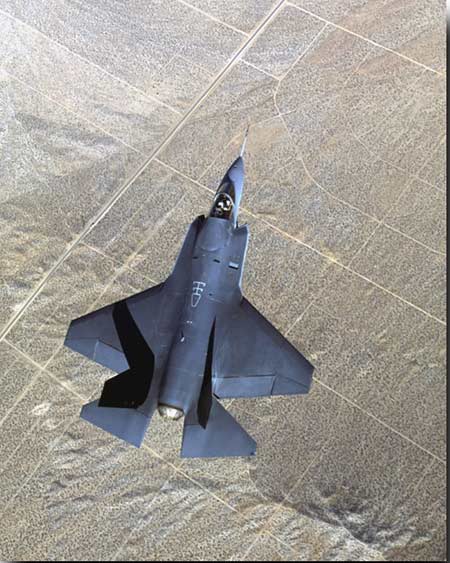
The Joint Strike Fighter, the JSF, is being developed by Lockheed Martin Aeronautics Company for the US Air Force, Navy and Marine Corps and the UK Royal Navy. The stealthy, supersonic multi-role fighter is to be designated the F-35. The JSF is being built in three variants: a conventional take-off and landing aircraft (CTOL) for the US Air Force; a carrier based variant (CV) for the US Navy; and a short take-off and vertical landing (STOVL) aircraft for the US Marine Corps and the Royal Navy. A 70 � 90% commonality is required for all variants.
The requirement is for: USAF F-35A �air-to-ground strike aircraft, replacing F-16 and A-10, complementing F-22 (1763); USMC F-35B � STOVL strike fighter to replace F/A-18B/C and AV-8B (480); UK RN F-35C � STOVL strike fighter to replace Sea Harriers (60); US Navy F-35C � first-day-of-war strike fighter to replace F/A-18B/C and A-6, complementing the F/A-18E/F (480 aircraft). In January 2001, the UK MOD signed a memorandum of understanding to co-operate in the SDD (System Development and Demonstration) phase of JSF. Following the contract award, other nations signed up to the SDD phase are: Australia, Canada, Denmark, Italy, Netherlands and Norway. Nations interested in participating in the project include Australia and Turkey.
The Concept Demonstration Phase of the programme began in November 1996 with the award of contracts to two consortia, led by Boeing Aerospace and Lockheed Martin. The contracts involved the building of demonstrator aircraft for three different configurations of JSF, with one of the two consortia to be selected for the development and manufacture of all three variants.
In October 2001, an international team led by Lockheed Martin was awarded the contract to build JSF. An initial 22 aircraft will be built in the programs System Development and Demonstration (SDD) phase. Flight testing will be carried out at Edwards Air Force Base, California, and Naval Air Station, Patuxent River, Maryland. The fighter is expected to enter service in 2008.
DESIGN:
In order to minimise the structural weight and complexity of assembly, the wingbox section integrates the wing and fuselage section into one piece. To minimise radar signature, sweep angles are identical for the leading and trailing edges of the wing and tail (planform alignment). The fuselage and canopy have sloping sides. The seam of the canopy and the weapon bay doors are sawtoothed and the vertical tails are canted at an angle.
The Marine variant of JSF is very similar to the Air Force variant, but with a slightly shorter range because some of the space used for fuel is used for the lift fan of the STOVL propulsion system. The main differences between the naval variant and the other versions of JSF are associated with the carrier operations. The internal structure of the naval version is very strong to withstand the high loading of catapult assisted launches and tailhook arrested landings. The aircraft has larger wing and tail control surfaces for low speed approaches for carrier landing. Larger leading edge flaps and foldable wingtip sections provide a larger wing area, which provides an increased range and payload capacity.
The canopy, radar and most of the avionics are common to the three variants.
WEAPONS:
Weapons are carried in two parallel bays located in front of the landing gear. Each weapons bay is fitted with two hardpoints for carrying a range of bombs and missiles.
The air force and naval variants have an internally mounted gun. The Marine variant has no internal gun but an external gun can be fitted. The internally mounted gun system will be the Advanced 27 mm Cannon being developed by a team led by Boeing, with Mauser-Werke of Germany and Primex Technologies and Western Design of USA. The cannon is a single barrel, gas-operated lightweight revolver gun that fires electrically-primed ammunition at 1800 shots per minute.
RADAR:
Northrop Grumman Electronic Systems is developing the advanced electronically scanned array (AESA) multi-function radar. The AESA will combine an integrated radio frequency subsystem with a multifunction array. The radar system will also incorporate the agile beam steering capabilities developed for the APG-77.
ENGINES:
All three variants are powered by the Pratt and Whitney afterburning turbofan JSF119-611 engine, a derivative of the F119 fitted on the F-22.
On the F-35B, the engine is coupled with a shaft-driven lift fan system for STOVL propulsion. The lift fan has been developed by Rolls-Royce Defence. Doors installed above and below the vertical fan open as the fin spins up to provide vertical lift. The main engine has a three bearing swivelling exhaust nozzle. The nozzle, which is supplemented by two roll control ducts on the inboard section of the wing, together with the vertical lift fan provide the required STOVL capability.
TARGETING:
Lockheed Martin Missile & Fire Control and Northrop Grumman Electronic Sensors and Systems are jointly responsible for the JSF electro-optical system. A Lockheed Martin electro-optical targeting system (EOTS) will provide long-range detection and precision targeting, along with the Northrop Grumman DAS (Distributed Aperture System) thermal imaging system. EOTS will be based on the Sniper XL pod developed for the F-16, which incorporates a mid-wave third generation FLIR, dual mode laser, CCD TV, laser tracker and laser marker. DAS consists of multiple infrared cameras providing 360 degree coverage using advanced signal conditioning algorithms. As well as situational awareness, DAS provides navigation, missile warning and infrared search and track (IRST). EOTS is embedded under the aircraft�s nose, and DAS sensors are fitted at multiple locations on the aircraft.