F-18 Super Hornet
More pics
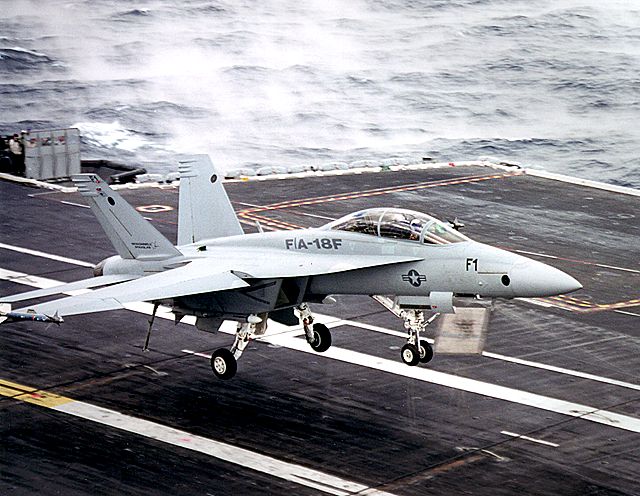
The F/A-18E/F Super Hornet, the nation's newest strike fighter, entered service with U.S. Navy squadron VFA-122 in November 1999. Seven-production model Super Hornets landed at Naval Air Station Lemoore, Calif. on Nov. 17. VFA-122 is a fleet readiness squadron responsible for aircrew and maintenance training in the Super Hornet.
The Navy has ordered 62 Super Hornets and plans to buy a minimum of 548 of the aircraft through 2010. All 12 of the LRIP 1 aircraft were delivered on or ahead of their contractual delivery date. The first class will graduate from VFA-122 in the early part of 2001. The first Super Hornet fleet deployment is scheduled for the spring of 2002.
The Super Hornet is the newest version of the combat-proven F/A-18 Hornet. The aircraft is 25 percent larger than its predecessor but has 42 percent fewer parts. Both the single-seat E and two-seat F models offer increased range, greater endurance, more payload-carrying ability, more powerful engines, increased carrier bringback capability, enhanced survivability and a renewed potential for future growth.
Structural changes to the airframe increase internal fuel capacity by 3,600 pounds, or about 33 percent. This extends the Hornet's mission radius by up to 40 percent. The fuselage is slightly longer - the result of a 34-inch extension - and the wing is 25 percent larger with 100 additional square feet of surface area. There are two additional weapons stations, bringing the total to 11. This allows for increased payload flexibility by mixing and matching air-to-air and/or air-to-ground ordnance. The aircraft also carries the complete complement of "smart" weapons including JDAM and JSOW. For aircraft carrier operations, about three times more payloads can be brought back to the ship.
Increased engine power comes from the F414-GE-400, an advanced derivative of the Hornet's current F404 engine family. The F414 produces 35 percent more thrust and improves overall mission performance. The F414's nine-to-one thrust-to-weight ratio is one of the highest of any modern fighter engine. Enlarged air inlets provide increased airflow to the engines.
The Super Hornet is an adverse-weather, day and night, multi-mission strike fighter whose survivability improvements over its predecessors make it harder to find, and if found, harder to hit, and if hit, harder to disable.
WEAPONS:
The Super Hornet being larger than its predecessor carries more weapons. The aircraft has eleven weapon stations which include two additional wing store stations in comparison to the earlier aircraft. The F/A-18E/F will support a full range of armaments. Flight tests activities carried out during 1997 have included the launching of the air-to-air missiles, AIM-9 Sidewinder, AIM-7 Sparrow and the AIM-120 AMRAAM; the release of guided air-to-ground weapons, Harpoon, SLAM, GBU-10, HARM, and Maverick; the release of free-fall air-to-ground bombs, Mk-76, BDU-48, Mk-82LD, Mk-82HD, and Mk-84..
COUNTERMEASURES:
The countermeasures systems are managed by the Integrated Defensive Countermeasures system, IDECM, which provides a coordinated situation awareness, manages the on-board and off-board deception countermeasures, manages the expendable decoys, and signal and frequency control of emissions. The IDECM system includes the ALE-47 countermeasures dispenser, the ALE-50 towed decoy and the AN/ALR-67(V)3 radar warning receiver.
The ALE-47 threat adaptive countermeasures dispenser system supplied by Tracor is capable of dispensing chaff cartridges, flares, and the POET and GEN-X active expendable decoys.
The ALE-50 Towed Decoy from the E-Systems Goleta Division of Raytheon consists of the decoy, a launcher and a launch control unit. The decoy is installed in a sealed canister, which includes a payout reel. The system provides long range detection and extremely fast deployment to defend against most radar-guided threats.
The radar warning receiver AN/ALR-67 (V)3 produced by Raytheon intercepts, identifies and prioritizes the threat signals. The signals are characterized in terms of frequency, amplitude, direction, pulse width, etc. and the parameters are compared against a threat library in order to identify the threat.
COCKPIT:
The Super Hornet F/A-18E is the single seat version and the F/A-18F is the two-seat version. The heated and air-conditioned cockpit is very similar to the Hornet's cockpit. The zero/zero ejection seat is the SJU-5/6 from Martin Baker Aircraft Company Ltd. in the U.K.
The F/A-18 cockpit is equipped with three color display screens and an advanced head-up display. At night time, television like images from the navigation forward looking infra-red (Nav FLIR) are presented to the pilot on the head-up display, allowing the pilots to see ahead of the aircraft as if it were daytime. The cockpit also has a color digital map and the pilots are also equipped with night vision goggles.
The cockpit in the F/A-18E/F is equipped with a touch sensitive 3 inch by 5 inch control display, a larger six and a quarter inch multi-purpose liquid crystal color display which shows tactical information, two 5 inch monochrome displays and a new engine fuel display.
The aircraft retains the mission software and a high proportion of the avionics found in the C/D models.
Although regarded as an essential enhancement by the US Navy, the decision to buy the aircraft has been hotly debated with critics saying the US Armed Forces budget could not cope with simultaneous purchases of the Super Hornet for the Navy, the development of the F-22 Raptor for the US Air Force and the development of the Joint Strike Fighter for the Navy, Marine Corps an Air Force.