F-18 Hornet
More pics
The F/A-18 Hornet has once again demonstrated its versatility during the recent war in Kosovo. Two Marine Corps F/A-18D model Hornets-the two seat version-equipped with the Advanced Tactical Airborne Reconnaissance System (ATARS) entered combat operations May 26, 1999 filling a void in airborne manned tactical reconnaissance in the Marine Corps since the RF-4 Phantom retired from service.
The Marine Corps began taking delivery of Hornets with provisions for a reconnaissance package in February 1992. Plans call for a total purchase of 31 tactical reconnaissance conversion kits, 24 data link pods and seven squadron ground stations. Deliveries will continue through 2002.
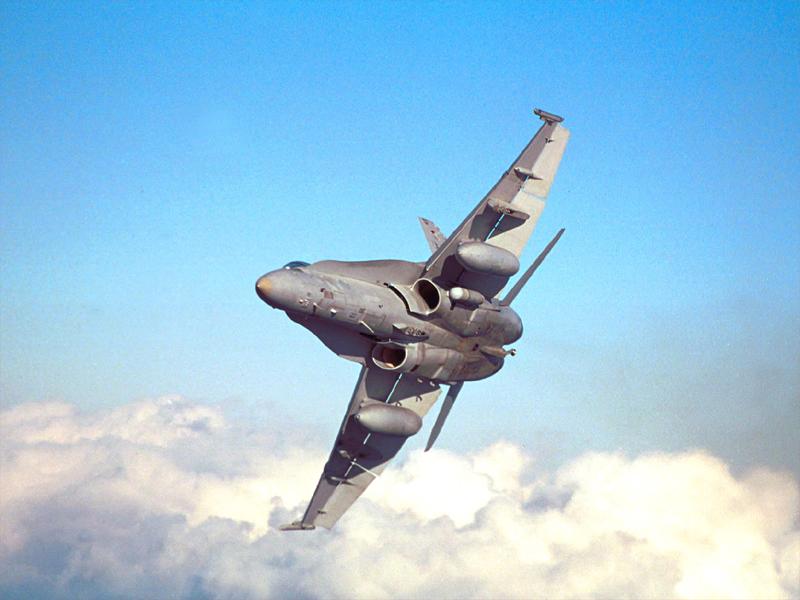
The combat-proven F/A-18 Hornet is a single- and dual-seat, twin-engine multimission tactical aircraft. It is the first tactical aircraft designed from its inception to carry out both air-to-air and air-to-ground missions.
Today, the F/A-18 is in service with the U.S. Navy, U.S. Marine Corps and the air forces of Canada, Australia, Spain, Kuwait, Finland, Switzerland, and Malaysia. As of May 1999 Hornet pilots have accumulated more than 3.7 million flight hours and, in the process, are establishing new records daily in safety, reliability, maintainability and mission performance.
A key aspect of the Hornet's popularity with pilots is the ease with which the aircraft can be converted from fighter to strike mode and back again; it's as easy as flipping a switch. During Operation Desert Storm, F/A-18s routinely performed fighter and strike missions on the same sortie. Fulfilling a variety of roles-air superiority, fighter escort, suppression of enemy air defenses, reconnaissance, forward air control, close air support, and day and night strike missions-the F/A-18 has proven to be the most versatile combat aircraft in service.
The Hornet was designed to be reliable and easily maintainable. These factors result in significantly lower operating and maintenance costs for the F/A-18 compared to other U.S. Navy fighter and attack aircraft; and life cycle costs comparable to other modern multi-role aircraft. Survivability is another key feature of the Hornet. The F/A-18 uses a variety of systems and technologies to increase its likelihood of reaching a target undetected, of escaping unhurt if detected, and of returning its crew safely if it is hit. These systems and technologies have been significantly enhanced in the F/A-18E/F Super Hornet to further improve survivability.
The F/A-18 has been upgraded regularly since entering service in 1983. In November 1989, the first F/A-18s equipped with night strike capability were delivered. Since 1991, F/A-18s have been delivered with F404-GE-402 enhanced performance engines that produce up to 20 percent more thrust than previous F404 engines. The Hornet's two engines deliver about 36,000 pounds combined thrust and a top speed of more than Mach 1.8.
Since May 1994, the Hornet has been equipped with upgraded radar - the APG-73 -, which substantially increases the speed and memory capacity of the radar's processors. In addition, today's Hornets have a laser target designator/ranger, housed within the targeting forward-looking infrared sensor that enables the aircraft to deliver precision laser-guided bombs with pinpoint accuracy.