B-52 Stratofortress
More pics
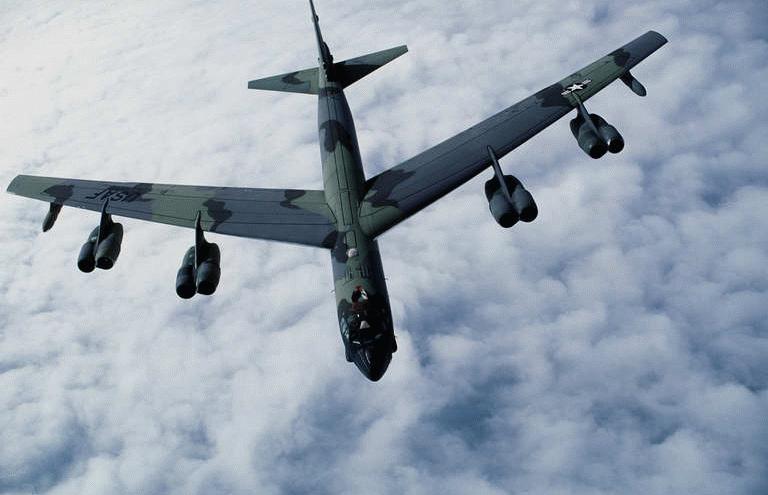
The B-52H is the US Air Force's long-range, large-payload multi-role bomber and is known as the Stratofortress or the Buff (Big Ugly Fat Fellow). It is the USAF's principal strategic nuclear and conventional weapons platform, and supports the US Navy in anti-surface and submarine warfare missions. It celebrated its 50th anniversary (first flight April 1952) in April 2002 and is the longest serving combat aircraft in the world � a total of 744 were built. The B-52H entered service in 1961 and 104 were built. The last was delivered in 1962. However, due to extensive system and structural upgrades, its service life is expected to continue beyond the year 2030. There are now 94 B-52H aircraft in service with three squadrons at Barksdale AFB, Louisiana, and two squadrons at Minot AFB in North Dakota.
The B-52H is a very large aircraft, with a length of 159ft 4in and a take-off weight of 488,000lb. The all-metal skin bears a high proportion of the flight loading. When on the ground, the surface of the aircraft on the forward section of the fuselage has a wrinkled appearance. The skin expands and becomes smooth as the crew compartment is pressurised when the aircraft gains altitude.
WEAPONS:
The B-52H, with a weapons payload of more than 70,000lb, is capable of carrying the most diverse range of weapons of any combat aircraft.
The nuclear weapons capacity includes twelve AGM-129 Advanced Cruise Missiles (ACMS), 20 AGM-86A Air Launched Cruise Missiles (ALCM) and eight bombs. The conventional weapons payload is 8 AGM-84 Harpoon missiles, 4 AGM-142 Raptor missiles, 51 x 500lb bombs, 30 x 1,000lb bombs, 20 AGM-86C Conventional Air Launched Cruise Missiles (CALCM), 12 Joint Stand Off Weapons (JSOW), 12 Joint Direct Attack Munitions (JDAM) and 16 Wind Corrected Munitions Dispenser (WCMD). WCMD and JSOW are due to enter service in 2002.
The B-52H can also deliver 51 x 500lb, 30 x 1,000lb and 20 x 2,000lb navy mines.
COUNTERMEASURES:
The B-52H is equipped with a wide range of electronic warfare equipment. The ITT AN/ALQ-172(V)2 electronic countermeasures system features multi-band threat recognition and multiple threat jamming. The AN/ALR-20A radar warning system detects and prioritises multiple threats. The Litton/Dalmo Victor AN/ALR-46 digital warning receiver detects radar emissions in the 2-18GHz band, and can simultaneously identify up to 16 radar signals. Northrop Grumman's AN/ALQ-155 jammer power management system gives 360-degree coverage in D,E,F,G, and H radar bands. It is also equipped with Motorola AN/ALQ-122 multiple false target generator, AN/ALT-32 noise jammer and Northrop Grumman AN/ALQ-153 tail warning set, which is a pulse Doppler threat warner.
Twelve AN/ALE-20 infrared flare dispensers and eight launchers for the AN/ALE-24 chaff dispenser are fitted.
ELECTRO-OPTICAL VIEWING SYSTEM:
Under the nose section are the steerable chin turrets for the AN/ASQ-151 electro-optical viewing system (EVS), which consists of the Raytheon AN/AAQ-6 Forward Looking Infrared (FLIR) in the starboard turret and Northrop Grumman AN/AVQ-22 low-light-level television camera (LLTV) in the port turret. The images from the EVS are displayed on monochrome screens on the flight deck and on the lower deck.
OFFENSIVE AVIONICS SYSTEM:
The AN/ASQ-176 Offensive Avionics System (OAS) includes a Northrop Grumman strategic radar, Honeywell radar altimeter, Smiths attitude heading and reference system, Tercom terrain comparison, Teledyne Ryan Doppler navigation radar, Honeywell AN/ASN-131 inertial navigation system, and IBM/Raytheon AN/ASQ-38 bombing and navigation system.
In January 2000, Boeing received a contract to upgrade the OAS. The B-52 Avionics Midlife Improvement Program will replace the inertial navigation system with the SNU-84 INS and provide open architecture avionics computers with faster processors, and with a new data transfer system.
ENGINES:
The B-52H has eight Pratt and Whitney TF33-P-3 turbofan engines, each providing more than 17,000lb of thrust. The aircraft has ten internal plus two external fuel tanks with a capacity of over 181,000 litres, which give an unrefuelled range of more than 8,600 miles. The operational range with one air refuelling is 7,500 nautical miles.
There has been increasing support for an upgrade programme to re-engine the B-52H. The installation of new Rolls-Royce RB211 turbofan engines would increase the unrefuelled range and provide the aircraft with the capability to strike a target located anywhere on earth from a CONUS (continental USA) base with a single refuelling.