B-2 Spirit
More pics
MISSION:
The B-2 Spirit is a multi-role bomber capable of delivering both conventional and nuclear munitions. A dramatic leap forward in technology, the bomber represents a major milestone in the U.S. bomber modernization program. The B-2 brings massive firepower to bear, in a short time, anywhere on the globe through previously impenetrable defenses.
BACKGROUND:
The first B-2 was publicly displayed on Nov. 22, 1988, when it was rolled out of its hangar at Air Force Plant 42, Palmdale, Calif. Its first flight was July 17, 1989. The B-2 Combined Test Force, Air Force Flight Test Center, Edwards Air Force Base, Calif., is responsible for flight testing the engineering, manufacturing and development aircraft as they are produced.
Whiteman AFB, Mo., is the B-2's only operational base. The first aircraft, Spirit of Missouri, was delivered Dec. 17, 1993. Depot maintenance responsibility for the B-2 is performed by Air Force contractor support and is managed at the Oklahoma City Air Logistics Center at Tinker AFB, Okla.
The prime contractor, responsible for overall system design and integration, is Northrop Grumman's Military Aircraft Systems Division. Boeing Military Airplanes Co., Hughes Radar Systems Group and General Electric Aircraft Engine Group are key members of the aircraft contractor team. Another major contractor, responsible for aircrew training devices (weapon system trainer and mission trainer) is Hughes Training Inc. (HTI) - Link Division, formerly known as CAE - Link Flight Simulation Corp. Northrop Grumman and its major subcontractor HTI, are responsible for developing and integrating all aircrew and maintenance training programs.
FEATURES:
Along with the B-52 and B-1B, the B-2 provides the penetrating flexibility and effectiveness inherent in manned bombers.
Its low-observable, or "stealth," characteristics give it the unique ability to penetrate an enemy's most sophisticated defenses and threaten its most valued, and heavily defended, targets. Its capability to penetrate air defenses and threaten effective retaliation provide a strong, effective deterrent and combat force well into the 21st century.
The revolutionary blending of low-observable technologies with high aerodynamic efficiency and large payload gives the B-2 important advantages over existing bombers.
Its low-observability provides it greater freedom of action at high altitudes, thus increasing its range and a better field of view for the aircraft's sensors. In the conventional role, the B-2 will operate with far less support aircraft than other bombers require. That means fewer pilots and aircraft put in harm's way. Its long range will enable it to strike targets all over the world from bases in the United States. With its large payload, it will be able to attack eight times as many targets on each mission as the stealthy F-117 strike fighter. With the proliferation of modern radar-guided air defenses throughout the world, non-stealthy aircraft will face increasing difficulty accomplishing their missions.
Its unrefueled range is approximately 6,000 nautical miles (9,600 kilometers).
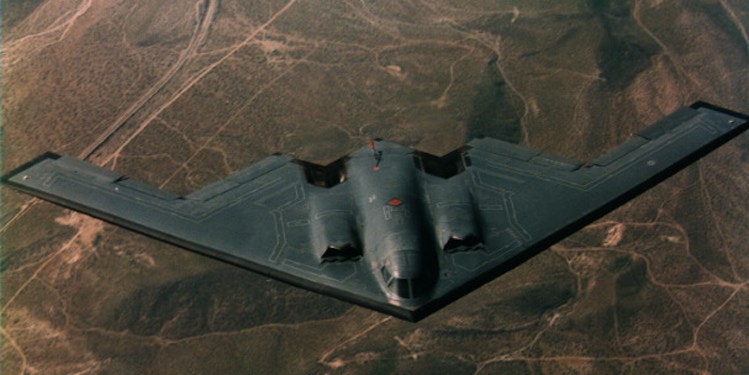
The B-2's low observability is derived from a combination of reduced infrared, acoustic, electromagnetic, visual and radar signatures. These signatures make it difficult for the sophisticated defensive systems to detect, track and engage the B-2. Many aspects of the low-observability process remain classified; however, the B-2's composite materials, special coatings and flying-wing design all contribute to its "stealthiness."
The B-2 has a crew of two pilots, a pilot in the left seat and mission commander in the right, compared to the B-1B's crew of four and the B-52's crew of five.