A-10 Thunderbolt
More pics
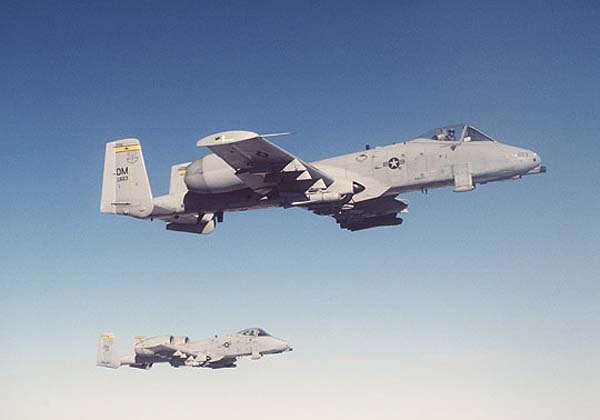
The A-10 Thunderbolt is also known as the Warthog, the Flying Gun and the Tankbuster. The aircraft was used extensively during Operation Desert Storm and in support of NATO operations in response to the Kosovo crisis. During Operation Desert Storm, 144 A-10 aircraft flew in various roles, achieving 95.7% mission capability and 8,100 combat sorties. The A-10 was responsible for more than half of the Iraqi military inventory losses, including tanks, Scuds and helicopters.
The A-10 is a high-survivability and versatile aircraft, popular with pilots for the 'get home' effectiveness. The mission of the aircraft is ground attack against tanks, armoured vehicles and installations, and close air support of ground forces. The aircraft is suitable for operation from forward air bases, with short take-off and landing capability. The aircraft has a long range (800 miles) and endurance and can loiter in the battle area. The manoeuvrability at low speed and at low altitude (below 1,000ft) allows accurate and effective targeting and weapon delivery over all types of terrain.
The first flight of the A-10 was in May 1972, and a total of 707 aircraft have since been produced. Originally manufactured by Fairchild, since 1987 the prime contractor for the A-10 has been Northrop Grumman, which carries out support and structural upgrade programmes from the Integrated Systems and Aerostructures Divisions at Bethpage, New York and at St Augustine in Florida. Over 350 A-10 aircraft are in service with the US Air Force, Air Combat Command, the US Air Force Reserve and the Air National Guard.
COCKPIT:
The single-seat cockpit is protected by all-round armor, with a titanium 'bathtub' structure to protect the pilot that is up to 3.8cm thick. The cockpit has a large bulletproof bubble canopy, which gives good all-round vision.
The cockpit is equipped with a head-up display, which is used for targeting and weapon aiming, a Have-Quick secure radio communications system, inertial navigation and a tactical air navigation (TACAN) system. Lockheed Martin has begun delivery of 21 USAF A-10 aircraft with the embedded global positioning system/inertial navigation system (EGI), which pinpoints the exact location of the aircraft. The aircraft are also to be fitted with BAE Systems terrain profile matching systems (TERPROM).
The pilot is equipped with night-vision goggles and also the infrared imaging display of the Maverick AGM-65.
WEAPONS:
The aircraft has eleven stores pylons, providing an external load capacity of 7,260kg. There are three pylons under the fuselage and the loads can be configured to use either the centre-line pylon or the two flanking fuselage pylons. For weapon guidance, the aircraft can be fitted with Pave Penny laser guidance/electronic support measures, pod installed on the starboard fuselage pylon. Each wing carries four stores pylons: three outboard and one inboard of the wheel fairing.
The A-10 can carry up to ten Maverick air-to-surface missiles. The Raytheon Maverick AGM-65 missile uses a variety of guidance systems, including imaging infrared guidance and warheads, including a high-penetration, 57kg conical-shaped charge warhead. Range is more than 45km. The A-10 can also carry the Sidewinder air-to-air missile, which is an all-aspect short-range missile with maximum speed over Mach 2.
The A10 is capable of deploying a wide range of ordnance: for example, the LDGP Mk 82 226kg, 500lb general-purpose bombs, BLU-1 and BLU-27/B Rockeye II cluster bombs and the cluster bomb unit CBU-52/71.
The aircraft is armed with a General Dynamics GAU-8/A Avenger 30mm cannon, mounted in the nose of the aircraft. Using the cannon, the A-10 is capable of disabling a main battle tank from a range of over 6,500m. The cannon can fire a range of ammunition, including armor-piercing incendiary rounds (API) weighing up to 0.75kg, or uranium-depleted 0.43kg API rounds. The magazine can hold 1,350 rounds of ammunition. The pilot can select a firing rate of 2,100 or 4,200 rounds per minute.
ENGINES:
The two non-afterburning turbo fan engines, TF34-GE-100, supplied by General Electric, each supply 9,065lb thrust. The location of the engines, high on the fuselage, allows the pilot to fly the aircraft fairly easily with one engine inoperable.
PRECISION ENGAGEMENT UPGRADE PROGRAM:
An upgrade program for the A-10 is being defined, which may include enhanced precision target engagement capabilities as well as enabling an extension of the aircraft's service life to 2028. Improvements may include: airframe modifications, new cockpit displays, situational awareness datalinks, digital stores management system, 1760 weapons databus, targeting pod for precision-guided weapons and helmet-mounted sighting system. Lockheed Martin Systems Integration-Oswego will be prime contractor for the program. Low rate initial production of the upgrade is planned to start in 2004. It is possible that the A-10 engine will also be upgraded if funding is made available.