51 Fleetgate Rear North Room -
Scullery
Background:
The scullery was originally part of the open 15th century
hall. It is possible that the wall separating the scullery from
the kitchen would have been built at the same time that the
outside chimney was built for the set pot in the corner, probably
in the 18th century. You can see that the outside wall was built
out to house the set pot, which is simply a cast iron water
container set in bricks over a coal fire. A scullery is an old
name for a room where rough kitchen work was done, such as
washing dishes and clothes and some food preparation, such as
washing and peeling vegetables and preparing meet prior to
cooking it. It comes from an old French word escuelerie
which is from the old French word for dish, escuele.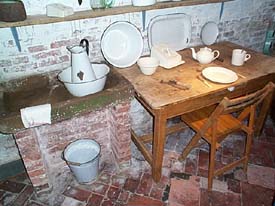
Principal Features:
- The set pot was used for heating water for the weekly
wash, which was always done on Monday. Clothes were also
boiled in it as a final washing stage. The fire would
have been hard to light and burning coals would have
probably been carried through from the kitchen range
using an ash pan.
- The dolly-tub was used for soaking dirty clothes
overnight in washing soda and then for washing in hot
water after being soaped and scrubbed. Either a posher or
a wooden dolly was used to agitate the clothes in the
dolly-tub. Another tub would be filled with cold fresh
water for rinsing clothes after washing.
- The wooden tub was used for scrubbibg and soaping dirty
clothes. (Before detergents were invented)
- Clothes were part dried by squeezing them through the
wooden rollers of a mangle. (There is a Victorian one in
51 Fleetgate)
- There is an arch to the left of the set pot which was
probably where a bread oven originally stood. These were
heated up with coals and then the coals were screped out
and the risen dough placed in the hot oven.
- The slop-stone is an early version of a kitchen sink and
was carved from York stone. It would have probably been
connected to a drain, leading to a sewer or a soakaway.
- There is a bathtub at 51 Fleetgate which is typical
Victorian. The family would have taken turns to use it
one a week. In winter, baths would have been taken in
front of the kitchen range. This would have stopped the
water cooling down too quickly.
- There are many kitchen tools on show in 51 Fleetgate.
These include shears, sleaver, peel, straining frame,
salt glazed pots, stew and jam pans, cast iron saucepans,
slop pail, fire shovel, Edwardian posher and many more.
- One of the windows has been blocked up in the scullery.
This was probably done after the introduction of tax on
windows in the 17th century.
- The floor was originally all brick, laid in a herringbone
pattern.
- The pine table would have been regularily scrubbed to
keep it clean, especially before and after food
preparation.
- The water pump in the yard was the only source of fresh
water. (There is now a tap next to it connected to the
mains supply)
Menu Home
Room Plan