
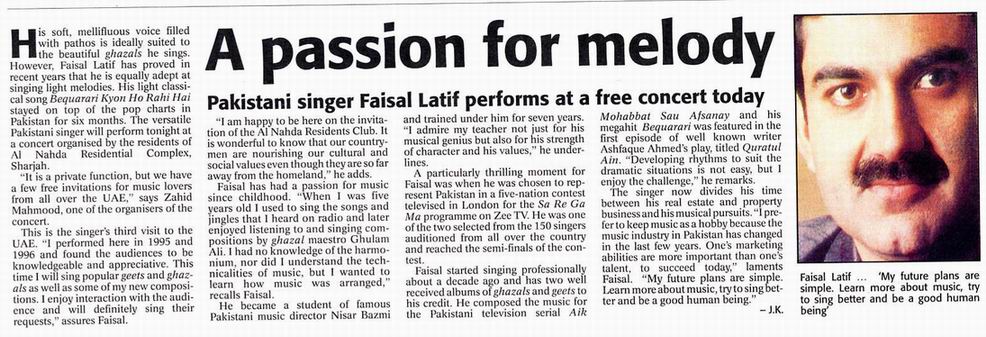
An interview published in daily ‘DAWN’ Images, on March 21st 1999.
Images of an interview published in TV-ASIA Magazine (Urdu), October 2005.
|
|
An interview published in daily ‘DAWN’ Images, on March 21st 1999. |
|
|
|
|
|
|
|
Images of an interview published in TV-ASIA Magazine (Urdu), October 2005. |
___________________________________________________________________________________________________
By Shehla K. Fatah
How many of our singers actually have the courage to risk changing their style and still be good at it? Not many! Being able to self-criticize his performance and accordingly diversify his style is what Faisal Latif has accomplished through the years.
Eight years back hearing Faisal Latif singing geets and ghazals. I instinctively knew that he would eventually make an impact in the music circle. He was young, ambitious and above all not influenced by the ‘pop-top’ culture. Faisal had a considerable command over the ragas and alaps, beats etc. At the time the music scene in our country was influenced by pop video productions, and ghazal performers such as Salman and Sarim Alvi, Sheelo and Masood and Faisal Latif only performed at private functions. It appeared as if traditional music and the classics would literally fade into oblivion.
“It is a tragedy that the new generation has not been trained to hear traditional music by their parents, who for their part, had not only listened to it but enjoyed it immensely. Our media has not done justice to it either. Good vocalists have not been given adequate projection and that is why they do not attract youngsters. It used to be the artiste and his art that were important, not his marketing abilities. Now it is the other way round”, Faisal said.
Faisal Latif, since the past few months, has created a niche for himself on television. He developed the music format for the Combine production serial Aik Mohabat Sau Afsanay. The first episode of Ashfaque Ahmed’s original plays, Quratul Ain, featured Faisal’s light melody Bekarari kyon ho rahi hai, a complete break from his original style of ghazal performance. “After singing ghazals for almost ten years, I did not get the popularity which I got from singing Bekarari. Developing rhythms in accordance with the dramatic situation is not easy, but it is a challenge for me”.
For Faisal music was a childhood passion. “As a five-year-old, a time when most children like talking to themselves, I used to sing the songs and jingles I heard on television. While other parents asked their children to recite nursery rhymes, mine would ask me to sing songs. In Matric, I enjoyed listening to Ghulam Ali and would sing his compositions all the time. I had no clue of what a harmonium was, nor did I understand the technicalities of music. I had not developed a sense of music till then, but I wanted to learn how music was arranged”. He became a shagird of Nisar Bazmi and religiously trained under him for seven years. “Abbu was totally against these activities, though my mother was very supportive, but only if I performed on a limited scale. Now that I am running my own business and my performances have decreased considerably, all is well at home”. Faisal would go with Nisar sahib and learn the mutations, the ragas and ragnis. He bought a computer and keyboard and whatever he learnt he would record with the right sequencing. “I also realized that in any composition the singer contributes only five percent though he is the one who comes in the limelight, while the composer and music director who form the backbone of the song, never make it to the front.”
In 1989, Faisal made his debut television appearance in Dhanak, rendering Iftikhar Arif’s ghazal Khwab ki tarah bikhar janay ko jee chahta hai, which ran a couple of times on air. Two years later, his album of ghazals was released through EMI. “It did not do very well in the market. There were two reasons for this, first EMI was going through a major crisis, and secondly ghazal listeners could not accept a young boy of 20 as a ghazal singer. For them ghazals were meant to be sung by a mature person who had an understanding of lyrics, someone like Iqbal Bano or Farida Khanum or Ghulam Ali”.
Faisal’s first composition, Jaan-e-mehfil teri har baat, har andaaz naiya, was a jingle for a biscuit commercial, and although he got other offers from advertising agencies, he turned them down. “I did not approve that clients who did not have a sense for appreciating good music, should reject or criticize my composition just for the sake of criticism”.
Due to the lack of promotion of geets and ghazals, Faisal has not appeared very frequently on television. However, satellite viewers saw him recently on Zee TV’s production Sa Re Ga Ma which was produced in England. Of the more than 150 singers auditioned from Pakistan. Faisal and Khalil Haider were the only two who came up to the standard of the international selectors to represent Pakistan in the five nation contest. Faisal reached the semi-finals. “Our performances were okay, not extraordinary. It was, however, an excellent experience because we came to know our strengths and our weaknesses. The Indian female performers were out of the ordinary, and it was obvious they had been learning music from childhood”.
This was not Faisal Latif’s first appearance before the British audiences. In 1995, he toured England and performed at several occasions. “What I noticed was that people who had settled there from Pakistan almost 20-30 years back still appreciate the music of those times. The melodies of the 70s still exist in their minds and they are indifferent to the pop music of today. Music groups who go from here are popular only with the youngsters”. Faisal Latif’s second album is being released soon not only in Pakistan but also internationally. The album features 12 light numbers, including four Punjabi folk songs. “I hope that I will soon be able to record an album of geets and ghazals. After all, it is our traditional music and needs to be promoted in a better way”.
___________________________________________________________________________________________________
___________________________________________________________________________________________________
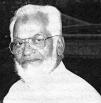
Nisar Bazmi:
A Maharashtrian Muslim boy
from Khandesh goes to Pakistan.
Posted By M M
Whenever an upcoming artist or one of yesteryear in an interview says that he or
she wanted to be in their present professional field since childhood, it is
taken with a light tone, for children do not venture out in the world in quest
of their dreams. Never have I once believed one who has said so. However, after
meeting the multi-talented music composer-cum-director, photographer and poet,
Nisar Bazmi, I realized that with commitment of purpose and intent to look
beyond the stars, a child, too, can make his dreams come true.
An illustrious, well-acclaimed career that spans well over five decades began at
the age of eleven as a hamnawa of Bombay's famous Yasin Qawal, and went on to
establish Bazmi as one of India-Pak's most renowned music director.
Neither Nisar Bazmi, nor his family members, had any clue of what lay ahead for
him when he left his house in a small town of District Khandesh (in Maharashtra)
for Mumbai in quest of becoming a singer.
Mumbai even in 1936 was the hub of glamour and culture, and every young man
dreamt of this fantasy land of opportunities. Staying with an aunt, on joining
Yasin Qawal, the little fellow came to be lovingly known as "Yasin ka chokra".
For the chokra, performing with the qawwali group at private functions seemed a
lifetime achievement. The Rs. 800 that the group earned from four performances a
month were a fortune, considering that Rs. 500 to a person meant he was rich.
The next four years saw him under the tutelage of Ustad Amanullah Khan from
where he graduated as a casual singer at the All India Radio (AIR).
It was here that music composer Dinkar Rao caught the musical sense in Bazmi. He
not only got him promoted to permanent staff member, but also provided him with
the opportunity to compose songs and background music for his play, Nadir Shah
Durrani.
In 1940, Bazmi was earning Rs. 45, which was almost equivalent to what a banker
earned then. "My father would very proudly say: 'My son is earning as much as a
graduate earns!' I was not even a matriculate."
The songs of the play, which were rendered by Rafique Ghaznavi and Ameer Bai
Karnataki, gained instant popularity, andimmediately after the play was aired,
film director A. R. Zamindar approached Bazmi for his under-production
movie,Jamna Paar. It was goodbye to AIR and to his desire of becoming a singer.
He was now on his way to composing music for the Indian film industry.
In the subsequent years he composed music for more than 40 films, 30 of which
were released, including Jeb Katra, Daghabaaz, Extra Girl, Khaufnak Ankhen and
Khoj.
His songs were given life by Mohammad Rafi, Asha Bhosale (who had just entered
the film world), Lata Mangeshkar and Mana Dey among others. He was instrumental
in introducing the famous lyricist Anand Bakshi in Bhola Aadmi and helped in the
career development of Laxmikant Pyarelal. Rafi's execution of Bazmi's
composition, Chand ka dil toot gaya hai, ronay lagay hain sitaray, for the film
Khoj was the composer's first composition to be played on radio.
"There were three categories in the film industry of India - A, B and C - for
artists, photographers, producers, directors and music composers. These
categories were according to the level of perfection, and each level had more
finances attached to it.
To reach the A class, one had to qualify in rating from level C to B. "All the
movies I composed music for were low-budget, C class movies. Even though the
best directors and producers of the time tried their level best to break this
barrier for me, this barrier could not be surpassed," he candidly admits. "In
all those 15 years, none of my songs were apparently good enough to fall in the
B category, leave alone A."
Nisar Bazmi would probably have struggled all his life trying to cross these
fundamental barriers, had it not been for his friend Noman who travelled to
Lahore in quest of brighter horizons for Bazmi. Noman's family urged Bazmi to go
to Pakistan and fetch their son back. And so in 1962, it was this incidental
trip to Lahore that changed the destiny of Nisar Bazmi.
Noman had ventured the then flourishing film studios of Lahore and ultimately,
after hearing Bazmi's records, Fazal Karim Fazli signed Bazmi for the musical
construction of his film Aisa bhi hota hai.
Although the film was released in 1965, its songs, including Ho tamana aur kya,
jane tamana aap hain by Nur Jehan, and Mohabat main teray sar ki kasam, a duet
by the Melody Queen and Ahmed Rushdi, were on the lips of every second person as
early as 1963. "Noman returned home to India, but I stayed on and somehow or the
other I never had the chance to go back to India or visit my hometown and
friends in Khandesh (Maharashtra)."
After the tremendous success of Aisa Bhi Hota Hai, the success graph for Nisar
Bazmi kept rising. Adl, Hatim Tai, and Aag came within a span of 18 months.
A new dimension of his personality came to the fore. That of being a poet. The
1960s and 1970s were the peak times of the Pakistan film industry with a maximum
number of musical and situational films being produced. Bazmi gave vent to his
poetic inclinations by studying the situations that developed in the movie and
writing the antra on which the poet or lyricist was to develop the mukhra and
the rest of the song. Very few music composers had this quality.
"The films presented for cinegoers in those years were the result of much
calculated teamwork. To put a song together the entire production unit would sit
with the music director, study the story and framework of the movie and then,
keeping the situation in perspective, the initial verses were composed. In Reza
Mir's Lakhon Mein Aik, where the story evolves out of a love affair, and the boy
loses his memory, refusing to acknowledge his once beloved, the verses,Chalo
acha hua tum bhool gaye, ik bhool hi tha mera pyar ho sajna, perfectly fitted
the situation.
The scripts written then had depth, emotions and sentiments that people could
associate with. "The focal point in present day movies is violence and sex.
Songs are just put in with a strong beat that youngsters can dance to, but this
type of music is transient, it cannot last. We try to ape the West and in doing
so are left hanging midway."
For the more than 80 movies to which he contributed songs from 1962 to 1985, he
received seven Nigar Awards, two student awards, one national award and the
President's Pride of Performance. He missed the expected award for Lakhon Mein
Aik, for at the same time Robin Ghosh was also a nominee for his songs of
box-office hit Chakori, and won the Nigar Award.
The musical compositions for all time hits, Anjuman, Naag Mani, Meri Zindagi Hai
Naghma, Saiqa, Andaleeb, Umrao Jan Ada, Khak aur Khoon, andEk Gunah aur Sahi are
unforgettable. Nisar Bazmi's ghazals sung by Mehdi Hassan, including Ranjish hi
sahi, Ik Husan ki devi say mujhe, Youn zindagi ki rah main, and Nur Jehan's Jo
bacha tha woh lutaney kay leay, Aa parwanay aa, and Man mandir kay devta, will
remain in the minds of people for a long time to come.
Bazmi also composed light melodies sung by Runa Laila ( Katay na katay ray, Dil
dharkay, Aap dil ki anjuman main) and the versatile Ahmed Rushdi ( Aisay bhi
hain meherbaan). He also composed several songs for television. His quomi
naghmas became extremely popular, especiallyKhayal rakhna andHum zinda quom hain.
After 1978, the deterioration of the film industry set in motion. The general
trend of going to movies began to fade with the rising sense of insecurity. Good
scripts, professional directors and performers began to fizzle out. Bazmi did
his last film,Meray Apney, in Lahore in 1981 with director Shamim Ara. The same
year he shifted to Karachi and started giving music lessons. One of his best
students was Faisal Latif, who has excelled in Ghazal singing, and has now
started music compositions. "I feel proud of my students, and also of the fact
that whatever I have learnt I am now transferring it to the younger generation,
though there are not many."
Very few people know that Nisar Bazmi was a good photographer in the past. His
majmua-i-kalam, "Phir Saaz-i-Sada Khamoosh Hua," is a beautiful addition to Urdu
literature.
A few hours with him can be a very knowledgeable experience. Under that stern
facade is a gentle heart full of humorous anecdotes.
Though he is content with living the life of a Sufi, and feels one should
cherish the abilities one has, he, too, has some regrets. "None of my eight
children has any interest in music; I did not get awards for at least five of
the films that I deserved, especially Lakhon Main Aik,and above all I could not
personally pursue classical music that I had set out to do way back in 1936."
____________________________________________________________________________________________