ARTICLES ON BRUCE LEE


Why Bruce Turned to Weight Training
The following material has been excerpted from the Ohara Publications Inc. book Bruce Lee: The Incomparable Fighter, authored by M. Uyehara, who was a close friend of the late martial artist.
--Editor

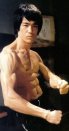
Bruce Lee never bragged about his muscular body, but he was proud of it, especially of his highly developed abdominal muscles. When Bruce wore loose clothing, he looked like a normally built guy. But underneath the clothing, he was a man with extraordinary muscles.

"I've seen many muscular bodybuilders," one of his fans said, "but never like Bruce. He is built perfectly, not bulky. He has muscles on top of muscles, yet he moves with the finesse of a ballet dancer. Those men with bulky muscles can't move like that; they are too tight and clumsy."

Fred Weintraub, the producer of Enter The Dragon, gave this description of Bruce: "...His body never had an inch of fat; it was pure muscle, like steel."

Bruce had to work hard to develop those muscles. "l used to have a big, soft belly," he explained. "My stomach protruded and I looked terrible for a young guy. I decided to streamline my waist."

From that revelation, Bruce took up weight training. He was always a bundle of energy. He was like a small kid who would never tire. If he had his mind set to do something, nothing could have stopped him.

He combined weight training with his regular workout.

He spent as much as four hours in his garage, hardly taking a break, as he worked on the equipment, built by his students to his specifications. He designed his weight-training workout to avoid bulky muscles that might interfere with his performance. For instance, he did not want muscles that restricted the movement of his elbows.

"You must tuck your elbows in quickly when a blow is directed to your midsection," he explained. "Some bodybuilders are so bulky that they have no way to defend the solar plexus area with efficiency. They can't cover the area with their elbows, so when they use another method to protect it, they leave other parts of their body open. Weight training is supposed to help you, not screw you.

Bruce concentrated heavily on his abdominal muscles because he believed that the body is "the biggest target and the least mobile. The more muscles you have around your abdomen, the more blows it can take." Bruce's body was covered with ripples of muscles. Broad-shouldered and narrow-waisted, he was the envy of even bodybuilders.

To Bruce, training was a full-time job. Even while watching television, he would be in motion. He would do his sit-ups very slowly, his body descending slower than ascending. "You'll get more benefit by doing them slowly," he said. "It's not the number of repetitions, but the way it's done."

When he wasn't doing sit-ups, he would be squeezing a rubber ball or pumping a pair of dumbbells. Desiring accolades, many times he would ask a friend or acquaintance to place a hand on his abdomen or leg to "feel my stomach muscles" or "feel how hard my legs are."

Bruce wasn't particular about what he ate. He avoided cigarettes, wine and liquor, but never refused a cup of hot tea. He would eat anything: pork, chicken, fish, beef, vegetables. His favorite dishes were Chinese and Japanese.

Although he was small man, 5-foot-7 and 135 pounds, he had a voracious appetite. In a restaurant, he always ordered an additional plate of food for himself- one serving was not enough. He also drank a lot of water, probably because he perspired so much.

Bruce took a daily amount of vitamin pills, apparently influenced by the body-building magazine he subscribed to. He prided himself on being healthy.


Training With "The Dragon" by Ted Wong
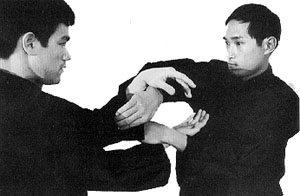
Few individuals were as close to Bruce Lee as Ted Wong. Now 57, and still teaching the system he learned from Lee, Wong can offer important insights into the late Dragon's training and instructional methods. As a friend and training partner of Lee, Wong gleaned technical and philosophical information from the legendary martial artist that most individuals were never privy to. In the following Dragon Spirit column, Wong explains what changes he thinks Lee would have undergone in his personal training, and in his overall outlook on the martial arts, had he been alive today. -- Editor

  After Bruce Lee died, I remained quiet for a number of years. But in the past few years, I have started to get a little more actively involved in the martial arts and jeet kune do. I had always wanted to teach the martial arts someday, but during those years, I felt I was still learning and still training. But I think after 20­some years, I have paid my dues and put my time into it. I have found that people really want to learn the original art and what Bruce Lee taught when he was alive. That's the reason I'm teaching now.

I teach, as close as I can, the art that Bruce taught, and hopefully it has evolved and changed, and become better. I basically teach the fundamentals of jeet kune do, based on Bruce's philosophy and principles. Over the years, I have tried to improve on it and make it better.

Probably only one percent of those teaching jeet kune do today are still teaching Bruce's art. Keep in mind that he did not really teach or talk about jeet kune do to many people in his life. I can't find one instructor who teaches the original form full­time; it's more like a hobby.

I think Bruce would be pretty pleased with the martial arts today. A lot of people apply his philosophies and principles, but with his concepts, you can make them conform to other martial arts and, in so doing, they will improve them. The martial arts have really come a long way since his passing. They have become much better and more practical.

Bruce always wanted to stay away from the martial arts being used as a sport. I think he tended to stay away from it as a sport because you could not fully utilize the art or its potential. It was not the ultimate martial art unless it was "anything ­goes." Bruce wanted to practice an art that he could use. No holds barred, no holding back, anything goes- that was his philosophy.

But I think today Bruce would also like the sport portion of martial arts because you develop speed, power and timing- things you can apply to sharpen your skills.

As far as no­holds­barred tournaments like the Ultimate Fighting Championship (UFC), I don't think Bruce would enter something like that. The UFC still has some limitations to it, even though they refer to it as ultimate fighting. There are still rules that say you can't do this or that. But I think as a test of your skills, Bruce would like it.

I don't think Bruce really liked teaching. He definitely didn't like to teach large groups. If anything, he enjoyed teaching one on one, or small groups. He always found a new way to develop different muscles, to improve speed or whatever. I'm sure he would still be looking for ways to improve conditioning, especially ways that no one else had discovered. He was always researching, reading and looking for more knowledge, analyzing it, and trying to utilize it.

The way Bruce taught and trained was always individualized. He would gear the training to work for you. Bruce could look at you and see what you were lacking and what your potential was. and then he could fully develop your potential. I think he was always looking at the individual and developing a program to suit that individual.

Bruce was a great motivator. He would get interested in you and consumed with the idea of doing everything to motivate you.

If he were still alive today, he would still train and be looking for ways to improve. Because he once said that if you are lacking in your physical ability and conditioning, then you have no business in the martial arts.

He spent most of his time developing, researching and experimenting with his art. That left him little time for teaching. In those days, seminars were unheard of. It wasn't until the early 1980s that people started teaching seminars to large numbers.

When I train now, I always think about him. I try to apply the things I learned from Bruce and use them in my daily routine. It makes me a much better person.

People always ask me about his physical conditioning. I looked up to him because he set the standard to follow in training and conditioning the human body. If he were here today, I believe he would be in even better shape. I don't think he would ever let himself go.


THE TAO OF JEET KUNE DO
Martial art has a very very deep meaning as far as my life is concerned because as an actor,as a martial artist, as a human being,all these I have learned from martial art. -Bruce Lee

I'd like to inform the public that kung fu cannot be mastered in just "three easy lessons". Intelligent thinking and hard work are required.-Bruce Lee

"Every Chinese martial artist wants to be like water;flexible,flows and yet can crash.What it means is that we don't offend firmness with firmness but instead accept it with softness and harmonize with it."

"Martial art, like any other art, is an expression of human being. Some have flavour, some are logical, but most martial arts are the mere performing of repetition and fixed pattern."

"This is incorrect because to live is to express and to expand. In order to achieve these we have to create. Creation is never repetition. Do take note that all styles are man-made and man is always more flexible, versatile and more important than any styles.Styles are dead.Man lives."

"Therefore martial art is ultimately an athletic expression of the human body.More importantly,the man who is expressing his own soul.Martial art is an unfolding of oneself,the feelings of anger,fear and pride. Yet under all these natural commotions,a quality martial artist still can be himself."

"During a battle, it is not the question of winning or losing but being wholeheartedly involved with that particular moment and doing one's best.The consequence is left to what will happen."

"So,to be martial artist is also to be artist of life.In the life of ever-going process, we should flow in the process, to discover, to actualize and to expand."

Hosted by www.Geocities.ws

1