|
 Raised in a small home in a modest Louisville, Kentucky neighborhood,
Clay would rise to dominate headlines, boxing and otherwise, and become
Muhammad Ali before his twenty-third birthday. He would stretch his
"fifteen minutes of fame" into an incredible legacy that will last for
generations to come.
Raised in a small home in a modest Louisville, Kentucky neighborhood,
Clay would rise to dominate headlines, boxing and otherwise, and become
Muhammad Ali before his twenty-third birthday. He would stretch his
"fifteen minutes of fame" into an incredible legacy that will last for
generations to come.
Spurred by the theft of his prized new bicycle, the 12-year
old Ali began to study the art of boxing. Vowing to never be victimized again, he spent
his teen years at the gym, molding both his body and mind into championship calibre. But
not even the ever-confident Ali could have fathomed the career that waited in his future:
a Golden Gloves champion at age 17, an Olympic gold medalist at age 18, an undefeated
heavyweight champion at age 22. But this, as they say, was just the beginning. |
|
Ali would continue his trek to boxing and, ultimately, social
dominance in the coming years. His professional career began with a victory over Tunney
Hunsaker on October 29, 1960, and would end some twenty-one years later with a loss to
Trevor Berbick on December 11, 1981, only his fifth loss in more than two decades of
professional boxing. Always inspired by the toughest of challenges, Ali would face many of
history's greatest fighters, almost always leaving the ring victorious. He would win the
world heavyweight championship three times by utilizing his lethal combination of blinding
speed and awesome power. As Ali's speed slowed with time, his intelligence and cunning
became his main weapons in the ring. Watching Ali perform his magic in the ring was a near
breathtaking experience, and the combination of brute force and beautiful choreography
exhibited by Ali created a visual experience difficult to forget. |
|
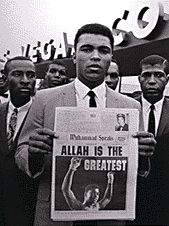
However, perhaps Ali's greatest
moments came in the life he led outside the ring. Ali was as confident in the public
circle as he was in the boxing ring, and he continued to meet every challenge with a mind
that was as powerful as his fists. As a black man living in an era that continued to
question his rights as a person, Ali faced and battled issues of race and class, and to
this day ranks as one of the champions of the Civil Rights movement. His conversion to
Islam, and
his subsequent refusal to be inducted into the military, created the largest controversy
of his life and he was stripped of his heavyweight title. Not surprisingly, this adversity
only made Ali stronger, prouder, and more determined than ever to live his life with
dignity and by his own conviction. And while it may have looked to some that the count was
nearing ten and the final bell was about to ring, Ali emerged from this battle with chin
high and hands raised, and years later would be selected the greatest athlete of modern
times by Sports Illustrated. |
|
No other athlete has transcended the
glamour and glory pinned to the lapels of sports champions the way Muhammad Ali has. His
grace under fire, his confidence tinged with cockiness, the spirit of his convictions, and
his pride of self make Muhammad Ali not only the greatest sports figure who ever lived,
but one of the greatest human beings to ever grace the Earth. Ali was truly a champion of
the people, a hero in the truest sense of the word, and a testament to humanity. Ali used
to say, "I am the greatest." And he is. |
|