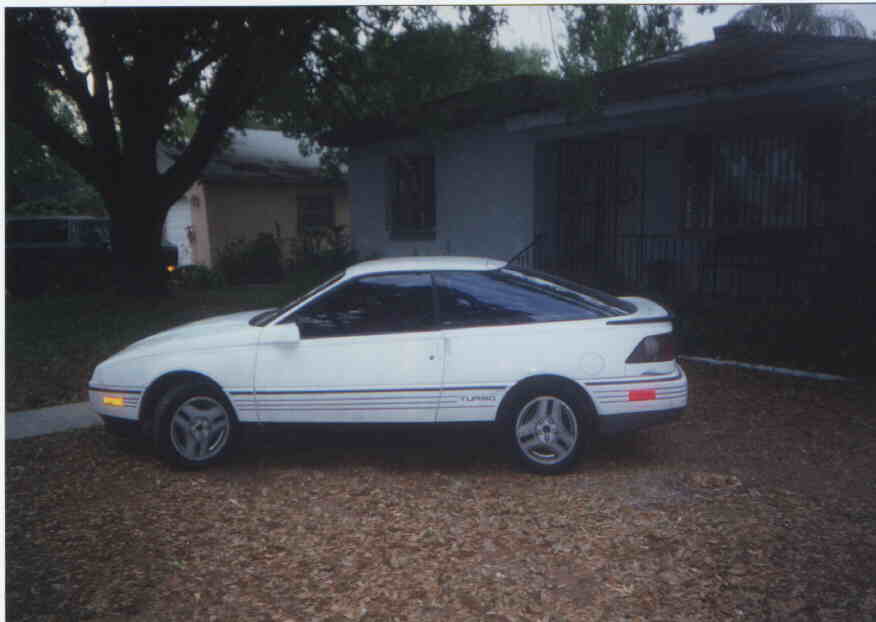
The Probe was a joint venture between Mazda and Ford. It was manufactured in Flat Rock, Michigan, right alongside Mazda's MX-6 coupe with which it shared most of its understructure. In late 1983 with the Probe's design theme established, the co-operative phase of the Ford/Mazda venture began. Design engineers from both companies worked in Mazda's Hiroshima headquarters in Japan on a feasible design that would allow both the Probe and the MX-6 to share the same floorpan, chassis and structural pieces. Ford was stretching the design boundaries because at that time the Probe was expected to replace the Mustang. The feasibility process was trying. Ford insisted on a lower cowl, a lower hood, a lower nose, and a more steeply raked windshield than Mazda was prepared to produce. Radical wraparound quarter glass and a frameless glass hatch were also on Ford's list. In the late summer of 1984, Ford's management approved the team's final full-scale clay model. The Probe design was ready.
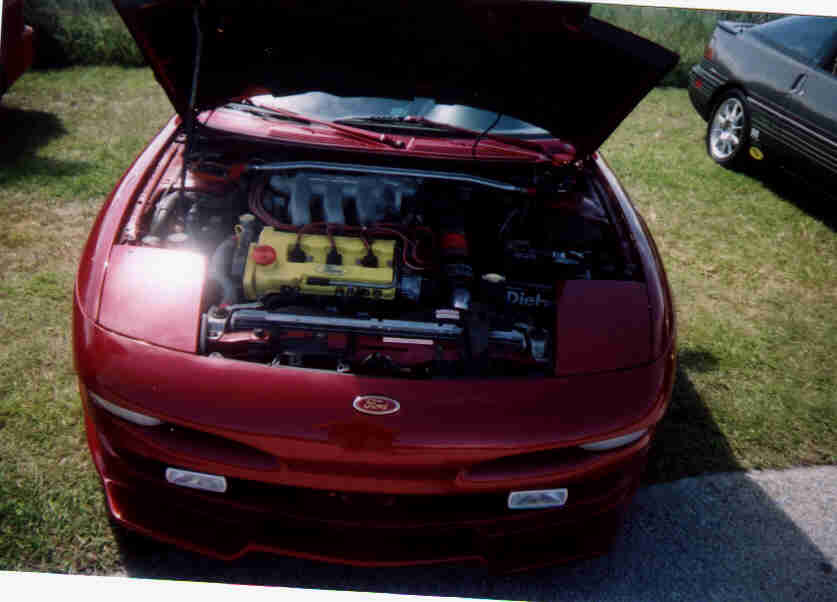
1988-1992 4 Cylinder GT Engine
| The Probe was effectively an MX-6 clone. Like the MX-6, it's a front wheel drive transversely mounted 2.2-litre Mazda four-cylinder engine with an aluminum head, three valves per cylinder and low-maintenance hydraulic valve-lash adjusters. They share Mazda's electronic engine-control systems and port fuel injection. | |
| The base engine produces 110hp at 4700 rpm and 130 ft-lb of torque at 3000 rpm. The more energetic GT powerplant added an IHI turbocharger and an inter-cooler to the intake tract, as well as a knock sensor and electronic boost control to the engine-control system. The entire arrangement was calibrated to provide midrange output; the maximum boost pressure rises to 9.3 psi in the vicinity of 3000 rpm, tapering down to 7.3 psi elsewhere. The results were 145 hp at a 4300-rpm power peak and a healthy 190 ft-lb of torque at 3500 rpm. Because the Probe's engine hardware came straight from the MX-6/626, Ford felt the need to visually distinguish its car from Mazda's offerings. | |
|
|
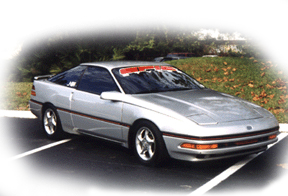
Styling Subtle alterations to the Mazda blueprint might have been adequate for the Tracer, but not for the car intended to replace the Mustang. As a result, Ford's designers received both the mandate and the budget to develop their own unique design. The MX-6 looked like the refined grand-touring car that it was but the new Mustang would have to look like a gutsy sports coupe. With its combination of sleek but aggressive lines, the Probe was both distinctive and instantly likable. And like the series of aerodynamically advanced show cars for which it was named, the Probe presents a clean face to the wind. The relatively unadorned GL and LX versions boasted a drag coefficient of 0.30. The GT, with its wider tires and additional air intake, was only slightly less efficient, with a Cd of 0.32. |
|
Options Despite its sporty appearance and design, the Probe could be equipped with enough luxury options to suit a driver well into the hedonistic phase of life. Options included air conditioning, cruise control, a trip computer, and power everything. |
| The GT came standard with four-wheel discs brakes and an option for the anti-lock system. If you wanted an automatic transmission, you had to forgo the turbocharged engine and choose either the GL or the LX. Both models had softer suspensions, narrower tires, and cleaner, more conservative bodywork than the GT. The LX had a more luxurious interior trim than the base GL and shared the GT's highly adjustable seats, tilt steering, electric mirrors, and alloy wheels. Like the GT, both the GL and the LX could be outfitted with a long list of comfort and convenience options. If you had to have electronic gauges, the Probe LX was the only choice. The Probe faced such established competitors as the Toyota Celica, the Honda Prelude, and the Nissan 200SX, as well as the MX-6, but it showed itself to be a strong contender. The Probe was also priced competitively. A fully equipped GT was only about $17,600 (US) back in 1988. | |
|
Minor
Styling Changes
|
|
| 1989 All 89' models have amber turn signals, different front bumper, and different side mirrors. Inside, they have manual seatbelts and different steering wheel. The GT has three spoke(straight) alloy wheels with brake dust guards. Foglights are integrated into the lower portion of the bumper. | |
| 1990 The LX variant get's the 3.0L V6 used in the Taurus. Now the LX is available with the 3-spoke GT rims from the 89' GT's, while 90' GT's get new rims, still 3 spoke but now the spokes are slanted. All car change to red turn signals, and a new front bumper. The foglights on the GT are moved to the grille area. | |
| 1991 Color coded trim was available on the LX models. The GL/LX remained unchanged. | |
| 1992 The last year before the new bodystyle was introduced. Styling remained unchanged until the 93's were released. | |
|
Second
Generation Production Cars
|
|
|
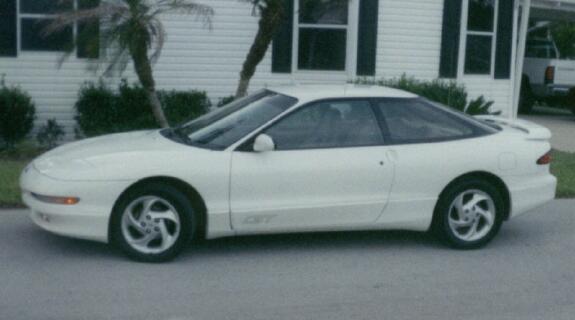
1993 The new model arrives. This car was totally redesigned to take advantage of the new MX-6 chassis and running gear. The sway bar was a little light but after market bars are available and they do make a big difference to the handling. A number of manufacturers also supply lowering springs and these are a worthwhile addition if you want more handling improvements. |
|
Engine The new model GT came with the hi-tech 2.5 Litre Fuel Injected DOHC Mazda V-6. |
|
Minor
Styling Changes
|
|
| 1995 - Base: Several stylistic changes from 1994 as follows: Tail lights are restyled, but plate still between the tail lights. Interior has been slightly restyled partially due to the addition of passenger side airbag. The interior door handles are also restyled. They are now just handles instead of being convenient places to keep some change like in the 93 and 94. | |
| 1995 - SE: No changes from 1994 except as listed above in the 1995 Base. | |
| 1995 - GT: Same interior changes as Base 95' and SE. License plate has been moved from between retyled tail lights down to lower bumper area. A large plastic GT logo now resides between tail lights. The small GT sticker next to the metal PROBE badge under the left tail light has been replaced by a metal 24V badge. The 16" 5 spoke alloys have been restyled from straight spokes to "sweeping" spokes. In addition, the trim for the rear lights on the GT is red. | |
| 1996 - OBD-II came in 96. Stands for On Board Diagnostics II. Pre 96 cars have OBD-I. You cannot read your own codes if you have a 96 or later, but the computer does not seem to be bothered by performance mods. | |
| 1996 - Base: No apparent changes from 1995. Plastic molding around tail lights may have been changed from red to black. | |
| 1996 - SE: No apparent changes from 1995. Plastic molding around tail lights may have been changed from red to black. Only the GT had red trim in 95. The SE had black trim. | |
| 1996 - GT: No visual changes from 1995 except for plastic molding around tail lights that may been changed from red to black. GT suspension has been softened up slightly to improve ride without significant changes in handling. New springs were used, no shopping cart strip around the car, deletion of many options, ODB-II, 2 x o2 sensors near the Cat, 2 x o2 sensors in the exhaust manifolds, black trim around rear lights. | |
| 1997 - Minor cosmetic body and interior changes. | |