
In a recent lab Holly took in the fine UW-Madison Journalism School, the final project entailed creating a class Web site on a particular topic and populating it with over 50 informative and persuasive multimedia stories, all generated by the 15 lab-mates. Lo and behold, Holly's suggestion of politics as the umbrella topic miraculously won out over several variations on "Guide to being a stereotypical lazy, drunken, promiscuous college student." She also worked as one of the site's three Webmasters, and thanks to her, the site gained a beautious banner, was copy-edited to her high AP Style Nazi standards and, following a drawn-out battle rife with whiny and passive-aggressive sneak-attacks, emerged unmarred by tacky American flag graphics of any persuasion.
To add to the site's content, all students wrote one individual informative piece on a topic of their choosing, for which they completed all necessary research and interviews on some potentially wicked deadlines.
The following article is Holly's informative contribution. She is loathe to brag, truly, but it was singled out during an expert panel review by a professional reporter as the first of the top two pieces of informative writing on the site. 'Twas a joy to create, and she is extremely pleased with the outcome.
Many thanks to the incomparable Merry Anderson and the delightfully quotable Tim Rusterholz.
More information follows the article if it sparks your interest. Enjoy!
Much has changed at UW-Madison since the Vietnam era. Bandanas have gone from helping protesters brave tear gas clouds on Library Mall to adorning the hair of coeds. Bob Dylan has gone from an emblematic musician to that creepy old man in the Victoria’s Secret commercials. Students have gone from taking occasional LSD-induced headers off Van Vleck to taking frequent drunken spills on the stairwells and sidewalks of Langdon Street. Though much has changed, a penchant for political expression among UW students has endured.
As an undergrad, Merry Anderson witnessed how UW-Madison came to symbolize the anti-war movement of the late 1960s. Anderson graduated in 1972 with a degree in comparative literature, though she arrived on campus in 1966 (“We could afford to stay here for five or six years.”). She is currently a writer for the UW Foundation, giving her a unique perspective on the UW’s political present, colored by her recollections of its dynamic past during the Vietnam War.
"It was college campuses leading the anti-war movement, and there was never a doubt we could do it," Anderson said. "I would say virtually everybody here was against the war. You had some people more violently against it than others, who were willing to demonstrate, but everybody was affected by it."
Anderson saw friends sent to fight overseas, news arrive directly from soldiers returning to campus and students' futures charted by the draft lottery. Discussion of all things political was pervasive, both in the classroom and out, and student activists were energized.
Anderson recalls an atmosphere of antagonism on campus–between students and university administrators, government leaders, police and authority figures in general. "It was very much 'us versus them,'" she said. "Anger was the emotion. It took over everything else."
As the war dragged on, violent protests became expected. As Anderson put it, "It wasn’t a good demonstration unless we had some tear gas."
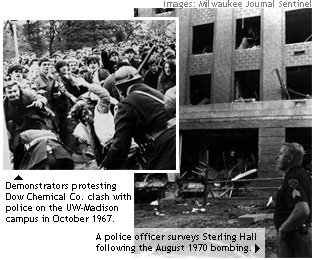 One early and famous incident involved the Dow Chemical Co.,
which made napalm used in the war and arrived on campus in October 1967
to recruit new employees. A sit-in at the Commerce Building (now Ingraham
Hall) Oct. 17 drew hundreds of student protesters and ultimately escalated
into a riot. Police used tear gas and clubs against demonstrators, injuring
75 and arresting 11.
One early and famous incident involved the Dow Chemical Co.,
which made napalm used in the war and arrived on campus in October 1967
to recruit new employees. A sit-in at the Commerce Building (now Ingraham
Hall) Oct. 17 drew hundreds of student protesters and ultimately escalated
into a riot. Police used tear gas and clubs against demonstrators, injuring
75 and arresting 11.
Anderson was employed at the hospital on campus at the time, and recalls the incident brought the realities of the anti-war movement home. "I was working when they started bringing in the students, and I remember my reaction to seeing these bloody kids–it was a great shock," she said. "It was, 'My god, this is real, this is serious.'"
Campus anti-war tensions reached a crescendo on Aug. 24, 1970 with the bombing of Sterling Hall, which housed the physics department and the Army Math Research Center. Faculty there were reported by sources including the Daily Cardinal to be working on secret military weapons projects, making the Center a target for activists. At 3:40 a.m., four set off an ammonium nitrate bomb left in a stolen van outside the building. Graduate student Robert Fassnacht was killed, four others were injured and 26 campus buildings were damaged.
Ted Crabb, director of the Wisconsin Union at the time of the bombing, recalls a sense of gloom and devastation settling over the university in its aftermath. "The event occurred at the start of a school year and all activities came to a halt," he said. "Students didn’t even want to be on campus. The UW community was stunned and didn’t know how to react."
Anderson's friends knew one of the four bombers, and she was questioned by the FBI, "though of course I didn't know anything."
Following the bombing, campus life changed and activism sharply declined. For Anderson, this marked not only an end to the anti-war drive, but the larger movement for civil rights. "We were trying to change everything, make everything better," she said. "We truly believed there could be peace and equality, we truly believed we could make it happen. And we wanted it so badly."
Looking back on what her generation's activism accomplished, Anderson is disappointed. "We still have war. We still have racism. I think we failed miserably. At least I feel like a failure."
Truly, current student activists still have a wealth of injustices to protest. Though there seems to be comparative lack of widespread, overt, passionate politicizing on campus today, the politically expressive are still around.
Tim Rusterholz, a UW-Madison junior majoring in music composition, writes, sings and plays for local punk/ska band Sunshine Policy. Some of the band's songs address politics, Rusterholz said, "in that general punk vein of 'let's make a satire out of anything we can.'"
One such song is titled "Another Vietnam," though it was originally written prior to Sept. 11 to comment on the comparative lack of dramatic protests over contemporary issues. "We decided we should add a third verse to reflect the changed political climate and the way that the song was sort of self-fulfilling–in that we did actually get another Vietnam," Rusterholz said. "That song can sort of be summarized in the line: 'The government today is much more subtle when it rapes you in the ass.'"
Though that particular phrase may not find its way into many protest chants, Rusterholz believes his band's style of music has a political impact by reaching younger audiences "with the view that a lot of punk promotes: that it's important just to think for yourself, come to your own conclusions and take with a grain of salt anything you hear from authority figures."
As for why there aren't more conservatives out expressing their views through song, Rusterholz isn't sure. "I think there is a general correlation between people who express themselves artistically and people who have liberal political views," he said. "But it’s hard to say."
On the UW-Madison campus today, it seems those with more liberal views still hold sway. "One time I was walking down Library Mall and saw 'Vote Bush' chalked on the sidewalk, and I just started laughing out loud," Rusterholz said. "And I realized, hey, wait a minute, there are campus Republicans."
Rusterholz cites the overwhelmingly liberal atmosphere he experiences on campus as a possible reason current students aren't as vocal on political matters. "I think that, at least on this campus, there's such a widespread understanding of the terrible things the government is doing that most students don't feel the need to discuss it," Rusterholz said. "It seems like anyone who brings that up as a conversation topic other than just a passing 'I hate Bush' is not saying anything that everyone doesn't already know." He has also seen this occur in lectures when professors start to voice political opinions, then cut off to knowing laughter from like-minded students.
In terms of larger-scale political activism, Rusterholz notes that though the Internet has allowed today's activists to link up with nationwide groups such as MoveOn.org, "It makes the whole process a little less personal and less interactive."
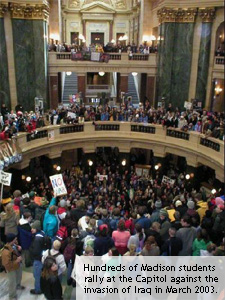 Demonstrations against the war in Iraq have remained largely
subdued on campus, and closely tied to opposition to the Bush administration's
policies in general. Rusterholz thinks at this point many student activists
recognize nonviolent response as being the most logical, legitimate and
effective. "I think that maybe the reason for the degree of control and
organization of protests nowadays is that students see it as the only way
we’ll actually be effective in creating changes in the system."
Demonstrations against the war in Iraq have remained largely
subdued on campus, and closely tied to opposition to the Bush administration's
policies in general. Rusterholz thinks at this point many student activists
recognize nonviolent response as being the most logical, legitimate and
effective. "I think that maybe the reason for the degree of control and
organization of protests nowadays is that students see it as the only way
we’ll actually be effective in creating changes in the system."
Anderson names this desire to work within the system in order to change it as the biggest difference between her generation, whose attitude she summed up as "fuck the system," and today's. She said she sees current student activists as almost unwilling to step outside the system. "If they wanted to demonstrate, I swear they’d go out and get a permit."
Anderson points to the recent failed campaign to get Howard Dean the Democratic presidential nomination as an example of younger voters rallying for change from within. Rusterholz believes this was a worthwhile endeavor, particularly because its goal was "somewhat realistic."
"Personally I would like to see our political system get torn apart and replaced with something better, but it’s really hard to say how practical of a goal that is," he said.
Though Rusterholz thinks activism through existing channels has the potential to create change, he also notes working within the current political framework doesn’t come without a fair measure of frustration.
"That rally last March, on the eve of the [Iraq] invasion, was the biggest worldwide protest since the Vietnam days. The fact that the Bush administration didn't really respond to it at all is kind of intimidating to everyone's beliefs in the power of activism," he said.
The 2000 Presidential election (or "appointment," as Rusterholz prefers) raised a similar dilemma regarding the value of voting as a means of political assertion. "I've always been a supporter of voting, even though to some extent I can see the futility of voting when trapped by a system that limits the extent to which real change is possible," Rusterholz said. "But I don’t think the system is limited to the point where it's not worth it to vote at all"–even if one is only voting for the lesser of two partisan evils.
"The Democratic Party is far from ideal, but not nearly as far from ideal as the Republican Party. So if we can get a lot of young people to vote Bush out of office, the situation won’t be perfect, but it'll be a big improvement," Rusterholz said.
Indeed, though a host of factors differentiate today's politically-minded UW-Madison students from those of the Vietnam era, bridges can nonetheless be found. For instance, though separated by a good 30 years, Anderson and Rusterholz characterize President Bush as "a buffoon" who just doesn't get it and "partly just a bumbling idiot, but underneath that a malicious terrorist," respectively.
###
Check out the slightly abridged version of this article that appeared as a feature in the September 23, 2004 edition of The Daily Cardinal.
Click on "Music" to listen to "Another Vietnam," the song referenced in this article. Also, check the calendar for live shows if you're in the area, they're great good fun.
This is the finished Web site the article appears on, but it's password-protected against crazy hackers and terrorist thugs out to disrupt the journalistic process. If you'd really like to see it, e-mail Holly and she'll probably oblige you, especially if you superfluously compliment her.
Two of Holly's favorite presidential humor links that got cut from the final links page because one of her fellow Webmasters pointed out there wasn't rationally enough material to warrant an entire humor section. (Or who knows, it may have been because he was a pawn of Ashcroft out to stifle critical speech.)
After reading this article, do you feel an intense compulsion to stick shiny, pointy things into choice areas of the president's anatomy? If so, support Holly's poor single mother and order a Bush Baby!
If you'd like more information on any aspect of this topic, e-mail Holly at [email protected]. If she can't answer your questions, she can likely get you in touch with someone who can.
Also, e-mail her if you'd like to wax political, share some humor or just vent.