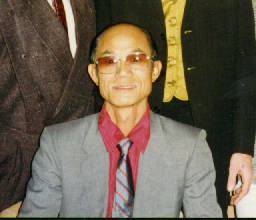
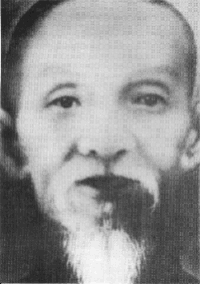
Before his death in 1948, Lee accepted his youngest and last disciple. This child came to Lee at age six, and when Lee died, the young student continued to learn with the elder students until he mastered the Wah Lum Praying Mantis system that had been combined with Lee's Tam Tui family style. The child's name was Pui Chan.
These events are linked to the development of Kung Fu in America by the fact that Pui Chan grew up to be a very knowledgeable and accomplished martial artist who later, with much difficulty and great courage, made his way to the United States. He accomplished this by moving southward in China to the Hong Kong area. When he got there, he swam from the mainland to the city of Hong Kong. Once there, he got a job on a boat as a seaman, and when the boat arrived in New York harbor, he again swam ashore at night.
Arriving in New York, alone and penniless, he found his way to Boston, where he took a job as a cook. At this time, he had no particular intention to teach Kung Fu. Later on, when Chan could no longer pretend he was nothing more than a cook, he joined a Kung Fu school, began working out and teaching, and eventually opened his own school in Boston, Massachusetts in the late 1960's.
Chan soon became recognized as a legitimate master practitioner, and his knowledge and classical teaching has contributed greatly to the transfer of real Kung Fu to the United States.
In 1980, Pui Chan chose to pass on his knowledge in a way that is very different from most Kung Fu schools. He decided to move his family to Orlando, Florida, and actually build a Kung Fu temple in the Wah Lum tradition, calling it the Wah Lum Temple. He allows instructors from all over the country to live there and undertake intensive Kung Fu training in an atmosphere free of distractions. Chan has done this in order to preserve the traditional ways of Kung Fu training, and to provide an atmosphere of serenity and sincerity in the modern world.
Chan is proud of his students and his modern Wah Lum Temple. He would like to be known, more than anything else, as a man who spent his lifetime promoting and teaching Kung Fu. |