"Forms developed as one or two movements. Someone developed a striking technique that fooled his opponents. After a while, the opposition caught on and developed a counter to his strike. then of course the originator developed a counter to the counter. And so the moves became longer and longer to counter until the opposition was thrown off-balance. I use the analogy of a simple chess match. When you first learn to play, you are concerned only with how each piece is moved, and how that one piece can be used to defeat your playing partner. Later, you begin to take several pieces into account to defeat the opposition, and a chess master thinks ten or twenty moves ahead. He makes forced sacrifices, so that you fall into his trap and are eventually thrown off balance with the words "checkmate". MORE "Traditional training in Kung Fu makes use of classical Kung Fu forms. Kung fu forms combine proper offensive and defensive techniques, while training the student to move from one position to various positions. Individual movements or positions are blended tegether and executed with balance and precision, while maintaining proper focus and power. A form is a flowing picture of strength and grace when performed by a skilled person. The forms taught in our system are centuries old, and when practiced diligently, increase an individual's agility, balance, speed, strength, flexibility and cardiovascular fitness." MORE "The real question for training, and the most misunderstood aspect of martial arts is: Should forms make sense? Should they be clear and obvious in movement and meaning? And the surprising answer is NO. If they were clear and obvious to beginners they would have to be at a beginner's level. This does not advocate that the information in a form be non-functional or elaborate for it's own sake. But Kung Fu forms are far more than dances. They are sets of formulae which can be recombined endlessly to create new answers. After all , you may learn the form at ten and still be practicing it at eighty. Forms must contain enough interest and depth to spend a life on. I never tire of Shakespeare's sonnets because they never stop giving me something. Kung Fu forms are puzzles with multiple answers. The deeper the practitioner's art the deeper the responses from the form. MORE "How can pre-defined moves be useful in a fight?" "Kata (forms) is not meant to prepare you for individual situations, one technique in a kata equaling one, and only one, situation "in the street". Kata is not meant to be "real". Kata is meant to address the center of a generic reality. The purpose is to generally reprogram the types of movements that your body does naturally, while visualization teaches the body "when" to do those movements. It is the job of the practitioner to modify and alter those movements to fit situations, re-directing them to fit whatever variation of an attack the opponent actually end up doing." MORE "In any physical movement there is always a most efficient and lively manner to carry it out, that is regarding leverage, balance, economical use of motion, and so forth. However, live efficient form is one thing. A sterile classical set that binds and conditions is another. There is a subtle difference between "having no form" and having "no-form". The first is ignorance; the second, transcendence. - Bruce Lee. |
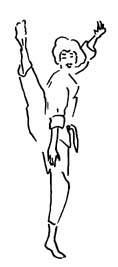
| "Form" is the terminology used for a set of movements put together in sequence. The movements are all individual techniques for an attack or self defense purpose, and in the form, the movements follow in sequence. The main purpose of a form is to assist the martial artist in practicing the movements in one continuous flow, so that the response to stimulus becomes automatic. Wah Lum Fist Forms Although the forms are too intricate to explain in words, the names, themselves, are interesting: Sixteen Hands Little Open Gate Straight Form Seven Kicks Eighteen Elbows Two Man Forms Little Mantis Say Lok Thirty-six Hands Leopard Law Horn Wah Lum First Form Wah Lum Second Form Wah Lum Third Form Wah Lum Fourth Form Wah Lum Fifth Form Wah Lum Sixth Form Fan Cha Big Mantis Tam Tui Form-sets Buddha Palm Lok Low Little Fan Cha Advanced Wah Lum Fist Forms: Drunken Form Swallow Plum Flower Six Corners Eighteen Kicks Eighteen Locking Hands Tin Fong Fingers So Lo Sow Tong Long Juk Dung Soft Form Plum flower Wood Pole Advanced Exhibition Forms Advanced Two-man Forms |
| Much has been said about Kung Fu forms, Karate katas .... and I have included some of these ideas, and the attached webpages for debate here ........... |
 |
 |
 |