You should know, may Allah have mercy on you, that we should learn four points:
And the evidence is from the saying of Allah azza wa jall: "By the Time. Verily Man is in loss. Except such as have Faith, and do righteous deeds, and (join together) in the mutual enjoining of Truth, and of Patience and Constancy."(103:1-3) Al-Shafiái said about these verses: "If no argument besides this verse had been revealed by Allah to his creatures, it would have been sufficient for them." Al-Bukhari, may Allah have mercy on him, named a chapter in his Sahih: "Chapter : Knowledge before Saying and Acting" The evidence is the saying of Allah azza wa jall: " Know, therefore, that there is no god but Allah, and ask forgiveness for thy fault,"(47:19) He, azza wa jall, began with knowledge first before saying and acting. Know, may Allah have mercy on you, that every Muslim, male and female, should learn these three things and act according to them:
Know you, may Allah guide you to His obedience, that the Hanifiyyah is the creed of Ibrahim (Abraham), which is to worship Allah alone, with pure religious devotion. It is this that Allah has ordained on all people; and indeed He created them for this purpose. The evidence is in His saying: "I have only created Jinns and men, that they may serve Me." (51:56) To "serve Me" means to serve and worship Allah azza wa jall alone without partners. The greatest thing that Allah has ordered is to Tawheed, that is to worship Allah alone. The greatest of what he forbade is Shirk, which means calling upon other with Allah. The evidence is in His saying: "Serve Allah, and join not any partners with Him;." (4:36)
The Three Fundaments If you were asked "What are the three fundamentals that must be understood by every Muslim", say : "A worshipper should know his Lord, his religion, and his Prophet, salla Allah u alihi wa sallam. The First Fundament: Knowing Allah. If you are asked : "Who is your Lord?", say : "My Lord is Allah. He has nourished me and all other creatures with his blessings. He is my Deity, and I have no other Deity but Him." The evidence is in His saying: "Praise be to Allah, the Cherisher and Sustainer of the worlds;" (1:2) Every thing other than Allah is of His Creation; and I am part of that Creation. If you were asked : "How did you know your Lord?", say : "Through His signs and His creatures. Among his signs are the Night and Day, and Sun and Moon. Among his creatures are the Heavens and the Earth, and all that is in and between them." The evidence is in His saying: "Among His Sings are the Night and the Day, and the Sun and the Moon. prostrate not to the Sun and the Moon, but prostrate to Allah, Who created them, if it is Him ye wish to serve." (41:37) And His saying: "Your Guardian Lord is Allah, Who created the heavens and the earth in six days, then He settled Himself on the Throne: He draweth the Night as a veil o'er the Day, each seeking the other in rapid succession: and the Sun, the Moon, and the stars, (all) are subservient by His Command. Verily, His are the Creation and the Command. Blessed be Allah, the Cherisher and Sustainer of the Worlds!" (7:54) The "Lord" here is the worshipped Diety. The evidence to this is in His saying: "O ye people! Worship your Guardian Lord, who created you and those who came before you, that ye may become righteous; Who has made the earth your couch, and the heavens your canopy; and sent down rain from the heavens; and brought forth therewith Fruits for your sustenance; then set not up rivals unto Allah when ye know (the truth)"(2:21-22) Ibn Katheer, may Allah have mercy on him, said: " It is only the creator of all these things who is worthy to be worshipped." Some of the forms of worship ordained by Allah are Islam (Submission), eman (faith), ehsan (charity), Duâa (prayer and supplications), khawf (fear), rajaa (hope), tawakkul (trust), raghbah (aspiration), rahbah (awe), khoshoâ (homage), khashiah (apprehension), enabah (remorse), estianah (supplication), estiadhah (appeal for refuge), estighathah (succour), dhabh (sacrifice), nadhr (vowing). These as well as other forms ordained by Allah are all to Him, taala. The evidence is in His saying: "And the places of worship are for Allah (alone): So invoke not any one along with Allah." (72:18) Consequently, if anyone performs one of these rites not exclusively to Allah; he is a polytheist and an unbeliever. The evidence to this is His saying: "If anyone invokes, besides Allah, any other god, he has no authority therefor; and his reckoning will be only with his Lord! And verily the Unbelievers shall not prosper!."(23:117)
The Second Fundament: Knowing the Religion of Islam through evidences. This knowledge is the submission to Allah alone, and yielding to Him by obeying His commandments; and the denial of association with Him and the Mushrikeen, or associationists. This knowledge is of three ranks:
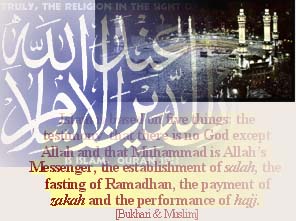
The first rank : Islam (submission). Islam has five pillars:
The evidence for testifying from the Quran is His saying: "There is no god but He: That is the witness of Allah, His angels, and those endued with knowledge. Standing firm on justice. There is no god but He, the Exalted in Power, the Wise."(3:18) This means that it is only Allah that is worthy of being worshipped, and the negation, "... no god but ...", implies the denial of any other deities worshipped besides Allah. He should have no partner in His worship as He has no partner in His Domain. The following verses illustrate this point "Behold! Abraham said to his father and his people: 'I do indeed clear myself of what ye worship: (I worship) only Him Who originated me, and He will certainly guide me.' And he left it as a Word to endure among those who came after him, that they may turn back (to Allah)." (43:26-28) And His saying "Say: 'O People of the Book! come to common terms as between us and you: That we worship none but Allah; that we associate no partners with him; that we erect not, from among ourselves, Lords and patrons other than Allah.' If then they turn back, say ye: "Bear witness that we (at least) are Muslims (bowing to Allah's Will)." (3:64) The evidence for testifying that Muhammed is the Messenger of Allah is in His saying: "Now hath come unto you a Messenger from amongst yourselves: it grieves him that ye should suffer, ardently anxious is he over you: to the Believers is he most kind and merciful. But if they turn away, Say: '(Allah) sufficeth me: there is no god but He: On Him is my trust,- He the Lord of the Throne Supreme!'" (9:128-129) To testify that Muhammed is the Messenger of Allah signifies that one should obey his ordinances and believe him in what he tells, avoid what he prohibits and worship Allah according to His precepts. The evidence for prayers and Zakat, and the meaning of worshipping Allah alone is in His saying: "And they have been commanded no more than this: to worship Allah, offering Him sincere devotion, being true (in faith); to establish regular prayer; and to give Zakat; and that is the Religion Right and Straight."(98:5) The evidence for fasting from the Quran is His saying: "O ye who believe! Fasting is prescribed to you as it was prescribed to those before you, that ye may (learn) self-restraint,-" (2:183) The evidence for Pilgrimage is His saying: "Pilgrimage thereto is a duty men owe to Allah,- those who can afford the journey; but if any deny faith, Allah stands not in need of any of His creatures."(3:97)
Eman comprises of seventy and something branches (narrated by Bukhari), that highest is to say "La ilaha illa Allah" which is to testify that "there is no god but Allah", and the lowest is to remove obstacles from the path of the people. Modesty and bashfulness is one of the branches of Eman. The pillars of Eman are six: Belief in...
Evidence from the Quran for the six pillars of Eman is: "It is not righteousness that ye turn your faces towards East or West; but it is righteousness to believe in Allah and the Last Day, and the Angels, and the Book, and the Messengers; to spend of your substance, out of love for Him, for your kin, for orphans, for the needy, for the wayfarer, for those who ask, and for the ransom of slaves; to be steadfast in prayer, and give Zakat; to fulfill the contracts which ye have made; and to be firm and patient, in pain (or suffering) and adversity, and throughout all periods of panic. Such are the people of truth, the God fearing."(2:177) Evidence for Destiny from the Quran is: "Verily, all things have We created in proportion and measure."(54:49)
Ehsan has only one pillar and that is you have to worship Allah as if you see Him; for though you do not see Him, He sees you. Evidence is in His saying "For Allah is with those who restrain themselves, and those who do good." (16:128) and in His saying: "In whatever business thou mayest be, and whatever portion thou mayest be reciting from the Quran,- and whatever deed ye (mankind) may be doing,- We are Witnesses thereof when ye are deeply engrossed therein." (10:61) Evidence from the hadith is the well known hadith of Jibreel (Gabriel). According to Omar bin Al-Khattab, may Allah be pleased with him, who said: "One day while we were sitting with the Prophet, salla Allah u alihi wa sallam, there came upon us a man with very white clothes and very dark hair; no traces of any traveling on him, and non of us knew him. He sat before the Prophet, salla Allah u alihi wa sallam, with his knees touching the Prophet's knees, and his hands over the Prophet's thighs. The stranger said: "O Muhammad, tell me about Islam." He (salla Allah u alihi wa sallam) said: "It is to testify that there is no god but Allah and that Muhammed is the Messenger of Allah, to perform prayer, to give Zakat, to fast the month of Ramadhan, and to perform the Pilgrimage to the House, if you can afford it.". He (the stranger) said: "You have spoken the truth." We wondered why he asked him and then told him that what he had said was true. The stranger then said: "Tell me about Eman." He said: "It is to believe in Allah, His Angles, His Books, His Messengers, The Last Day, and in Destiny, whether good or bad." He said: "Tell me about Ehsan." He said: "To worship Allah as if you are seeing Him, for though you do not see Him, He sees you." He said: "Tell me about the Final Day." He said: "The answerer has no better knowledge than the questioner." He said: "Tell me about its signs." He said: "When a slave girl gives birth to her own mistress, and when you see the bare-footed and tattered needy shepherds vying with each other in erecting high buildings." Then that stranger left, and the Prophet was silent for a while then said: "O Omar, do you know who was the questioner?" I said:" Allah and His Messenger know better." He said: "That was Gabriel. He came to teach you your religion."
He is Muhammad, son of Abdullah, son of Abdulmuttalib, son of Hashim, of the clan of Quraysh, one of the Arab clans, the descendants of Ismael, the son Ibrahim Al-Khalil. He was born in Mecca. He lived for sixty three years, forty before his mission and twenty three years as a prophet and a messenger. He was initiated into prophethood with the revelation of the verses: "Read! in the name of thy Lord and Cherisher, Who created. Created man, out of a leech-like clot. Read! And thy Lord is Most Bountiful,- He Who taught (the use of) the Pen,- Taught man that which he knew not." (96:1-5) Later Allah sent him as a messenger to warn against associating partners with Allah and to preach worshipping Allah alone. The evidence is in His saying: "O thou wrapped up (in the mantle)! Arise and deliver thy warning! And thy Lord do thou magnify! And thy garments keep free from stain! And all abomination shun! Nor expect, in giving, any increase (for thyself)! But, for thy Lord's (Cause), be patient and constant!" (74:1-7) "Arise and deliver thy warning" against associating partners with Allah, and call the people to worship Allah alone, and "Thy Lord do thou magnify" through testifying His unity, and "Thy garments keep free from stain", means keep your deeds clean from the acts of association, and "Abomination shun" mean keep away from idols and from idolaters and deny them. He continued to preach worshipping Allah alone for ten years, when he was ascended to Heaven where the five prayers (salat) and their times were ordained. Thus, he performed prayers in Mecca for three years. The he was ordered to emigrate to Madinah. This emigration means departing from among the polytheists to settle with the community of Islam. This type of immigration is a duty that Muslims should observe up till the Last Day. The evidence is in His saying: "When angels take the souls of those who die in sin against their souls, they say: "In what (plight) were ye?" They reply: "Weak and oppressed were we in the earth." They say: "Was not the earth of Allah spacious enough for you to move yourselves away (from evil)?" Such men will find their abode in Hell,- What an evil refuge! - Except those who are (really) weak and oppressed - men, women, and children - who have no means in their power, nor can they find a way (to escape). For these, there is hope that Allah will forgive: For Allah doth blot out (sins) and forgive again and again." (4:97-99) and His saying: "O My servants who believe! Truly, spacious is My Earth: therefore serve ye Me - (and Me alone)!"(29:56) Al-Baghawi, may Allah have mercy on him, said: "This revelation refers to the Muslims who remained in Mecca and had not emigrated to Madinah. For Allah calls them as people who have faith." Evidence from the hadith is in the Prophet's saying: "Emigration shall never cease (to be the refuge of oppressed Muslims) until repentance ceases; and repentance shall never cease till the sun rises from the west." When the Prophet settled in Madinah, the other ordinances of Islam were prescribed; these include the Zakat, fasting, Pilgrimage, the Adhan (call to prayers), Jihad (fighting in the cause of Allah), and the injunction to recommend good and denounce evil. He remained in Madinah until he died ten years later, but his religion remains to guide the Muslim community to all the good and to warn them against all evil. The good is the creed of worshipping Allah alone and every thing with which Allah is pleased and satisfied. The evil is associating partners to Allah and every thing that Allah dislikes and prohibits. Allah has sent him to all people and nations, and He has ordained that all mankind and jinn should follow him in obedience to his message. The evidence is in His saying: "Say: 'O men! I am sent unto you all, as the Messenger of Allah,'" "(7:158) And with him Allah has completed and perfected the religion. The evidence is in His saying: "This day have I perfected your religion for you, completed My favor upon you, and have chosen for you Islam as your religion."(5:3) The evidence of the prophet's death is in His saying: "Truly thou wilt die, and truly they (too) will die. In the end will ye (all) dispute, on the Day of Judgment, in the presence of your Lord."(39:30- 31) And when the people die they shall be resurrected. The evidence is in His saying: "From the (earth) did We create you, and into it shall We return you, and from it shall We bring you out once again."(20:55) And His saying: "And Allah has produced you from the earth growing (gradually), and in the End He will return you into the (earth), and raise you forth (again at the Resurrection) "(71:17-18) After Resurrection, they shall render account to Allah and they are rewarded or punished. The evidence is in His saying: "Yea, to Allah belongs all that is in the heavens and on earth: so that He rewards those who do evil, according to their deeds, and He rewards those who do good, with what is best."(53:31) Any one who denies Resurrection is an unbeliever. The evidence is in His saying: "The Unbelievers think that they will not be raised up (for Judgment). Say: "Yea, By my Lord, ye shall surely be raised up: then shall ye be told (the truth) of all that ye did. And that is easy for Allah."(64:7) Allah has sent all the messengers to give good news and warnings. The evidence is in His saying: "Messengers who gave good news as well as warning, that mankind, after (the coming) of the messengers, should have no plea against Allah." (4:165) The first messenger was Noah, and the last was Muhammad; and he is the Seal (Last) of the prophets. The evidence that the first messenger is Noah is in His saying: "We have sent thee inspiration, as We sent it to Noah and the Messengers after him."(4:163) And to every nation, from the time of Noah to Muhammad, a Messenger was sent to command them to worship Allah alone, and to interdict the worship of all idols. The evidence is in His saying: "For We assuredly sent amongst every People a Messengers, (with the Command), 'Serve Allah, and eschew Evil.'"(16:36) Allah has commanded all mankind to disbelieve in idols and to believe in Him. Ibn Al-Qayyim, may Allah have mercy on him, said: "An idol (Taghut) means any object for which the believer oversteps his limits, whether this is an object of worship, or subordination, or of obedience." The Idols (Tawagheet) are many, but their heads are five:
The evidence is in His saying: "Let there be no compulsion in religion: Truth stands out clear from Error: whoever rejects Taghut (evil) and believes in Allah hath grasped the most trustworthy hand-hold, that never breaks. And Allah heareth and knoweth all things." (2:256) This is the meaning of "La ilaha illa Allah", or "There is no God but Allah" The evidence in the hadith: "The head of the Command is Islam, its central Pillar is prayers, and its highest pinnacle is Jihad (struggle in the Cause of Allah)." And Allah
knows best. |
| Return To Main Page |