By: Alfred Bester
In 2301 A.D., guns are only museum pieces and benign telepaths sweep the minds of the populace to detect crimes before they happen. In 2301 A.D, homicide is virtually impossible - but one man in about to change that.
In this classic science fiction novel, the first to win the prestigious Hugo Award, a psychopathic business magnate devises the ultimate scheme to eliminate the competition and destroy the order of his society. Hurdling from the orgies of a future aristocracy to a deep space game preserve, and across densely realized subcultures of psychic doctors, grifters, and police. The Demolished Man is a masterpiece of high-tech suspense, set in a world in which everything has changed except for the ancient instinct for murder.
Three-hundred years into the future, the world is a very different place. Humans have managed to evolve into psychics, and the solar system is full of space colonies. The study of our own solar system is vital in the search for life in the Universe. If we can understand why life exists only exists on our planet, we'll know what to look for when we examine the Galaxy.
Early in the novel, Ben Reich looks at a clock that displays the dates on the various planets and moons that we occupy. The ones that were shown are:
These were chosen for specific reasons. At the time that this book was written, we did not know as much about the rest of the solar system as we do now. It stood to reason that the other terrestrial planets, as well as some of the larger moons of the Jovian worlds, would be able to support human life. It is not possible for the colonies in this book to exist in the way that they did. The following will explain why.
Before life can exist on a planet, that planet must first have habitability. Habitability is based off of three factors: a source of energy (such as the sun), liquid water, and organic material. We are certain that life cannot exist unless these conditions are met. This makes it easier for us to identify places that might contain alien life. The following will be a breakdown of the habitability of the planets/moon mentioned in the novel.
Venus is definitely not the best place to try to set up a space station. Scientists believe that both Venus and Mars had liquid water on their surface at one point. However, that water is now gone. Venus would only be about 30 Celcius hotter than Earth if the only factor was their distances to the Sun. The higher temperature on Venus was enough to cause water to evaporate on a higher level. Being a greenhouse gas, water vapor in Venus' atmosphere led to an increase of temperature. The rise in temperature caused more evaporation, which in turn caused higher temperatures. This continued until no water was left on the surface, and temperatures on Venus had risen to over 900 Fahrenheit. The surface of Mercury, the closest planet to the Sun, is not even this high. When greenhouse gases spin out of control like they did on Venus, it is referred to as the runaway greenhouse effect. Metals like lead will melt if placed within such a sweltering atmosphere. Spacecraft cannot last more than one hour before they break altogether. Humans might as well try to set up homes on the Sun. Needless to say, there is no water on the surface of Venus. Another reason why Venus is uninhabitable for humans is the air.
 Carbon Dioxide makes up more than 90% of the atmosphere. The volcanic activity on Venus has also contributed to the presence of sulfuric-acid clouds. Besides the extreme temperature and poisonous air, the atmospheric pressure on Venus must be taken into consideration. A human would be instantly crushed in Venus' atmosphere, which is about 90 times greater than it is on Earth. These three things put together make it hard to believe that we will ever be able to fully explore the surface of Venus.
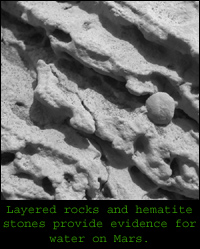 In the novel, Mars is a tropical paradise. There are flowing rivers, lush plant life, and many species of animal running around. The Mars that we know may not be such an active place, but it is still a remarkable planet. There is no liquid water on the surface of Mars, but we have reason to believe that it did at some point in it's past. The Spirit and Opportunity rovers have discovered many types of rocks which could only have formed in the presence of liquid water. If Mars did have water, this means that the range habitable zone, the area around the sun where liquid water can exist, is much larger than we previously believed. Experiments done on the surface of Mars have concluded that Mars is a sterile place. A layer of superoxides eliminates any organic material, but we aren't certain about what is below that layer. There is still the question of what lies under the surface of Mars. Further experiments conducted below the surface of Mars might uncover signs of life.
With the exception of our Moon, all of the moons in this book orbit around Jovian planets. These moons are all very interesting places for Astrobiologists. They are made up of ice, which exists in large quantities in the outer regions of the solar system, and rock. Since the moons orbit planets outside of the habitable zone, they don't receive energy from the Sun. Instead, they receive energy from the Jovian planets they orbit. The intense gravity of the planets provides friction, which heats the satellites. Tidal energy also can supply the moons with energy. The tidal energy from the Jovian planets may not provide enough heat for liquid water on the surface of the moons, but there is the possibility that ice has melted below the surface. It is a popular belief that there could be oceans beneath the layer of ice on Europa, a moon of Jupiter. Hopeful scientists are working on a way to dig through the layers of ice to find this water.
Titan is one of the more interesting moons for scientists to study. Titan is one of Saturn's many moons. It is the second largest moon in our solar system, and is larger than both Mercury and Pluto. What makes Titan a particularly interesting place is that it has a very rich atmosphere. The atmosphere on Titan is full of organic molecules, including water. These molecules form a smog-like layer above the surface, making it difficult to get a clear idea about its surface. The temperature on Titan is very cold, but it is unknown whether or not it is too cold for life to exist.
Even if life could exist on these worlds, we still would have to deal with getting there. In the story, Ben Reich owns a transportation company that can take people to any of the colonies. Technology in the novel is so far advanced that these flights can be launched several times a day, year-round. In real life, space travel is a much slower process. To send a spacecraft to Mars, we have to wait around two years for the orbits to align, and then it would take another six months for the spaceship to reach its destination. For us to be able to be able to travel anywhere in the solar system at a rapid rate, we will have to find a way to increase the speed of our ships.
Spaceships are not the only thing moving too fast in this novel. Humans have managed to evolve into telepaths in under 300 years. As it was discussed in The Time Machine, evolution is a process that takes thousands of years before a major change is noticeable. Telepathy would start off in a few children as a mutation, and if they were able to have children, that new trait would be carried on. If the new trait offers an advantage over the rest of the species, it will eventually become a dominant trait. Still, this process cannot happen overnight, like the way it was presented in this book.