
The City of Sydney Regiment

By Terry Fairbairn
The hot drinks, along with a mug of Johnny Walker Black Label whisky and Sao biscuits, were provided by Father Paddy Youll, Roman Catholic priest and Padre Harold Hosier of the Salvation Army.
To get to where the padres were operating, members of the 2/1st Battalion had retired from Veria Pass, which overlooked the Yugoslav border, moving firstly to Leventes and then non-stop to Velvenos, a withdrawal of about 55km through deep snow and falling snow and sleet.
They arrived at the top of Marmala Pass about 0600 hours and continued down to the Aliakmon River which they crossed on a hand-pulled punt built by men of the 2/1st Field Company, Royal Australian Engineers. On the other side they me the two padres.
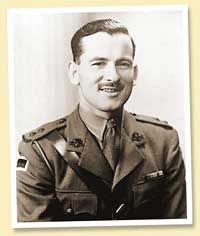
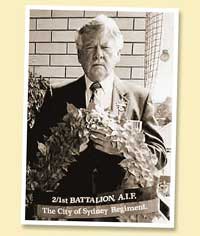
"They had carried their gear up the mountain on a donkey," recalled Terry, a lieutenant with the 2/1st Battalion. "Only padres could work like that. We, having marched about 55km in a little more than 15 hours, were delighted to see two Australian padres working so hard to assist us and certainly very delighted to drink warming fluid but the padres would not answer queries regarding the whisky.
"As we moved up lower Mount Olympus to Velvendos, soldiers thought about or spoke about two padres from different churches working so hard to help them. The padres had shown us that religious differences could be thrown away."
On the march south each man carried 100 rounds of ammunition, five days' rations, his greatcoat, blanket, groundsheet pack and haversack. Much of the route was covered in snow and ankle-deep mud and the cold was intense, so the hot drinks and whisky were extremely welcome.
Terry had joined the militia in 1936 before enlisting and being posted to the 2/1 Battalion. He was sent to the Middle East in 1940 and found himself in the thick of the desert campaign. He served in Bardia "blowing the wire" around the Italian defences and was blown several feet in the air for his troubles.
Being blown up became something of a habit for Terry - later, he found himself flying through the air again when a German bomb landed on his slit trench in Crete in May 1941.
He had been evacuated from Greece along with more than 50,000 Allied troops when ships of the Mediterranean Fleet including the Royal Navy, the Royal Australian Navy and many merchant ships, performed wonders against overwhelming odds to pick them up from the beaches of Greece and take many of them to Crete.
Having survived all these experiences, a German sniper finally put Terry out of action.
"The German snipers targeted officers," Terry said. "The Germans would raise their arms often with a white singlet as if surrendering and when our officer stood up to wave them in, the sniper shot him," he said. "That's what happened to me. But in my case I stood up and the sniper missed my head but caught me down near the hip. Of course my men opened fire and dealt with them. But that's how the Germans operated."
Terry was transferred to the 2/7th Field Ambulance station where casualties were so heavy many lay on the ground with no stretchers available. When the Germans overran the station, their doctors worked alongside Australians, treating both Allied and German wounded.
Soon after being taken prisoner, the Germans called for people who had been born in Ireland to come forward. After checking with his commanding officer, Terry spoke up only to find that the Germans were trying to form an Irish unit to fight against the Allies. When Terry refused to betray his country, he was singled out later for special treatment and spent the next nine months in handcuffs.
After that, Terry was sent to the POW camp at Rotenburg. There he met a British Army Padre, Michael Charlton who had been born in County Cork, Ireland.
"Michael, like the others spoke to this newcomer every day [seeking information about friends in the camp I had just left or war news they had not yet heard] and on the second Monday he said to me: 'Terry, you have been here for two Sundays and have not come to mass - why?' I remember my reply: 'Padre, I'm not coming to mass - I'm an Irish Presbyterian'.
"Michael, with a slight twinkle in his eyes, clasping his hands together, looked up to the sky and said 'Jesus, Mary and Holy Saint Joseph. It's an asp I've been clutching to my bosom'. Thus a great friendship was born."
In January 1945, the prisoners were marched out, first south and then west towards the Russians. "We really didn't want to go in that direction," Terry said.
He spotted an opportunity to escape by diving into a creek and managed to make his way to the American lines. The 3rd American Armoured Division made him divisional interpreter despite his protests that his German wasn't good enough, a position he held till the end of the war and his return to Australia.