 |
|
|
|
|
|
|
|
|
|
|
|
|
|
|
|
|
|
|
|
|
|
Alchemy: The embarassing forefather of chemistry? |
|
|
|
Alchemy is a broad term that describes an ancient pre-science that has been practiced by just about every culture since the ancient Egyptians. Alchemy served as a way to answer many questions that people had about their world. How do substances one and two interact? Why do they react in the way they do? What are these things, and where do they come from? Can they be changed? and more importantly, Can they be controlled? For the most part, modern-day chemistry concerns itself with these and other questions. Why is it then, that many chemists today scoff at alchemists? |
|
|
|
One reason that alchemy isn't taken seriously today is the stereotypical alchemist's dream: The Philosopher/Sorceror's Stone. This neat little concept would change any substance to gold, create immortality/perfect health or the user, and allow him to essentialy be a god. (Pshychologists like Jung argue that the search for this stone is actually a metaphor for man's chronic struggle to be like God.) Such a thing, obviously, does not exist. The fact that so many alchemists wasted their lives on such an impossibility does little to make them credible in today's world, while scientists today search for answers to the same problems the Philosopher's Stone was meant to solve. (Here's a fun fact: Scientists have actually changed lead into gold! By bombarding gold with accelerated particles changes it into gold! The process is so expensive, the gold output is so small, and the atoms are so unstable that it isn't widely practiced....) |
|
|
|
 |
|
|
Alchemists also treated their work as sacred and frowned upon sharing their findings with others If Bob the European alchemist was working ferociously in his lab and made a momentous discovery, like how extothermic and endothermic reactions work, he would confide only in his journal (even then the language would be constructed in a way that is impossible for anyone but him or an alchemist that he worked with.) Now if Al-jabob's experiment yielded resutls that needed the knowledge of Bob's work to understand them, his results are useless. And then, he in turn might repeat Bob's mistake, and keep his results secret. Both men might also have fallen prey to what many people from antiquity until the Renaissance have done: Answer the question with God. |
|
|
|
|
|
|
LAB SAFETY:
Because of this lame concept, you are forced to endure the dorky and severely uncomfortable eye goggles. You must survive the fate of the "fashion nightmare" that is Mr. Perrin's graffitied aprons. Now wrap your mind around this: Alchemists didn't have to contend with any of that jazz. There was no helpful warning label on his container of mercury that says one might be better off avoiding inhalation. Chemicals could be mixed to the alchemists haphazard glee. The danger in a midevil alchemy lab is equable to the danger faced in your friendly neighborhood meth lab.Midevil alchemists were convinced that mercury was a vital key in their quest to turn base metals into gold, and they used it often. -_-* Many alchemists actually died at their own inept hands, not tied to the stake. |
|
|
|
Now if alchemists are seen as bumbling idiots, how did "the art" as they called it last so long? (Yes there are STILL alchemists in the world today!) Ancient alchemists actually stumbled on some pretty neat stuff during their times. Alchemy helped ancient Egyptians concoct cosmetics, mortar, paints, and the chemicals they used to embalm one another. Through the practice of alchemy, the Greeks came upon the concept that objects in our everyday world were composed of different elementary components. (They used the ideas of fire, earth, air, and water, while today's periodic table is a bit larger...) And while they didn't have the standards we do today for accuracy, precision, and safety- alchemist basically did what scientists today do: they ask questions, pose answers, and test them. |
|
|
|
 |
|
|
|
|
|
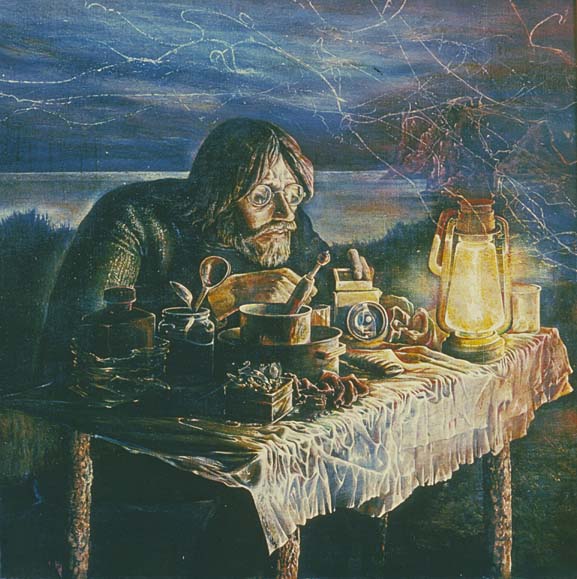
"Let's see what happens if I mix this white powder in this funny-smelling liquid..." |
|
|
|
|
| Alchemy links: |
|