
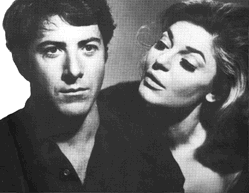
In the 1967 Academy Award winning film The Graduate,
a young Dustin Hoffman costars with Anne Bancroft.
Their style is similar; both act with only subtle facial expression, and
rely on the uncanny ability to convey an emotive type of energy and intensity
that expresses powerfully. Hoffman was fortunate to be working so early in
his career with the magnificent Bancroft, who had earlier won an Academy Award
for Miracle Worker.
Set in the 60�s, The Graduate is an antiestablishment film,
which evolves into a love story. Benjamin (Hoffman), a na�ve young graduate,
is seduced into a heartless sexual affair with the bitter and controlling
wife, Mrs. Robinson (Bancroft) of his father�s partner. As Benjamin struggles
with the question of graduate school and joining the bourgeois establishment,
Mrs. Robinson�s daughter shows up; an island in a sea of emptiness.
The film uses sex as a metaphor for the struggle between old and new of
that decade. Benjamin tries the best of the establishment (Bancroft) and
then engages on the journey for the new (Ross). His pathos is particularly
portrayed in a birthday party scene where his father (William Daniels)
has given him a scuba suit. Benjamin walks out onto the patio, encased in
rubber, completely separated from the culture of his parents and leaving it
by sitting at the bottom of the pool, alone.
Look for a walk on by a boyish Richard Dreyfuss. The Academy Award was
for best film. With a score from the best of Simon and Garfunkel,
written specifically for the film, The Graduate is one of the best
pieces of work epitomizing the 60�s.
Recipe for The Graduate (an alcoholic drink)
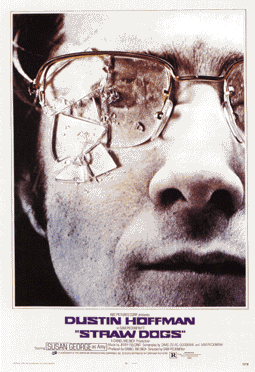
This well cast film teams Dustin Hoffman with Susan George.
They compliment each on the screen. David Sumner (Hoffman), a nonviolent
mathematician, has gone to a remote Irish village with his nymphet wife, Amy
(George), to write a book. She is annoyed with his detachment and concentration
in writing and precipitates a crisis by flirting with local hoodlums, exposing
herself to them.
The locals hang a cat, warning that they were willing to violate the couple.
The wife is upset with David, who will not confront the people who did this.
Unaware of the significance of the pet�s death, David is lured away on a snipe
hunt and his wife has intercourse with two of the hoodlums in a quasi-rape.
Finally, matters escalate until the hoodlums attack the house. Unaccustomed to
operating in a jungle-like environment, with no choice, David makes the
transition, though approaching defense as a mathematical problem. The film
contrasts primitive, uneducated, poor men who want the bratty seductress who
has taunted them against a physically unassertive, well to do intellectual
who discovers a missing part in himself.
After the violence, David is exhausted and on the floor. The first thing he
does when he regains his feet is to right an overturned chair, symbolizing a
man of order and a man of numbers who has encountered new experiences and is
now faced with the necessity of returning to his well ordered life with a new
element to deal with.
Sam Peckinpah, the director, was criticized for the violence in the
film; what should be any different about this one since offbeat violence is
a Peckinpah trademark? Both Hoffman and George are very strong actors, though
George does not possess the screen as, say, Bancroft does. Instead George is
known for her strong characterizations. Hoffman keeps his character very clean
and contained up until the time he is forced to defend himself. Then he shows
the character as he holds himself from falling apart under the strain, adding
an element of severe intensity. The 1971 film was nominated for an Academy Award.
Recipe for Amy's Celtic Vegetable Sausage on Watercress
Here is a role an actor can sink his teeth into. Hoffman (Willy Lohman) paces
himself beautifully through the role which requires a good deal of rich,
emotional activity with frequent shifting of states. Hoffman said the film
was the �greatest experience of my life as an actor.� The role is a classic
of American theater, a difficult part to carry which separates the men from
the boys, the great actors from just actors: Hoffman makes the part come alive
as only he can.
The story is about an aging salesman on his last leg who laments lost
opportunities. He feels like a failure, having never risen above being a
salesman Because he is a salesman, he oversells himself on dreams of achieving
that which in reality he cannot obtain. He transfers these hopes and dreams
onto his children, who, though they are younger, are not in a very advantageous
position either.
He regales them with pep talks and wild anticipations. He is fearful his
failure will infect his children and unconsciously fears his sons will not do
better than he. The sons see him as not only just a salesman but with
weaknesses which to them are beyond redemption. The only glory left to him,
the only degree of success he can obtain as he hits the wall of old age and
obsolescence, is the possibility that his death and insurance policy would
bring new finances into the home and renewed praises at the funeral of his
brilliant past successes.
John Malkovich, one of the sons, is well worth watching as he
holds his presence and has excellent timing in large scale shots void of
close ups; you can even forgive him for slipping in and out of the
character's accent.
Kate Reid, who plays Mrs. Lohman, is a fine actress
but seems to be waiting to speak her lines and not in response to those of
the other actors, throwing her timing off slightly. Her strength is in the
monologue where she can stand by herself. This 1985 rendition of Arthur Miller�s
Pulitzer Prize winning play is the best translation to film so far.
Recipe for Willy's Apple Flapjacks
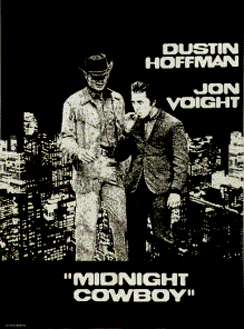
This film, set in the 1960s, was shocking for its time. It deals with
homosexual prostitution. Hoffman plays a lowlife street con man, Ratzo Rizzo,
who takes advantage of a na�ve newcomer, Joe Buck (John Voight),
to New York. Joe plans to sell his body to women but turns out to be too
gauche for wealthy women. Initially, he has problems collecting the fees,
even on one occasion paying her for his services. Joe turns out, though, to
be just right for men seeking a young, good looking cowboy type.
The difficulties Joe and Ratzo face in a desperate environment seal a
friendship between this unlikely two. When Ratzo becomes ill, Joe takes care
of him with the money he gets from selling his body, and makes possible the
fulfillment of Ratzo�s dream of escaping New York for Florida. Only the strong
survive the vicious streets of the New York underworld.
The film contrasts stark sexuality (until it was downgraded to an �R� rating,
it had been the most awarded �X� film) with Christianity; shots of crosses and
other Christian regalia surface as Joe plies his trade. Hoffman gracefully
slips in this character as a slimy, pathetic two bit drug addict; he received
his second Oscar nomination for best actor for this role. The 1969 film itself
was recognized with three Academy Awards (Best Picture, Best Director, and Best
Adapted Screenplay.)
Recipe for Ratzo's Garlic Soup
 Home
Home
 Filmography
Biography
Learn More / Talk to Others
 Get your own Free Home Page