






The film Text copyright (c) Filmverdict 2006-present. Any film titles and artwork used are copyright of their respective owners.
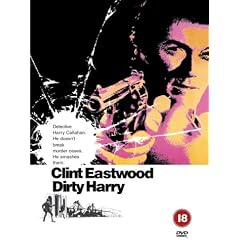
"When a naked man is chasing a woman through an alley with a butcher's knife and a hard-on, I figure he isn't out collecting for the Red Cross!" This and other quotes such as the celebrated "Do I feel lucky?" monologue can only be attributed to one of the silver screen's legendary figures: Clint Eastwood's Harry Callahan. The San Francisco streetwise Inspector embodies rough machismo throughout this classic crime thriller, loosely based on the Zodiac killing sprees of the time, and what director Don Siegel consequently creates is one of the two, with The French Connection (1971), decisive vigilante police films of the 1970s, and beyond. With his renegade and trigger-happy unorthodox methods of policing shining constantly, Eastwood illustrates how a correct dose of masculine ruggedness, when conveyed correctly, can be very appealing, even to the heterosexual male. Remember, like James Bond, multiple generations still want to possess the overt coolness of Clint. Furthermore, the Man with No Name turned Oscar-winning director also allows the fierce cop to have healthy blemishes of imperfection dotted in between the wielding of his .44 Magnum – a couple of lucky escapes thanks to his partner Chico Gonzalez (Reni Santoni) show the audience that Dirty Harry isn't an indestructible superhero.
The City by the Bay looks stunning and this beautiful choice of location is one of the reasons why Clint decided to accept the film after numerous actors (Frank Sinatra, Paul Newman and John Wayne) and cities (Seattle and New York) were attached to the project before his involvement. Along with his Western persona, Harry is undeniably one of the Californian's most famous roles, epitomizing the anti-hero figure he almost independently created. Scorpio, the villainous cerebral assassin played by an outstanding Andy Robinson is almost overshadowed by Clint's aura but, if anything, his psychotic serial killer performance is the glue which keeps the genius of Siegel and Eastwood on track. Siegel has stated on several occasions that he cast the New Yorker because he had the "face of a choir boy" and this certainly works in the antagonist's favour. Scorpio becomes more sadistic to the audience as he switches from calm and analytical to disturbed and illogical in a heartbeat in several scenes. The callous inclination to taunt his pursuers, exercise distressing humour and transmit acts of brute savagery is amazingly engrossing, especially considering how Clint's star persona responds to this sort of adversary.
With Siegel using his knowledge of the 14th largest city in America to create a great actionable tale of justice overcoming evil, an outstanding soundtrack to encapsulate the mood of time, and two wonderful performances, it's not surprising that this exemplary film spawned several gradually poorer quality sequels.
The extras
Zilch.
The summary
A stunning look complimented by oft-quoted one-liners and absorbing performances, Dirty Harry is a classic surpassing the genre boundaries of the simple crime thriller and resulting in filmic gold.