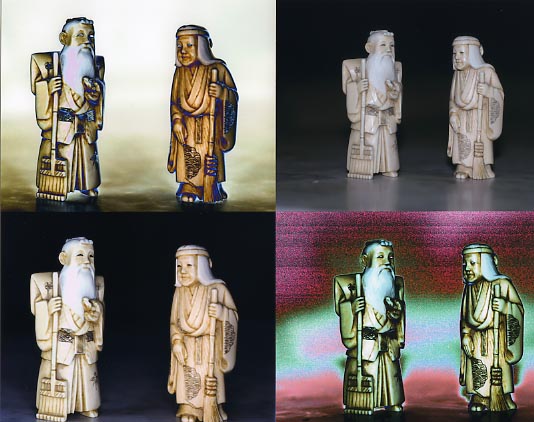
DIFFERENCES BETWEEN 'FILM' AND 'DIGITAL' PHOTOGRAPHY
Most people are deceived by the term "Digital", and assume that Digital Photography is superior to Film Photography in the same way that Digital Sound / Video is most definitely superior to Analogue Sound / Video. However, these are not comparable. Digital Sound / Video is a computerized electronic recording method which is of higher quality than the Analogue electronic recording method. Digital Photography is simply a computerized electronic Video Recording that is a STILL Picture rather than a Moving Picture. All electronic recordings are nothing more than an indirect analogous electric record of the original Light or Sound which has been artificially converted into Electricity. Film Photography, on the other hand, is NOT Analogue, but is a direct real Optical (Light) Record formed by the original Rays of Light. Film is an entirely unique recording medium that captures the very Light Rays which your Eyes can capture for only a brief 1/10 of a Second. In many ways Film is miraculous because it captures the original colour proportions of Light from the original scene, and then using real Light it prints the original colour proportions onto Photographic Paper. Digital Cameras and Photography are promoted by manufacturers as if superior to Film Photography, but this is physically impossible since Digital Pixel Sensors are much larger than Light Rays. Pixel Sensors are also in the shape of a square whereas Light Rays are round, and these factors distort the original Light. Not only is it impossible for the Digital process to equal Optical Film, but Digital Cameras are also monumentally more expensive than Film Cameras. While manufacturers may not actually state that Digital is superior to Film, they do leave that impression with naive consumers. The following are some important facts about the differences between Digital Photography compared to Film Photography.
RESOLUTION It must first be noted that the
size of Light Waves -- which varies based upon the colour -- is the resolution
limit of Photography as well as Vision. The numerous colours of Light that
you see do not come from "materials". All colours come from White
Light which is comprised of Red, Orange, Yellow, Green, Blue and Violet
Light in 100% proportions. "Materials" then absorb part of those colours,
and reflect the rest to produce the actual colours that you see. Human
Eyes only see Red, Green and Blue Light (the Primary Colours) which in various
proportions can produce every possible colour (including orange, yellow and
violet). Just like your Eyes, Film captures the original proportions of
Red, Green and Blue Light, but Digital Cameras must artificially convert that
Light into Electricity. Each Colour of Light Wave has three Dimensions:
Length (the Colour: Red, Green or Blue), Width (equal to Length) and Intensity
(the Shades of the Colour). Film captures all three Dimensions, but
Digital cannot capture Width, it can only record one of the
three Colours, and it can only record about 5% of the
Intensity range.
Starting with Red
Light (.65 to .70 microns) which can potentially produce up to a maximum
2,772,953 Light Waves in a Square Millimetre, then gradually increasing through
Green (.49 to .58 microns) which can produce up to 4,879,520 Light Waves per
Square Millimetre, and Blue (.42 to .49 microns) which can produce as many as
6,641,569 Light Waves in a Square Millimetre. These three Primary Colour
Light Waves interpose each other to form one Light Ray. The actual number
of Light Rays in a two dimensional Square Millimetre space depends entirely upon
the brilliance and amount of the Light Rays present in the scene, the distance
of the objects from the Camera Lens, the size of the Lens, and Diffraction
caused by too small an Aperture in the Camera (known as the Airy
Pattern).
CAMERA The top quality Professional Digital
Cameras currently have a Resolution of 12 to 60 Million
(Mega) Pixels of an artificial electronic image, and lower quality Consumer
Cameras have a Resolution of 2 to 8 Million Pixels with some going up to
12 MegaPixels. However, these Pixel Numbers are not an accurate
representation of the actual "Optical Resolution" of the Picture.
The role of the Camera's individual Pixel Sensors is to artificially convert the
original Light Rays into Electricity. Based upon that electrical Voltage,
the Camera's Computer then arbitrarily assigns a pre-determined
Colour to that Pixel. However, as noted these Pixel Sensors
are square and are monumentally larger than a
Light Ray, and so the Camera therefore "combines" or "mixes
together" hundreds of Light Rays for each Pixel of the Picture into
one BIG SQUARE of
ONE COLOUR. This saturates each Pixel
with that one Colour to make it artificially look good, but this is deceptive
because it distorts the Optical Resolution of the image. / The top
60 MP Professional Camera has a 6 micron Pixel CCD
(53.9x40.4). A 6 micron Pixel CCD Array (Charge-Coupled
Device containing all the Pixel Sensors) has 27,774 Pixel Sensors per Square
Millimetre -- which is only 0.01% as resolute as the maximum
Red Light potential, 0.006% as resolute as the
maximum Green Light potential, and only 0.004% as
resolute as the maximum Blue Light. /
The 39 MP Professional Camera has a 6.8 micron Pixel CCD
(49.1x36.8mm). A 6.8 micron Pixel CCD has 21,626 Pixel
Sensors per Square Millimetre -- which is only 0.008% as
resolute as the maximum Red Light potential,
0.004% as resolute as the maximum Green
Light potential, and only 0.003% as resolute as
maximum Blue Light. / With a 3:2
(Width:Height) Ratio and a 6.8 micron Pixel, the 22 MP Camera CCD is
39x26mm; the 16 MP CCD is 33.3x22.2mm; the 12 MP CCD is
28.8x19.2mm; the 8 MP CCD is 23.6x15.7mm; the 6 MP CCD is
20.4x13.6mm; and the 4 MP CCD is 16.7x11.1mm. Even though the
22 MP Camera's CCD is larger than the 135/35mm Film Frame (36x24mm), it still
has less resolution potential than 135 Film because its Pixels are linear and
are significantly larger than Light Rays. The 16 MP and all remaining
lower resolution Digital Camera CCDs are smaller than the 135 Film Frame
which means that they are exposed to less Light than a
135 Frame. The 4, 6, 8, 12 & 16 MegaPixel Cameras require a Lens
Diameter (with the Zoom OUT) of 20mm, 24mm, 28mm, 34mm & 40mm respectively
if the CCD is to receive maximum Light. (This will be
explained further in the chapter on Lens Size.) Some Photographers have
claimed that they get a higher resolution picture out of 16 MP and even smaller
Digital Cameras than they get from 135/35mm Film, but this is completely
impossible since the CCD is smaller than the 135 Frame. There are only
seven possible explanations for how a 16 MP Digital Picture could look better
than a 135 Film Picture: 1) too small a Lens was used in the Film Camera,
or the Zoom was used (this will be explained later); 2) there was insufficient
Light in the Scene, or the Camera Aperture was too small resulting in
Diffraction; 3) a High ISO Speed of Film was used; 4) the Film was not
professionally developed (many Photographers do not possess the necessary skills
for this task); 5) a Tripod was not used to keep the Camera steady; 6) the
Enlarger Lens was not accurately focused (N. B. "auto focus" sensors cannot be
relied on to be 100% accurate); 7) the Photographer is being deceived by the
artificial computer editing of the Digital photographic process. A printed
Digital Picture is "Computer-generated Artwork" -- not a "real Optical (Light)
Photograph". The Digital Picture Software 'papers-over' the coarse details
between Pixels, and it 'smudges-over' the finite details that the Pixel
Sensors cannot detect. By printing a solid
square for each Pixel, a Digital Picture appears to be
rich in colour and to look good, but this appearance
is a completely artificial representation of the original Light. Anyone
who prefers their Pictures to be artificially enhanced Computer Artwork will
prefer Digital Photography, but anyone who desires real Optical Photographs made
from real Light can only obtain this from Film. A Film Photo
can always be scanned into a Computer to produce Computer
Art.
Film (in any
Camera) captures the original Primary Colour Light Waves according to their
original proportions. The ISO Speed of the Film determines the sharpness
and clarity of the image. The Film Emulsion contains a monumental number
of Silver Halide Molecules catalyzed by the original Rays of Light Photons, and
these Halides capture the original Primary Colour Waves in their original
proportions. After developing, the Dye Molecules act as minutely tiny
filters to remove the excess colours from White Light which reproduces the
original colours from the image. The Molecules of Dye in the developed
Film Emulsion are considerably smaller than the diameter width of the Light
Waves. [They are so tiny that in a Square Millimetre it would be possible
to fit 10.009144643 Billion Molecules / mm
ISO SPEED In addition to the importance of
Film Speed for the sharpness and clarity of the Resolution of an image, it is
very important to note that the colour potential of Film (as
well as Digital) corresponds to the ISO Speed. The
'intensity' of the colours is related to the amount of Halides
/ Dyes in the Film Emulsion as based upon the Film's ISO Speed. Films with
Speeds of 100 ISO and LOWER will have a HIGHER Colour
quality than Films with Higher ISO Speeds. Higher ISO Speeds use
less Light to expose the Halides which will provide fewer developed Dyes
leaving empty space within Dye Clouds, and this will contribute to graininess on
large Photographs. Higher ISO Speeds are only a concern if you wish to
produce large Photographs from the Picture. For regular snapshots --
especially taken with a Fixed-Focus (small Lens) Camera -- 200 & 400 ISO
Film will serve very well to provide quality photos. [If you wish to
produce a large Photograph from a Picture, it is important to note that blurring
can be caused by even microscopic movement of the Camera during
Exposure if a Tripod is not used.] / For Digital Cameras, less Light
resulting from Higher ISO Speeds means lower Voltage will be produced by the
Pixel Sensors, and this thus diminishes the colour quality and accuracy that the
Camera can provide.
LENS SIZE It is very important to
note that the Resolution potential of Film (as well as Digital) also corresponds
to the Camera's Lens Size. In order for there to be maximum
Light to provide full Resolution it is necessary that the
Surface Area of the Lens, exposing the Film Frame (or CCD),
equal or exceed the Surface Area of the Frame (i.e. Arc
Diameter of Lens = Hypotenuse of Frame). With the Zoom OUT, a Lens with a
minimum Diameter of 43mm will provide maximum Light for 135/35mm
Film, and a Lens with a minimum Diameter of 84mm & 92mm is
required to provide maximum Light for 120 Film (60mm & 70mm width
respectively). However, as the Lens Zooms IN, the Surface Area
of the Lens exposing the Film decreases, and this decreases the amount of
Light. This will result in empty space between Dye
Clouds if the portion of the Lens, left over after that portion
lost to the Zoom, isn't large enough to
A quick couple notes regarding Film and Paper Developing: I want to
caution that when developing Film and Photographic Paper, if you don't use
distilled water, then you should use boiled
water (cooled down of course). Regular tap water contains chlorine and
fluoride as well as minerals which would have negative effects, but heating
it to boiling temperature will cause the chlorine and fluoride to evaporate
away. Bottled distilled water contains ozone, and so you should bring it
to near boiling which will evaporate the ozone away.
When developing the exposed Photographic
Paper, I suggest using a thin sheet of flexible Plastic to drag
through the Developer Solution to keep it properly mixed. Flexible
soft Plastic wouldn't pose any risk of scratching the Photographic
Paper, and it would provide better mixing of the Solution than rocking the
tray. It should also be easier to do in the dark!
PRINTED PICTURE To produce a printed Digital Picture is considerably more complicated than a Film Photograph. A Digital Picture Print cannot have a Resolution greater than the DPI (Dots Per Inch) Resolution of the PRINTER producing the Picture. It doesn't matter how high the Resolution of the actual Picture File. High quality Printers do have Resolutions that are much higher than the Resolution of the Digital Picture File, but much lower than the Resolution of Light! The DPI Resolution Numbers for Printers can be quite deceiving since the "Dots" are actually "Squares" or "Rectangles" -- not circles. If the Width x Height DPI Numbers are the same, then the Dots are Square, but if they're not the same then the Dots are Rectangles. If they're Rectangles, then it almost certainly takes four of them to produce a Square, and it is a Square which is required to print a Digital Picture. A 1200 x 4800 DPI Printer in reality has a Resolution of 1200 x 1200 Square Dots, and a 9600 x 2400 DPI Printer has a Resolution of 2400 x 2400 Square Dots. A 1200 DPI Printer is much higher than the Resolution of a Digital Picture File. However, the Printer's higher resolution does not increase the Resolution of the Picture File. The Printer will just print many identical-colour Dots for each Pixel of the Picture. There is also a very serious problem with printing Digital Pictures that you don't experience with a Film Optical Photograph. If the Number of Pixels in the Width and Height of the Digital Picture File cannot be divided into the Printer's DPI Number with a whole number (1,2,3,4,etc.), then the Picture proportions will be distorted when printed! This distortion is in addition to the distortion of the original Light Rays caused by the Camera's Pixel Sensors. With a 1200 DPI Printer printing a 5x7 Inch Picture Print, a 4 MP Picture File provides only 338x338 DPI Pixels with the Printer printing 12.6 identical-colour Dots for every Pixel, and the Width & Height proportions (between Picture File and Printer) are 3.4 & 3.7; an 8 MP Picture File provides 478x478 DPI Pixels with the Printer printing 6.3 identical Dots for every Pixel, and the Width & Height proportions are 2.4 & 2.6; and a 16 MP Picture File provides 676x676 DPI Pixels with the Printer printing 3.2 identical Dots for every Pixel, and the Width & Height proportions are 1.7 & 1.8. These 'non-whole' Width & Height proportions cause a very serious distortion of the original image on the Picture File. Additionally, the fact that the Printer cannot print a 'whole number' of Dots for each Pixel of the Picture further distorts the proportions of the original Picture File! These proportions would suffer the same distortions with a factor of two for a 2400 DPI Printer and a 5x7 Print. You don't suffer these proportion problems with a Film Optical Photograph since any excess in the Width or Height of the Film Frame will just project beyond the edge of the Photographic Paper and not be printed. Additionally, a Digital Picture Printer prints a big solid square Dot which is a completely artificial representation of a round Light Ray which is about 99.99% empty space. / With a Film Optical Photograph the original Resolution is maintained through to the Photographic Paper since the Optical / Chemical process uses real Light. Real Light also maintains a 1 to 1 Ratio between the image on the Film and the printed image on the Photograph as long as there are no defects with the Enlarger Lens. To produce a printed Photograph the Film simply filters out the excess Red, Green and Blue Light from White Light which reproduces the original proportions of Light from the original scene. Each colour point on an Optical Photograph is the same size as the Red, Green and Blue Light Rays which cause them to form, and this is a considerably higher Resolution than the number of Dots Per Inch a Computer Printer can produce. The Enlarger Lens will array the Light together like a Honeycomb, and this can produce up to 45781 Red Light Rays per Inch, 60730 Green Rays per Inch, and 70852 Blue Rays per Inch. The random size of the original Light on the Film is maintained. [N. B. to Professionals. In addition to inadequate Light and ISO Speed contributing to graininess on the Film, in order to limit graininess when producing very large Photographs it is fundamental to have bright enough Light in the Enlarger for the given size of Photograph. The practise of exposing the Photographic Paper for a longer time with inadequate Light is not as good as having a shorter exposure and brighter Light. Dim Light is simply less Light -- meaning that not every spot on the Paper will be exposed by its own Light Ray, and this cannot provide the higher picture quality which bright enough Light can provide. Additionally, with a longer exposure, the reflection of Light Rays off of the Photographic Paper can laterally affect picture clarity. The photographic size limits of an Enlarger (relative to its Light source) should be specified by the manufacturer. / A further factor regarding clarity is if the Enlarger Light uses Alternating Current Electricity which cycles on and off 50-60 times per second. Direct Current which remains on would definitely produce better quality Light. / Due to some problems with excess heat produced by Incandescent Light, it should also be noted that there are 'Cold Light' Enlargers which use Fluorescent Light which is about 85% cooler than Incandescent. / A point to note regarding 'Newton Rings'; these would likely indicate that the Enlarger's Light is too bright relative to how close the Lens is to the Photographic Paper. / When cleaning a Lens, it's best to use Water for the final wash, and then wipe it dry with soft cotton cloth. A Lens Cleaner solution -- even Isopropyl Alcohol -- will leave behind residue if not washed away with Water.]
THIRD DIMENSION OF DEPTH One final factor to mention regarding Resolution is that a Photograph is not entirely Two-Dimensional. The higher the Resolution of the Picture, the greater the ability to grasp the Third Dimension of Depth. The high resolution of Film, combined with its ability to randomly and proportionately record the "size" of Light Rays, better maintains the Depth of the Picture.
COLOUR Film captures the original Light Wave Photons which produce the natural living Colours present in real Light. If the Dye Cloud in each Emulsion Layer were only comprised of 2000 Dye Molecules, that would amount to 2000 Shades for each of the three Primary Colours for a total of 8 Billion Colours
. 3000 Dye Molecules would provide 27 Billion Colours! Different Dye Molecules absorb varying amounts of Light which is what provides the varying Hues distinct to different Film Brands. / A Digital Camera can only capture a pre-determined number of artificially assigned Colours. With a Digital Camera in High Colour (24-Bit) Mode, the Computer can only record 256 pre-determined Shades for each Primary Colour amounting to only 16.77 Million Colours -- Medium and Low Modes are much less. More expensive professional Cameras can provide higher colour storage going up to 48-Bits (65536 Shades). However, the actual Picture taken by the Camera only records ONE Primary Colour for each Pixel of the Picture. Using a method called the Bayer Pattern which groups together four single-colour Pixel Sensors in a block (Red, Blue and two Green), the Computer then uses complicated mathematical calculations to "guess" what the other two Colours for each Pixel should be! Many would consider this method of colour photography to be horrifying. [There is a new type of Sensor called the 'Foveon' which captures all three Primary Colours for each Pixel, but it is very expensive and has its own sensing problems. It is also still limited to the Computer's 256 Shades per Colour.] Although the Digital Camera's Computer (24-Bit Mode) can register 256 Shades for each Primary Colour (65536 Shades in 48-Bit), it is not known how reliable an electronic Light Sensor is for producing 256 different Voltages (let alone 65536) to reflect such a number of Colours, nor is it known how Light Sensors deteriorate in sensitivity with use. As well, as the Digital Camera's Battery Power Supply drains, the Voltage produced by the Pixel Light Sensors will diminish -- thus producing incorrect colours! Light Sensors also vary in sensitivity with temperature, and so the Voltage it produces for the Computer will vary based upon the Camera's temperature. Furthermore, regardless of the Digital Camera, the printed Digital Picture cannot comprise more colours than the number of colours which the Printer printing the Picture can produce. The ability of the Printer (not the Camera) to produce colours will determine the colour content and accuracy of a Digital Picture. With Film it is a simple fact of physics that every single Colour exists in White Light -- literally billions of colours. An Optical Photographic Print, produced by White Light itself passing through the Film, can likewise reproduce every single Colour onto the Photograph. Electronic Digital Photography cannot even begin to equate to Optical Film Photography in the area of colour.Photographer Neil Mitchell offers the following observations on the matter of Digital Colour Bits: "there is the question of colour resolution. Digital cameras use analogue to digital converters to create the digitized image off the imaging chip. Their colour rendering resolution (ability to differentiate colours and tones of colours) is often quoted as colour bit depth. Most modern digital SLRs for example have a bit depth of 12 bits with some of the latest models claiming 14 bits. If you save your images as jpegs then this will be compressed down to 8 bits. When I scan colour film my scanner can create images with a bit depth of 48 bits giving colour rendering that no digital camera can match. Even 48 bit depth still does not do the original film based image full justice. So film is not limited by bit depth as digital is. Film renders texture far better than monotone digital. But, digital is fast, convenient and easy to use and has its place where absolute image quality is not a requirement or image sizes are small and therefore image quality differences are much less noticeable. For most snappers, sports, news, and action photographers that means just about everything, I believe. Where you do see the difference is in landscape work and fine art print work where the superior sharpness, broad range of colours, and wider dynamic range of film can be used to advantage. Mind you, you have to know what you are doing with film to be able to use it well enough to show its advantages, and most modern digital cameras make their users look good, if you know what I mean."
Many Professional Photographers experience colour problems with Digital Photography. One Photographer John Heafield summarizes the following problems with Digital: "the narrow exposure latitude of digital when compared with color negative film. Also, the related lack of shadow and highlight detail. And the way the highlights get blown out and lose their color, such as the light gray or even cyan highlights on a forehead. Skin tones from most digital cameras appear monochrome, compared with the rich variety of lifelike tones from film. Digital images have a "look" about them that is easily recognized, and I believe it is something we will never prefer."
Some
Professional Photographers prefer to use colour reversal Positive Transparency
Film printed onto ILFOCHROME (Cibachrome) polyester photographic material.
Photography experts agree that Ilfochrome provides the highest quality and
longest-lasting colour photograph which fades more slowly, and it is also more
environmentally friendly. [It is possible to print a Negative onto
Ilfochrome by duplicating it onto another Negative which produces a "Positive"
Negative. Cyan and Magenta Filters would be used to correct colour when
printing the Ilfochrome Photograph, and under- or over-exposure can be corrected
when producing the Positive Negative. It is also possible for an
undeveloped Negative to be reversal processed to produce a Positive
Negative.] / Of all the Transparency Films in existence, KODACHROME
Film provides higher quality colour and a sharper image than any other
Transparency because, unlike other Films, its Emulsion Layers are thinner and do
not contain any unused Dye Couplers in the Emulsion, and its Dyes set directly
beside the Silver Halides thereby preventing lateral dispersion of the Dye
Molecules. The Kodachrome process is the most pristine photographic
process. / The Polaroid photographic process is an instant
equivalent to Ilfochrome. A Polaroid Photograph will have the same Optical
Resolution as Film relative to the size of the Camera
Lens.
A note to Archivists; it is
readily practicable to produce a Black & White Film "Positive" or "Negative"
contact copy, from an original Colour Negative or Transparency Film, but
it would have less Resolution quality than if it had been
originally taken in Black & White. You must use the "contact copy"
method to preserve the original Blue Light Resolution on the Colour Film.
LONG-TERM RETRIEVAL This is the worst
Achilles' Heel for Digital Photography. While Digital Cameras can only
take a Picture of an Electronic Image converted into a
non-real Computer File Record, Film captures the actual
Light Image on a real Optical (Light) Record which
is there to be seen. A Digital Picture is nothing more than a
modern-day Computer Programme File on a modern-day Computer
Hardware Disk, and both that Programme File and Hardware Disk will be
obsolete in ten years hence. Since a Film Picture is a real
Light Record -- and Light will never go out of style, you have the image
forever, and a Film Negative or Transparency can last hundreds of years
with proper care (i.e. being kept frozen in complete darkness and
in an air-tight package). You can't freeze a Digital Picture Disk
to protect it. [More than any other Film, Kodachrome has the
longest-lasting and best dark-storage Dye stability.] Digital Picture
Files cannot be viewed without the present-day computer technology Software and
Hardware required to view them. Unlike a Digital Picture Disk, you can
look at Film and know exactly what Pictures it contains. With Digital, you
also have the concern of having the Picture File accidentally erased. I
have personally suffered a malfunction of the Windows Operating System which
erased my personal files on my Hard Drive. Film Negatives and
Transparencies are quite safe from computer technology
malfunctions.
A quick note regarding protecting unexposed High
Speed Films: Unexposed High Speed Films are of course
susceptible to corruption by atmospheric radiation and electromagnetic radio
frequencies including cellular phones. The metal shell of a refrigerator /
freezer will provide some protection against radiation and frequencies. If
the fridge is in the basement, that would be better. For a low price, you
can have a local Metal Shop make you a Cast Iron Box to store your unexposed
Films. You would want to use 1/8 Inch plate Iron, and it can have a
removable lid like a shoe box. You could use Steel, but that won't be as
good as solid Iron. If stored in such an Iron Box in a fridge, unexposed
High Speed Films should stay fresh a long time.
COMPUTER EDITING At first glance, Digital
Photography would seem to be infinitely easier to do Editing on a Computer since
you need only download the Picture File. However, a Photograph from Film
can be easily scanned into a Computer, and you instantly have a Digital Picture
File for editing. After that, there's no difference between Digital and
Film as regards Computer Editing. In addition to that, with Film
you have the bonus ability to produce a Digital Picture File with a
Resolution much higher than Professional Digital Cameras.
Almost all Computer Scanners can record Film Negatives and Transparencies
directly into the Computer without the need for a printed Photograph. With
a 3200x6400 DPI Scanner, 135 Film can produce a Picture File of 28
MegaPixels, and 120 Film can produce a Picture File of 118
MegaPixels. There is also a further benefit to producing a Digital
Picture File from a scanned Film, instead of a Digital Camera, because the
Scanner can provide higher quality colour than a Digital Camera since a
Computer Scanner is progressive, and can record all three Primary Colours
for each Pixel -- unlike a Digital Camera which only records one
Colour. You can also scan a Film Photograph into your computer at a
super high Resolution to get more finite detail than a Digital Camera provides.
With a 3200x6400 DPI Scanner, a 4x6 Film Photo can produce a
Digital Picture File of 491 Million Pixels, and an 8x10 Film Photo
will produce a Picture File of a monumental 1.6 Billion Pixels.
With Film Photography you can enjoy all of the benefits of Digital
Computer Editing with more accurate colour, and at a Resolution
monumentally higher than Digital Cameras can provide -- without even having
to own a Digital Camera. There's a lot of money to be saved in not having
to purchase a Professional Digital Camera. With Film, you also have the
option of doing Optical Editing which preserves the much higher Optical
Resolution and Colour of the Film, and avoids the distortions caused by the
Digital photographic / editing process.
[N. B. Some Computer Scanners have
had difficulty scanning certain Transparency Films like Kodachrome. With
the Film in a Slide Frame Mount, you should expect problems since it is about
1/16 Inch away from the Scanner's window. Instead of taking the Film out
of the Slide Frame, you of course can scan a Positive Photograph made on
Ilfochrome, and you can also scan a "Negative" Photograph made on regular
photographic paper which the Computer Picture Software can turn into a
"Positive" Picture File. You should be able to fit 20 Slide contact prints
on one 8x10 Inch Photograph.]
LARGE PRINTS It is not fully possible to
appreciate the inferior quality of Digital Photography unless you have two
Pictures of the exact same scene taken with both Film and Digital
Cameras (with a full size Lens and the Zoom OUT). You could then compare
the Digital Print with a good Film Photograph (properly made through the Optical
/ Chemical process -- not printed through a Computer scan). The higher
Optical Resolution and Colour of the Film would be quite evident. With
Negative Film, it is also very much easier to produce a quality
Photograph from an under- or over-exposed image --
not so with Digital. It's necessary for Digital Cameras to be equipped
with a LCD Screen to see right away if the Picture turned out, but with a Film
Camera a LCD Screen is not needed because you're pretty much guaranteed
to get an adequate Picture unless there is so little Light in the scene that
photography itself is impossible. A Digital Camera cannot provide
the certainty of getting a Picture that Negative Film
provides!
On a regular 4x6 Inch Picture
Print, a Digital Picture may look the same as a Film Photo. A Digital
Picture may even look good in 5x7, 8x10 and larger sizes. However, without
a Film Photograph of the same scene for comparison, the deficiencies of Digital
may not be readily seen. For someone who values the quality of their
Pictures, there isn't a lot of sense in buying Digital Cameras which provide an
inferior Picture. The question to be asked is why would anyone wish to
spend the extra expense in order to use an inferior photographic
method? Sadly the answer to this question with far too many Professional
Photographers is an unwillingness to do hard work in a Darkroom. They'd
rather sit back at their computer. A Professional Photographer does have
an ethical obligation to inform their Client about the drawbacks and
inferiorities of Digital Photography, and to not force Digital upon their
Client. Many Professional Photographers see Digital Photography as a way
to save on the expense of Film -- especially 120 Format, but what they are doing
is shortchanging their customers by giving them inferior photography. The
answer to this question is also ignorance with average people who erroneously
believe that Digital is of higher quality than Film. Too many
Photographers don't realize that when you use your Zoom Lens you are diminishing
the Resolution of the Picture, and they have therefore not been enjoying the
full Resolution potential of Film.
The
printed Digital Picture cannot have a Resolution higher
than the DPI (Dots Per Inch) Resolution of the Printer producing the
Picture if the Printer Resolution should be lower. For a 4x6 and 5x7
Inch Picture printed on a 360x360 DPI Printer, a Digital Picture only has a
maximum Resolution of 3.1 Million and 4.5 Million Pixels
respectively. So even if the Picture File is 8 MegaPixels, the
extra 4.9 Million and 3.5 Million Pixels would be LOST in the printing process
-- leaving you with only the 3.1 and 4.5 Milllion Pixel printed Picture.
The Printer can never give you a higher Resolution than that of
the original Picture File, but it can give you less! When
printed on the 8x10 Inch picture format, an 8 MegaPixel Picture only has a
Resolution of 316x316 DPI Pixels -- which is less than the 360 DPI Resolution of
low-end home Printers. Even the 16 MegaPixel Professional Digital Camera,
when printed on the 10x14 Inch picture format, only has a menial Resolution of
338x338 DPI Pixels -- less than a cheap home Printer! Even though the
Printer printing the Picture has a Resolution higher than 316 and 338 DPI, as
noted previously, what the Printer would do to compensate is print more
than one Dot for each Pixel of the original Picture File. This
does not increase the Resolution of the Picture File! As also noted
previously the incompatible Picture and Printer DPI Numbers will
distort the original image on the Picture
File.
An Optical Print
made from Film maintains the original Resolution on the Film.
Furthermore, the individual colour points formed on the Photographic
Paper by the Red, Green & Blue Light Rays will be proportionate to the
"size" of the Light spots (.42 to .7 microns). Unlike real Light,
the "Pixel Dots" printed by a Computer Picture Printer are "one size fits
all". Basic Digital Picture Files are completely and thoroughly inferior
to Film's finite Resolution in the larger picture sizes, and the Professional
Digital Cameras and Printers -- necessary to make a Digital Picture look decent
-- are a very expensive option far beyond thhe budget of most people. [It
should also be noted that ridiculous claims are made that Digital Picture Prints
will last more than a hundred years without the colour fading. This is
ludicrous and impossible since it is a fact of physics that every colour
fades while it is exposed to light. The process of material absorbing
light and reflecting colour intrinsically deteriorates the substance of the
colour material, and nothing can prevent this. With Film Photography, you
can preserve your Negatives and Transparencies, and you don't need to worry
about the Picture Print fading.]
COST The matter of cost depends upon how
many pictures someone takes. Some Professional Photographers take
thousands and tens of thousands of pictures each year -- almost all of which
they discard, and so they save money with Digital Photography. However,
the vast majority of people don't take that many pictures in a year, and they
will not save money with Digital. Not only are Digital Cameras
monumentally more expensive than Film Cameras, but being an optical computer
they also go out-of-date in only a couple of years as computer technology
advances. Like any computer, Digital Cameras will develop problems -- such
as dirt on the CCD Sensor, and the cost of repairing the Camera will be more
than it's worth -- forcing you to buy a new one. Film Photography on the
other hand is essentially perfected, and a Film Camera can last you 10 or 20
years or longer. A lower-end 4-6 MegaPixel Digital Camera costs in the
$200-$300 range, an 8 MP Camera costs many hundreds of dollars and even $1000,
and a 16 MP Camera sells for thousands of dollars. Higher end Cameras can
cost $4000-$5000. The 39 MP Professional Camera went for up
to $10,000 dollars, and the 60 MP Camera is as high as $40,000
dollars. Digital Cameras also have the extra expense of high battery
consumption -- a problem not present with Film Cameras. A fixed-focus 35mm
Film Camera costs about $70, and it will take reliable snapshots with ease.
A Consumer 35mm Film Camera with Zoom Lens sells in the $150-$250 range,
and a Professional 35mm Film Camera with a Telephoto Lens only costs in the
$300-$500 range. The cost savings with Film Cameras are quite
obvious.
There are also cost savings in
permanently storing your Pictures on Film as well as simplicity. It only
costs about $4 to purchase a 24-Picture Roll of 35mm Film which contains about
27 Pictures, and about $5 will buy a 36-Picture Film Roll with about 39
Pictures. For $100 you can buy about twenty-five 24-Picture Rolls of 35mm
Film which is about 675 Film Pictures. The cost on Digital
Picture Disks has come down, but those Disks will be out-of-date in ten
years. With Digital Photography, if you wish to print your Pictures at
home, you also have to buy a Picture Printer, and purchase very expensive Ink
Cartridges for that Printer. If you have any problems with the Ink
streaking on a Print, you have to throw that Print out, and start all over again
costing more money. Instead of buying expensive Printers and Cartridges,
you can save money by saving Picture Files to a Computer CD or Card, and
bringing it to a Photo Shop to print out there. However, if you're going
to waste all that time burning a CD, and then you have to make a trip to the
Photo Shop, you might as well save time by using Film and getting the highest of
quality Pictures.
The conversion from Analogue to Digital over the past 25 years has been called the "Digital Revolution". In the areas of Sound and Video, the conversion to Digital is a definite improvement. However, the unique area of Digital Photography can be justly called a monumental scam which is being perpetrated upon consumers. The zealous promotion of Digital Cameras -- which are being pushed as the best thing since sliced bread, and the expensive cost of Digital Cameras, adds insult to injury given the facts of its inferiority to Film Photography. Film is a low-technology medium which is timeless. Digital Photography on the other hand is a high-technology computer record that will go obsolete every ten years. Film simply records the original Light, but the Digital process must artificially convert that Light into Electricity and then into complicated computer code. It is impossible to improve upon Light by artificially converting it into Electricity. The biggest and worst tragedy for people using Digital Cameras will be the loss of their precious family memories. With Film, you can be confident that your great-grandchildren will be able to reproduce top quality Pictures from your Negatives. You never know who in the future will find one of your Pictures to be very important! I have made beautiful Pictures from Negatives 40 and 45 Years old which look as if they're brand new pictures. It will be a serious problem for people to retrieve a Digital Picture in even 15 Years never mind 30 or 40 Years from now. Anyone who knows these facts would never choose to use Digital Photography for capturing their important family memories. I first realized this problem when my parents celebrated their 40th Wedding Anniversary in 1999, and I had beautiful new wedding photos printed from the Film Negatives. I could look at the Negatives and figure out what they were. Most often you don't realize how important a Picture is until years after you've taken it, and some of the people are deceased. With Film you don't have to worry. You can reproduce a top quality Portrait. With a Digital Picture Disk, good luck! Even if you could retrieve it, how is a low-resolution 4 MP Picture going to look as a large 10x14 Inch Portrait?
The type of person who actually needs a Digital Camera is someone who needs to be able to instantly E-Mail a Picture (such as a newspaper journalist) or someone taking temporary Pictures they don't wish to keep or print out. Anyone taking a high volume of temporary Pictures can save money with Digital in the long run, but only after their savings have recovered the cost of their Digital Camera. With 'one hour' Photo Labs for developing Film, speed is not a problem with Film Photography. The printed Photo from Film can be easily scanned into a computer, and then E-Mailed like a Digital Picture. Many commercial clients of Professional Photographers are more interested in speed than in quality, and are therefore content with the quality that Digital Photography provides for their purposes. That's perfectly fine for them. However, most people buying Digital Cameras are doing so because they erroneously believe it to be superior to Film. People likely take more Pictures with Digital Cameras than they do with Film, but most of those extra Pictures are trivial. A Cellular Phone Camera would suffice. The danger for them is if they take a Picture that will prove important, but was taken with a cheap Digital Camera. It is therefore urgently important that the facts of Film Photography vs. Digital Photography become known. A few camera companies have already stopped manufacturing Film Cameras which is thus forcing people to switch to Digital Cameras against their will. It is imperative that people know the facts before they would make a decision to switch to Digital Photography in ignorance. It is also imperative that they have the ability to purchase a Film Camera. The younger generation must have the full ability to choose Film Photography. The consequences of Digital Photography on Society will be the tragic loss of the photographic record of history, and the effect for individuals will be the loss of their family memories. I have produced this Article to enhance everyone's understanding of the differences between Film and Digital Photography, and I invite you to forward it on to others to disseminate this important information.
Mr. Terry Mester
Welland, Ontario, Canada
E-Mail: [email protected]
www.geocities.com/filmanddigitalinfo
v.
8.20.2009
Wikipedia Links (CLICK to download)
Moire Pattern
Problem
Bayer Filter
Pattern