--------------------------------------
Desperate Race For Vast Riches
Did Lt. Gen. Yamashita bury tons of gold in the Philippines in WWII?
Julian Ryall, Chronicle Foreign Service Sunday, March 4, 2001
--------------------------------------
Digos, Philippines -- Fred Leon comes to life when explaining why he invested his life savings to find treasure buried thousands of miles away in the Philippines archipelago.
"It was a good venture and I believed in my friend," he said. Leon, a 74-year-old retired credit manager who lives off a meager pension in a studio apartment in San Francisco's Tenderloin, gave his best friend $55, 000 to help finance several expeditions to look for gold, precious metals, jewels and art treasures taken from Asian temples, bank vaults and museums.
According to legend, the riches were hidden by Imperial Japanese Army Lt. Gen. Tomoyuki Yamashita at the end of World War II.
Now broke and in ill health, Leon spends his days walking the Tenderloin or receiving treatment at the Veterans Hospital for a bad back and emphysema. The Salvation Army and Meals on Wheels provides him with food. Leon's most valued possession is a treasure map left to him by his late friend, John Thoenges, a civil engineer who made eight trips to the Philippines in the 1980s and 1990s to look for buried treasure. Leon says he is willing to give the map to President Gloria Macapagal Arroyo for a "finder's fee."
"John proved that it is a valid map," said Leon, referring to Thoenges' claim that he found a vault filled with gold. "The Philippines could use the money. There's a lot of poverty there."
In a nation where the average annual income is $1,000, it is hardly surprising that for the past 55 years, hundreds of Filipinos have also been busy looking for the lost treasure. In fact, dozens have died digging up roads, riverbeds and mountainsides in a relentless pursuit of the Yamashita gold. Yamashita, dubbed the "Tiger of Malaya" after capturing Singapore in 1942 from the British, was hanged as a war criminal in 1946 near Manila. But before that, Filipinos say, Japanese Emperor Hirohito ordered him to keep the loot from falling into Allied hands. Prisoners of war were said to have been forced to build a maze of hundreds of elaborate underground tunnels with cement vaults, then they were executed and buried with the treasure. They allegedly dug to depths of up to 200 feet and often booby-trapped the tunnels with trip mines and poisonous sarin gas canisters.
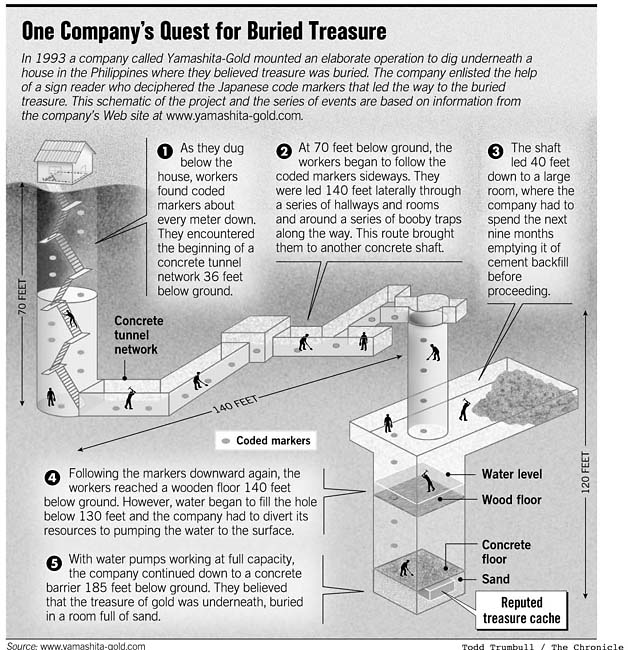
The International Recovery Group (IRG), a treasure salvage company in Singapore, claims its research shows that there are 172 "documented" sites with an estimated 4,000 to 6,000 tons of gold bullion, gemstones and other precious metals worth $100 billion by today's prices. Encouraged by such outlandish claims of wealth and armed with books, articles and Web sites about the Yamashita gold, treasure hunters continue to comb the islands year after year without finding anything more than stray items of gold or jewelry. There is even an Internet address -- www.yamashita-gold.com -- that keeps investors up-to-date on the search being carried out by a privately owned company that has been digging since 1993 with such sophisticated equipment as 50-horsepower water pumps, air compressors and power wrenches.
Many gold seekers are also driven by the stories of Rogelio Roxas and the soldiers of the 16th Infantry Battalion. In 1971, Roxas, a poor locksmith, said he found a tunnel lined with gold bullion that was later taken by then-President Ferdinand Marcos. Roxas's family eventually won a $22 billion judgment against the Marcos estate in a Hawaii court, one of the largest civil jury awards in U.S. history. They may also be encouraged by a lawsuit filed in 1996, in which 96 soldiers sued the Marcos estate in courts in Switzerland and California, claiming that they received no compensation for the 12 years that their battalion was ordered to dig up 60,000 metric tons of gold.
Today's treasure seekers seem to have overlooked the fact that Yamashita was not well liked by Japan's military high command and had been cashiered by Prime Minister Hideki Tojo in 1944. Nor do they consider that in the nine months before he surrendered in September 1945, Yamashita had to relocate his headquarters at least six times because of U.S. airstrikes and naval assaults.
"He was too busy fighting. It is doubtful that he would have time to bury all that gold," said Kwa Chong Guan, former director of Singapore's national museum. But the fortune hunters remain undaunted. Late last year, two men were buried alive when a tunnel collapsed near the Mindanao town of General Santos after they had dug 24 feet. Four others suffocated in Lumban, Laguna, according to the Manila newspaper, Business World. And in 1998, three men were killed in Nueva Ecija in Luzon province when a tunnel they had dug caved in. Like Leon, many treasure hunters have detailed maps, often written in a special code and a 2,000-year-old Japanese script known as Kung. The diagrams were allegedly drawn up in the belief that the treasure would be recovered after Japan reversed its military setbacks.
Leon's map shows 14 burial sites. Thoenges said he got it from a Japanese Shinto priest that he had befriended in Chicago. Before he died in 1998, Thoenges claimed to have found gold bars and silver ingots with a metal detector near the Mindanao city of Davao. Leon says his friend even showed him a photo of a room filled with gold bars that he couldn't touch because of poison gas canisters and a lack of adequate security if he managed to get it out.
In 1987, Ken Clark, a Livermore resident who owns a cement cutting company, accompanied Thoenges to Davao to cut holes in tunnel vaults. But after two weeks of working alongside armed guards and listening to tales of booby- trapped tunnels, Clark returned to the Bay Area.
"I think the map was for real," said Clark, "but I didn't believe that I would be safe."
Under Philippines law, those who find buried treasure must give 75 percent of the value of their findings to the federal government. In turn, the government provides official authorization and armed security during the dig. In rural areas, treasure hunts are typically monitored by police and military commanders. Three miles east of General Santos, a group of fortune hunters has been digging for eight months at an authorized site that is equipped with water pumps and hefty steel and wooden beams lashed together over an open pit. A man in a grubby T-shirt who refused to give his name said that several armed men in three jeeps had visited the camp the night before. The threat of violence didn't seem to faze him at all.
"There is something here worth working for, worth fighting for, worth everything," he said.
Near Digos, a polluted port town, George Braseros, a 51-year-old civil engineer, is so sure that there is gold in the jungles of Mindanao that he has gone on dozens of expeditions for the past 30 years.
"They came to me because I am an engineer," he said, refusing to identify his latest sponsors. As he traveled by jeep along a dirt track heading north, Braseros showed a Chronicle reporter a coconut grove with "signs" carved on rocks and trees that he says indicate buried treasure; surface markers were said to be placed at each treasure site. Braseros' team began digging with shovels and pickaxes before switching to a mechanical backhoe. About 20 feet down, they discovered a layer of bricks laid on top of 15 rough-cut pieces of timber. Six feet below the timber, they found a tunnel. They then proceeded cautiously because the image of three flowers was etched on a nearby tree. To a treasure hunter, flowers indicate a booby-trap. Without warning, water flooded into the shaft, nearly killing three of Braseros' men. The next day, the hole was totally under water.
"If I could find a sponsor, I would start all over again," Braceros said after the incident. Nearby, team member Alfredo Antonio is also contemplating his next treasure quest. Antonio, 28, has been seeking the famed Yamashita gold for the past 10 years. In fact, he has chased down so many leads that his wife recently left him, charging abandonment.
"It is like a battle of wits, trying to decipher the clues and outwit the people who designed the traps," he said.
Another battle of wits is being waged between the government and treasure hunters unwilling to legalize their venture and share any potential findings. They typically dig at night to keep their work secret from local officials. In December, police arrested a former university security guard named Julian C. Bagaforo. He was found with a 9mm pistol keeping watch over a 6-foot- deep hole in the arboretum of the University of the Philippines campus in Quezon City, according to the Philippine Daily Inquirer.
Back in San Francisco, Leon says he has no regrets that he lost his life savings. "I wouldn't change a thing," he said. "I don't blame John. That's just the way things went down."
Fore more info visit:
http://www.yamashita-gold.com