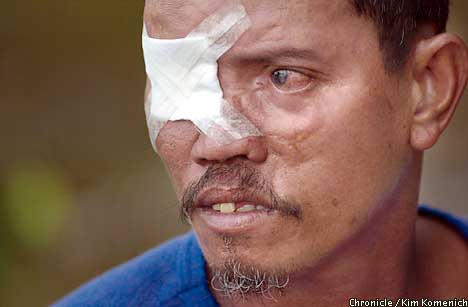
Mario Andillo lost an eye when a shell exploded near the former Subic Naval Base.
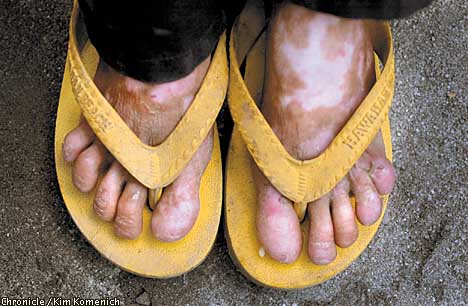
Unexplained skin disorders afflict many living near the former
Clark Air Force Base. The body and feet of Ariel Zamora, 17, are affected.
------------------------------------------------------------------------
DEADLY LEGACY
Dangerous ground
Leftover bombs, chemicals wreak havoc at former U.S. bases in Philippines
Benjamin Pimentel, Chronicle Staff Writer Thursday, July 5, 2001
------------------------------------------------------------------------
Zambales Province, Philippines -- The U.S. military withdrew from two major
bases in the Philippines in the early 1990s, admitting that it was no longer
welcome. The pullout quieted a storm of nationalist protest and appeared to
close a difficult chapter in the two countries' complex, shared history.
But nearly a decade later, the former Subic Bay Naval Station and Clark Air
Base are again the subject of a bitter dispute.
American and Philippine environmentalists say U.S. forces left a trail of hazardous
waste - from chemical-laced water that it is believed to have caused children
to contract crippling diseases to unexploded bombs that have maimed and killed
villagers.
The Pentagon says there is no proof that the U.S. military caused widespread
contamination at Subic and Clark, and it refuses to clean up or even investigate
the sites, saying that's the job of the Philippine government, which inherited
the valuable real estate.
Some Philippine officials denounce the Pentagon's position as arrogant and possibly
illegal.
"Why this is not being addressed is befuddling to me and many Filipinos,"
said Environment Secretary Heherson Alvarez.
The human toll is poignantly obvious in the affected areas.
A dozen residents of the town of Madapdap, within the Clark base's former boundaries,
say the water they drank and used for bathing and cooking reeked of fuel and
made them sick.
As they sat in the cramped front yard of a drab concrete house that serves as
a community center, their children, some as young as 2, gazed blankly at their
parents, unable to walk, talk or sit on their own. Most have cerebral palsy,
while some have unexplained skin rashes on their faces and arms.
"You can see a small rainbow on the surface of the water," said Elvira
Taruc, who gave birth to her son Abraham at Clark.
When her son contracted cerebral palsy, Taruc's heartbreak was overwhelming.
"I still didn't know what the word "toxic" meant, and I really
felt down," she said. "I asked why my child was going through this."
Later, she added, "I realized that there were others like us."
Christina Leano, the Washington, D.C.-based director of the Filipino American
Environmental Coalition, spent months with the Clark refugees in 1999.
She said that as of a year ago, local environmentalists and activists calculated
that more than 100 former refugees, many of them children, had died from such
illnesses as leukemia and cancer.
In the area around Subic Bay, leftover U.S. ordnance continues to take a grim
toll.
Standing in the tropical sun in the village of Nagyantoc, Ryan Reponte pointed
to an overturned boat where he lost his right hand after an artillery shell
he and other fishermen found in the ocean blew up in front of them.
In neighboring Quarry, a short boat ride away, Mario Andillo's right eye is
missing and his face scarred from the explosion of another shell he recovered
after it was left behind by U.S. troops on what was once a firing range.
"There are still shells left out there," he said, pointing to the
field beyond his village. "Sometimes we find them after they get washed
away by strong rain."
Defense Department spokesman Lt. Dave Gai points out that under a "hold
harmless" clause in a 1988 agreement with the Philippines, the U.S. military
did not have to return Subic and Clark in their original state.
"Upon our departure, responsibility reverted to the Philippine government,"
Gai said. "We expect those reaping the benefits of the infrastructure left
by the U.S. to also take the responsibility for any necessary remediation. We
have no authority or legal obligation to conduct any additional restoration."
Old base now a port
Subic, in fact, is now an international free port, home to such companies as
Acer Computers and FedEx. Clark is being turned into an international airport
and is a thriving business complex where companies such as America Online have
operations.
Jorge Emmanuel, an East Bay environmental scientist and member of the Filipino
American Coalition for Environmental Solutions, disputed the U.S. military's
interpretation of the hold harmless provision.
"In no way did the Philippines authorize the United States to pollute its
environment," he said. "There's a lot of evidence that there is contamination
at those sites."
Eugene Carroll, a retired U.S. Navy admiral who commanded aircraft carriers
and battleships that pulled into Subic during the Vietnam War, agrees. He says
U.S. forces routinely repaired and maintained ships and aircraft using toxic
chemicals that were often mishandled.
"The legacy was one of malign neglect in terms of abusing the land and
waters of the Philippines," said Carroll, now vice president of the Center
for Defense Information, a Washington, D.C.-based nonprofit group that deals
with national security issues.
The U.S. military began pulling out of the Philippines in 1991 after the country's
Senate voted against letting the Pentagon continue operating Subic and Clark,
once the largest overseas U.S. military bases.
That same year, the eruption of the Mount Pinatubo volcano forced the Air Force
to abandon Clark. The Navy closed Subic a year later.
"We removed all the hazardous waste that we could within the time allotted
by the Philippine government for us, given the conditions of eruption of Mount
Pinatubo," Gai said. "We cleaned up as much as possible."
But over the years, studies by Philippine and U.S. scientists and agencies have
raised concerns over what was not cleaned up. A 1992 report by the General Accounting
Office said U.S. forces caused significant environmental damage at Subic and
Clark.
"The government was not aware of the damage until we got hold of that study,
" said Philippine Sen. Serge Osmena, a leading advocate of a U.S. cleanup.
But Gai said the deal between the two nations was clear.
"We're not denying that there are environmental issues," he said.
"When (Subic and Clark) were U.S. military facilities, yes, there was some
environmental impact from that. But that impact was accepted and assumed by
the Philippine government."
Environmentalists believe soil and water contamination at Clark caused health
problems and possibly the deaths of dozens of refugees driven from their home
villages by Mount Pinatubo.
The calamity forced more than 30,000 people to seek shelter on the base grounds
shortly after it was abandoned by the Air Force. By then, Clark was technically
under Philippine jurisdiction. The refugees built a community with the help
of the government, which helped provide shallow wells as a source of water.
But environmentalists and Philippine officials later found out that the area
where they built shelters and planted their food turned out to be a former Air
Force motor pool where the Americans used fuels, solvents and other toxic chemicals
to repair and maintain trucks, jeeps and other vehicles.
"For decades they would throw oils and solvents for cleaning vehicles,"
said Emmanuel. "These chemicals would have seeped down to the groundwater."
Contamination fears Dr. Ted Schettler, a director of the Boston-based nonprofit
Science and Technology Health Network, visited the Clark site in 1994. He says
he was concerned that contaminants may have migrated to the water supply of
other communities outside the base.
Some studies done by U.S. and Philippine scientists detected levels of dieldrin
- a pesticide banned in the United States, jet fuels, mercury and arsenic. The
toxins can cause birth defects and other illnesses such as leukemia.
The Philippine government has not conducted an investigation because it lacks
the capability to do the necessary tests.
Emmanuel admits that without a more comprehensive study, it's hard to make a
direct link between the base and the deaths and illnesses. And he says other
factors may play a role, including poverty, pollution, and poor prenatal care,
nutrition and health care.
Although most of the refugees have moved out of Clark into new government resettlement
areas, not everyone could be accommodated. Jennifer and Arnel Agason, and some
others, still live on the base, drawing water from the same tainted wells.
"Even if we want to leave, we have nowhere to go," Jennifer Agason
said, standing next to an artesian well. "So even if they say the water
is bad, we stay."
At Subic, once the home port of the U.S. Seventh Fleet, local residents eked
out a living collecting and selling scrap metal from shells and bombs left over
from firing range exercises by Navy and Marine forces.
But on a recent visit to three villages along Subic Bay, residents who had lost
eyes and limbs, who had their skins scorched, or whose loved ones had been killed
in explosions, spoke of the price of living near a virtual minefield.
The most recent accident occurred in March 2000 at Nagyantoc, code-named White
Beach by the U.S. forces. Reponte and other fishermen were collecting tropical
fish when they found a four-inch capsule. They were trying to figure out what
it was when it exploded.
"When I regained consciousness, my hand was gone," said Reponte, who
also was blinded in his left eye.
Cosme Balasbas, 19, was killed. His brother, Agapito, showed a snapshot of his
dead brother, pointing to the gaping hole caused by the blast.
"There have been many such incidents, and they are just the latest victims,
" Balasbas said.
Fisherman Anding Velonza was 11 when he was severely burned by a piece of ammunition
he found outside Kinabuksan, code-named Red Beach.
Five months later, his brother Dan was killed by a shell he and other boys collected.
Nomer Labrador, 23, lost his arm and was left with only his pinky finger on
his left hand. His brother Nilo, 30, was blinded in the right eye.
Emmanuel said that had the problems reported at Clark and Subic been found in
the United States, "the U.S. government would have already conducted an
assessment to see if the environment has been destroyed and if public health
is threatened."
"There's no question that it needs a rigorous site assessment," Schettler
said. "That would help characterize the location and degree of the contamination.
And then you move on from there."
But the Pentagon refuses to do that, citing the "hold harmless" clause.
Expertise shared
Chris Castro, Philippine desk officer at the State Department, said the United
States intended to share its technical expertise to help the Philippines deal
with its environmental problems in general. But he said the chances of a U.S.-financed
cleanup of Subic and Clark were remote.
"We shouldn't talk about recriminations," he said. "That's not
constructive.
If your idea is that the U.S. government should spend money to clean up the
bases, that's difficult."
Saul Bloom, executive director of Arc Ecology, a San Francisco environmental
group working with the Filipino American coalition, said of Washington's position:
"The thing I find most reprehensible is the total denial and lack of any
kind of moral orientation toward the problem."
In part, that may be because the U.S. military has plenty of headaches at home.
There are 24,000 contaminated sites at about 1,800 military bases in the United
States, Bloom says.
A preliminary assessment at Clark and Subic could cost up to $3 million, and
a comprehensive cleanup up to $2 billion, he adds. The United States is also
under pressure to clean up other former and current bases in such countries
as Panama, Japan and South Korea.
"Their main concern is setting a precedent," said Paul Bloom, a professor
of soil science at the University of Minnesota, who co-wrote one study with
Emmanuel. "They are worried about Okinawa. They've got Panama and other
bases around the world, and it's expensive."
Last year, a Philippine environmental group filed a suit on behalf of more than
100 alleged victims, seeking more than $1 billion from the U.S. and Philippine
governments for the deaths and illnesses at Subic and Clark.
Emmanuel's group, together with other Philippine and American environmental
organizations, is also planning to take the U.S. military to court by filing
an unprecedented lawsuit in U.S. federal court on behalf of the suspected victims
of alleged contamination.
The suit would invoke the Comprehensive Environmental Response, Compensation
and Liability Act - commonly known as the Superfund law - to compel the Pentagon
to determine the damage it caused in the Philippines.
U.S. activist groups and communities often use the law to ask federal agencies
like the Environmental Protection Agency to look into suspected contamination
and begin a cleanup if necessary. This is the first time that the law would
be invoked by non-U.S. citizens on a territory outside the United States.
Some are skeptical. Chris Hellman, an analyst for the Center for Defense Information,
said suing the Pentagon under the Superfund law was "a nice idea, but I
don't think it has a basis in reality as far as the U.S. military goes."
San Francisco attorney Scott Allen is more optimistic. He helped draft the suit
and is a veteran of many legal battles over military bases in the United States,
including current campaigns to clean up Bayview-Hunters Point, Fort Ord and
McClellan Air Base.
Allen argues that because Subic and Clark were once under U.S. jurisdiction,
the military is liable for the contamination it caused, according to Superfund
guidelines - just as it would be held responsible for damage on facilities in
the United States.
"I feel pretty confident that we have a shot here," he said. "People
had their lives ruined, and there is nothing that I can find to indicate that
they have any less right to ask the U.S. military to live up to its legal obligations."
Hoping for cleanup
The government of President Gloria Macapagal Arroyo is asking the United States
to clean up the former bases, hoping to achieve the goal through diplomatic
means, Alvarez says.
Osmena, the former vice chair of the Philippine Senate's environment committee,
said the previous administrations of Fidel Ramos and Joseph Estrada had "soft-pedaled"
the issue for fear of displeasing the United States.
He added: "Traditionally, Philippine government officials are scared of
crossing the path of the U.S. government. They're worried about trade relations.
They're worried about foreign assistance."
Emmanuel said that in the early 1990s, Philippine officials were focused on
converting Subic and Clark into international commercial centers, and "reports
of people dying would surely drive away investors."
Osmena says the attitude toward American responsibility changed in the past
three years amid mounting reports in the Philippine media on the deaths of children
living near Clark.
"We were able to put a human face to the problem," Osmena said. "With
a human face, it becomes more significant in the minds of the people."
At Taruc's house in the Madapdap refugee center, the 36-year-old housewife cradled
Abraham in her arms as she sat inside the gloomy and cramped bathroom. Using
a big plastic cup, she poured water on the naked boy.
Abraham broke into a giggle, jerking his head with glee. "He likes taking
baths," her mother said.
In their living room, Taruc dried the little boy's body with a towel. He peed,
and she calmly used a rag to wipe off the mess. She rubbed the towel on the
boy's head and then kissed him.
"I still hope he would at least be able to sit down or walk," Taruc
said. "I have not lost hope."
E-mail Benjamin Pimentel [email protected].