Filipino
Cuisine Just Waiting To Be Discovered
Sample the fare at Rene-Rose
Laura Reiley, Special to The Chronicle Friday, March 2, 2001
I knew adobo.
I knew minudo (the stew with pork, not the band). But other than that, my
knowledge of Filipino cuisine was exceedingly limited. When I asked a friend
to lunch with me at Rene-Rose Philippine Cuisine and admitted my rookie status,
she sent me this that she'd culled from the Web: "Balut is a popular
Filipino snack enjoyed between meals. It's a half-boiled, ready-to-hatch egg.
A distinguishing feature is the beak and feathers of the bird inside."
It was sheer scare tactics, a dare. How will I cope when faced with beak and
feathers? Not to worry. Rene-Rose, which opened in November on Mountain View's
Castro Street, is the perfect place to ease into the foods of the Philippines.
Owner Rose Nepomuceno will ask at the door, "Is this your first time?"
From there, she will coach you.
She will make up for you a little plate from the dishes along the long row
of steam trays, steering you away from the dinuguan (a tripe stew made with
pork blood) and toward the pork adobo or peppery beef apritada. You taste
from your little freebie plate, and then you make your decisions. One item
with rice and soup is $4.50, two items are $5.50, whether it's lunch or dinner.
Drinks may not come in a timely way, you may not get the right number of forks
or napkins, but the Nepomucenos always graciously explain the food at hand.
There are similarities to Spanish food (stews such as cocido and puchero,
and flan) and sometimes it resembles Chinese cuisine (lots of noodles -- vermicelli,
rice stick or egg), but Filipino fare encompasses a wide world of its own.
The Nepomucenos moved their small Sunnyvale restaurant to Mountain View, bringing
their list of more than 50 traditional Filipino dishes with them. Rose and
her husband, Rene, don't serve all of them every day -- the menu is a confusing
list of asterisked and crossed-out items -- but a core group of popular dishes
remains, with more esoteric or special "fiesta" dishes rotated in.
There are dishes made in the kinilaw style -- meats and vegetables slow- cooked
in native white vinegar. Deep-fried milkfish and braised oxtail feature prominently.
Organ meats and long-cooked lean cuts of meat dominate, with most vegetable
dishes flavored with bits of pork or a salty fish sauce.
The bare-bones, cafeteria-style dining room is filled with experienced diners
heading straight to Filipino comfort foods (kare-kare, oxtail braised in a
peanut sauce with soft bits of eggplant, string beans and swirls of a spinachlike
leafy vegetable, all topped with salty dried shrimp). For the real experience,
follow suit.
The timid can make a meal of Rene-Rose's accessible side orders. There are
pan-fried egg noodles or vermicelli with bits of vegetables and shrimp (all
$5), very akin to chow mein, and tiny lumpia (egg rolls, $3) filled with a
familiar mix of cabbage or ground pork. Pair these up with a soda ($1), a
bottled water ($1) or a beer (Bud, Heineken, Corona, all $3) and it's certainly
a meal, and a cheap one at that. But the real drama comes from the bubbling
and gasping steam trays along one wall.
Dinuguan, the tripe stew served most days, is a ruby red, the filigreed beef
stomach flavored with the minerally taste of pork blood kicked up with hot
peppers and garlic. Like so many of Rene-Rose's dishes, there is an undercurrent
of vinegar that is distinctive.
Echoing that tang, the soup that comes with each meal begins one day with
a tamarind broth, its slightly sour taste perfect with the floating disks
of daikon and swirls of kangkong (Asian watercress). Another day it boasts
a tangy chicken broth accented heavily with ginger and white onion.
The textural homogeneity of the stews (at least four are served daily) make
the deep-fried tilapia or milkfish a welcome change. With big heads and little
bodies, the milkfish (imported from Philippine waters) is oily and requires
some expert picking with a fork or fingers, but the crispy meat, flavored
lightly with onion and soy sauce, is delicious.
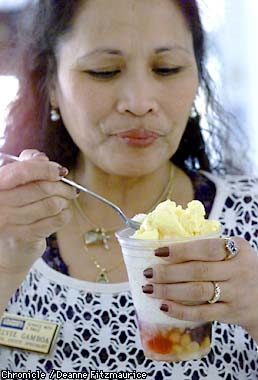
For dessert, there's pale green avocado ice cream (avocado is a sweet, not
savory food in the Philippines) atop halo-halo ($4), a concoction of shaved
ice, milk, coconut bits, jackfruit, little red adzuki beans and chickpeas.
Or, you could opt for the strictly-an-acquired-taste warm, purple jellied
logs topped with granulated sugar and coconut flakes.
Rene-Rose Philippine Cuisine
Address: 873 Castro St. (at El Camino), Mountain View
Phone:(650) 210-9393
Hours: Open 11 a.m.-10 p.m. Monday-Saturday. Beer only. Credit cards
accepted. No reservations. Easy street parking.
OVERALL: TWO STARS
Food: TWO STARS
Service: TWO STARS
Atmosphere: ONE STAR
.
PRICES: $
NOISE RATING: TWO BELLS
---------------------------------------------------
PLUSES: Rene and Rose are able guides to Filipino cuisine, willing to dole
out little tastes of this or that before you commit to your dishes.
MINUSES: The dining room is a very bare-bones, cafeteria-style square without
charm. Food is displayed in a long, unappetizing row of steam trays.
---------------------------------------------------
RATINGS KEY
FOUR STARS: Extraordinary
THREE STARS: Excellent
TWO STARS: Good
ONE STAR: Fair
(box): Poor
.
$ Inexpensive: entrees under $10
$$ Moderate: $10-$17
$$$ Expensive: $18-$24
$$$$ Very Expensive: more than $25
Prices based on main courses. When entrees fall between these categories,
the prices of appetizers help determine the dollar ratings.
ONE BELL: Pleasantly quiet (under 65 decibels)
TWO BELLS: Can talk easily (65-70)
THREE BELLS: Talking normally gets difficult (70-75)
FOUR BELLS: Can only talk in raised voices (75-80)
BOMB: Too noisy for normal conversation (80+)
.
Chronicle critics make every attempt to remain anonymous.
All meals are paid for by the Chronicle.
Star ratings are based on a minimum of three visits.
Ratings are updated continually based on a least one revisit.