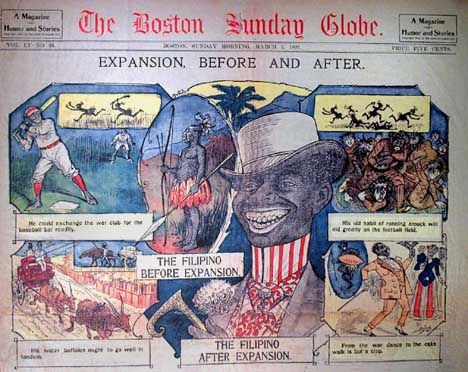
In 1899 the Boston Sunday Globe illustrated how 'savage' Filipinos could adapt their skills to 'civilized' society
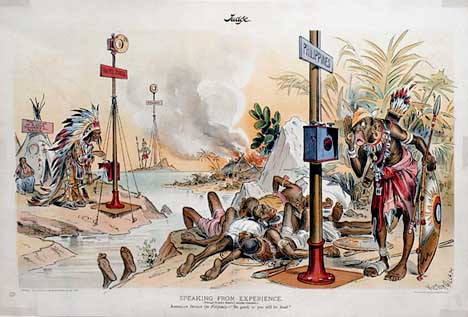
An 1899 drawing in Puck magazine showed Native Americans sending a message to the Philippines: 'Be good, or you will be dead'
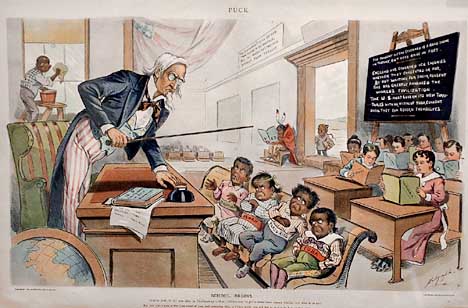
Puck in 1899 showed Uncle Sam glaring at four pupils representing (from left) the Phillippiines, Hawaii, Puerto Rico and Cuba
------------------------------------------------------------------------
IMAGES OF RACISM: HOW 19th CENTURY US.MEDIA DEPICTED FILIPINOS AS SAVAGES
SAN FRANCISCO CHRONICLE - Benjamin Pimintel
----------------------------------------------------------------------
Abe Ignacio said he couldn't believe his eyes when he saw the century-old illustration
for sale on eBay.
The cover of an 1899 issue of Judge magazine shows President William McKinley
scrubbing a Filipino child saying, "Oh, you dirty boy!" The caption
reads: "The Filipino's First Bath."
Ignacio of San Leandro bought the rare image and others from the era that are
now part of a Berkeley exhibit of depictions of Filipinos in mainstream media
-- as savages to be civilized by the United States as part of the colonization
of the Philippines.
"It's revisiting a terrible period that most historians have ignored,"
said Ignacio, who works as a Federal Express driver and has collected about
400 images from that period since the late 1980s. "It's important to show
that there was a very ugly side to America's rise as a world power."
"Colored: Black n' White," at exhibit at Pusod, a community arts and
environmental center, includes drawings, editorial cartoons, photos and news
clips from prominent magazines and newspapers that covered the U.S. annexation
of the Philippines in the late 19th and early 20th centuries. It was put together
by Ignacio, his wife, Helen Toribio, who is a college instructor, and Jorge
Emmanuel, an environmental scientist.
The Philippines had declared its independence from Spain in 1898 when the archipelago
was ceded to the United States for $20 million. Filipino revolutionaries rejected
the U.S. colonial regime, but their resistance was suppressed in a bloody war
of conquest that claimed at least 250,000 lives, mostly Filipino civilians.
To justify the use of military force in the Philippines, many pro- annexation
politicians, writers and artists portrayed the Filipinos as primitive, childlike
and incapable of governing themselves.
An August 1898 drawing from Puck magazine, which is part of the exhibit, shows
a mother figure representing America accepting a basket of crying babies representing
the Philippines and other nations conquered by United States, including Hawaii
and Puerto Rico.
An 1899 illustration in Judge magazine shows a similar image with the caption
"The White Man's Burden" -- a phrase coined by British writer Rudyard
Kipling, who supported the U.S. bid to annex the Philippines.
In 1899, the Boston Sunday Globe published an illustration depicting the supposed
transformation of Filipinos under U.S. tutelage, from ignorant savages to civilized
people who play baseball and wear Western clothes.
A headline from the San Francisco Evening Post declared: "Filipinos Do
Not Like Work."
The collection includes clippings from two other San Francisco newspapers. "Manila
Insurgents Routed With Great Slaughter/Two Hundred of Our Men Wounded, Natives
Driven Into the River and Drowned," reads an 1899 headline in The Chronicle.
"I Left Samar A Howling Wilderness," read a headline with an account
of a U.S.-led massacre published in the Hearst-owned Examiner.
The most striking illustrations in the collection came from Puck and Judge magazines.
The publications are now defunct, but Professor Tom Leonard, university librarian
of the University of California at Berkeley, said they were important and influential
publications in the early 20th century, the equivalent of today's Time and Newsweek.
"They were major magazines and they were read by educated people,"
he said. "They were not fringe publications."
U.S. media in the late 19th century were notorious for depicting nonwhite communities,
including American minorities, as lower forms of people, Leonard said. Public
opinion has progressed to the point that such depictions are "widely condemned"
as inaccurate and unfair, he added.
Ignacio said he believes racism is still a problem in America, citing the killing
of Joseph Ileto, the Filipino American postal worker shot in Los Angeles two
years ago by a white supremacist.
Collecting the images was a personal journey for Ignacio. The son of Filipino
immigrants, he endured racial taunts as a child growing up in San Diego.
"You actually begin to not like yourself and deny that," he said.
Doing research on the Philippine American War helped him understand the roots
of the racism. He began buying old magazine illustrations and cartoons at antique
stores, bookstores and on the Internet.
"It was exciting, like a treasure hunt," he said. "You find important
pieces to give people a full flavor of the racial sensibilities of the time."
Many who have seen them were shocked.
Larkspur artist Elizabeth Saul said the exhibit helps explain the concept of
Manifest Destiny, the philosophy that sought to justify the United States' westward
expansion.
"These images speak so strongly," she said. "You can hear someone
talk about (Manifest Destiny) over and over again, but when you are confronted
with images that are vile, pompous and arrogant, it strikes a chord that words
can't communicate efficiently."
A section of the exhibit focused on similarities in the portrayals of Filipinos
and African Americans. U.S. troops fighting in the Philippines referred to Filipinos
as "niggers" or "gugus."
Berkeley artist Mildred Howard said the exhibit "makes something horrible
visible."
"How is it that one race feels that they were so much more important?"
Howard, who is African American, asked. "I know it's probably because of
greed and economics and a way to exploit others."
The exhibit will run until September 30. Ignacio said he and the other curators
have received invitations from colleges, universities and Filipino American
organizations.
Co-curator Helen Toribio, who grew up in Hawaii, said the exhibit is a way to
get a dark period of U.S. and Philippines history "out of my system."
"Anyone who grew up here, grew up with the mythology of America the beautiful,
the great democracy, and there is very little exposure to the dark side,"
she said. "There is a lot that is hidden about American history."
"Colored: Black n' White" is open Tuesdays through Saturdays from
11 a.m. to 6 p.m. at Pusod, 1808 Fifth St., Berkeley. It is open by appointment
on other days and at other times. For information, call the Pusod center at
(510) 883-1808. / E-mail Benjamin