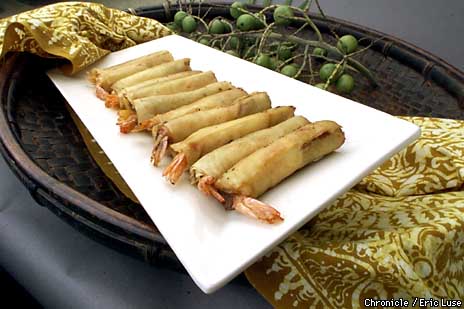
Lumpia Shanghai -- fried egg rolls -- make great appetizers. Chronicle photo by Eric Luse
Lumpia Shanghai -- fried egg rolls -- make great appetizers. Chronicle photo
by Eric Luse
------------------------------------------------------------------------
The Road from Manila
The Philippines cuisine travels a path paved by Spanish, Chinese & American
influences
Noel Advincula Wednesday, June 7, 2000
San Francisco Chronicle
-----------------------------------------------------------------------
In the Philippines, people are passionate about three things --
religion, politics and eating. In fact, food is so important that the first
thing you're likely to hear on entering a Filipino home is, ``Kumain ka na ba?
Have you eaten yet?''
Yet despite the fact that the Bay Area is home to 250,000 Filipinos, nearly
a fifth of the entire U.S. Filipino population, the food of that island country
is relatively unknown. And that's a shame, because it's filled with bold yet
simple combinations of ingredients and flavors, from sour and salty to fresh
and spicy, that can captivate the unaccustomed tongue.
Most of those flavors -- from dishes like kare-kare, oxtail stew in peanut sauce,
to kinilaw, fish marinated in vinegar -- show up in dishes that are cooked at
home -- and something is almost always cooking in Filipino homes. Someone is
also almost always eating -- three full meals a day, plus a merienda, or afternoon
snack. ``Food is the catalyst that brings everyone together,'' says Rosa-Linda
Canonizado, a homemaker from Berkeley. Margaret Lacson, producer and anchor
of KMTP-TV's Filipino American Report, agrees. ``Breaking bread with friends
and family forms a bond. Through this we pass stories and histories that parallel
with the food in our culture.'' Still, Filipino food has a low profile to those
outside the community. One reason may be that it's mainly cooked at home rather
than in restaurants and thus largely hidden from outsiders. Another hypothesis
is that Filipino food is such a mix of influences -- from Spain, China, Malaysia
and the U.S. -- that it's hard to pinpoint specific dishes.
Spain ruled the Philippines for nearly 400 years and Spanish ingredients and
dishes play a large part on Filipino menus. The Spaniards introduced rich stews,
sausages, and dishes focusing on meat and dairy. Paella, menudo and pochero
(cocido) all have Spanish roots. Eighty percent of Filipino dishes have Spanish
influence although not all carry a Spanish name.
The Chinese contributed noodles, the basis of the many pancit rice or egg noodle
stir-fry dishes. Lumpia, the Filipino version of spring rolls, come in various
forms including lumpia shanghai (small spring rolls filled with ground meat
dipped in sweet-sour sauce) and sariwa (vegetables wrapped with fresh crepe
and peanut sauce).
Spain ceded the Philippines to the U.S. in 1898, and the islands remained an
American territory for nearly 50 years. Life would never be the same for Filipinos
after hamburgers, fried chicken, canned corned beef and the ever-popular Spam
became part of the culinary scene.
Americans also left behind ``jeepneys,'' World War II-era surplus jeeps that
Filipinos converted into neon-colored lavish minibuses that became a popular
mode of transportation. Like the colorful jeepney, Filipino cuisine reflects
adaptability, innovation and individuality.
New settlers may have contributed the basic ideas for most of the dishes, but
the Filipinos adapted them by incorporating local ingredients and simple techniques.
``Dishes such as arroz a la Valenciana and menudo had become a part of the Filipino
fare by substituting saffron threads with annato and adding local ingredients
that were originally meant to copy the dishes,'' says Eppie Rafanan, executive
director of Likha Filipino Folk Ensemble and a long-time Bay Area resident.
``But these substitutions instead created dishes that are bolder, more exciting
for the Filipino palate.''
However, Filipino cuisine that is available in the few Bay Area restaurants
that do serve it rarely goes beyond traditional dishes. Most Filipino restaurants
are the limited-service turo-turo, a pre-made selection that is ordered cafeteria
style, or are all-you-can-eat buffet restaurants that offer good value. Many
Filipinos simply prefer to eat at home -- for a variety of reasons. Lety Cabreros,
a nutrition consultant in Daly City, says she prefers to cook at home rather
than eating out because it's more economical and it gives her a chance to bond
with her family. ``It is important for Filipinos to share meals with their family,
a pattern that is almost as sacred as praying itself,'' she says. Vicky Roberts,
who writes the Auntie Vicky food column for the Filipino newsletter At iba pa,
also points out that cooking traditions are paramount.
``Most Bay Area Filipinos prefer their food cooked the traditional way and anything
that's cooked otherwise has very little following,'' she says.
That's especially true for celebrations, which are often rooted in fiestas that
typically commemorate a religious event or saint. Fiesta banquets are not complete
without relleno (stuffed milkfish or chicken), morcon (stuffed meat roll), the
paella-like arroz a la valenciana, brazo de mercedes (meringue cake) and lechon
(whole roasted pig). Some of these dishes are also perfect for Philippine Independence
Day parties this month (see related story).
Still, things are changing in the Filipino food world -- innovative chefs have
been fusing Filipino cuisine with classic Mediterranean and French styles. The
results are dishes such as sinigang (sour soup) bisque topped with puff pastry,
roasted lamb with lime leaves and guava sauce, and milkfish mousse with aligi
(crab roe) sauce. ``In recent years there has been an influx of talented chefs
in the Philippines who were trained abroad that are creating Filipino haute
cuisine,'' says Nicki Garcia, who came from the Philippines to learn classical
cooking technique at the California Culinary Academy. ``I just want to be a
part of this exciting change.''
Enrique Gatchalian, executive chef of Betelnut in San Francisco, looks for similar
changes to happen locally.
``That Filipino food is recognized as the nouvelle cuisine in the Bay Area will
happen sooner or later. We have all the resources and the interest for exploring
Filipino cuisine is out there. It's just a matter of time.''
------------------------------------------------------------------------
FILIPINO INGREDIENTS
--Atsuete (annatto). This small dark red seed is used mainly as food coloring
by soaking in water or hot oil to extract the red-orange color. It is also available
as a liquid extract.
--Bagoong. Bagoong alamang is a salty, fermented tiny shrimp paste. Bagoong
halubaybay/balayan are fermented anchovies. Both are used for cooking or as
a condiment.
--Banana blossom. The flower bud of a banana tree can be finely sliced or cut
into wedges and used as a vegetable.
--Pandan leaf. The unique fragrance is wonderful in steamed rice and also blends
beautifully with desserts and cold drinks.
--Pansit noodles. There are several versions of these noodles, but the most
popular ones are bihon (rice noodles), kanton ( flour and egg noodles) and sotanghon
(mung bean noodles).
--Philippine mango. Government regulations prohibit importing fresh Philippine
mangoes, but the Manila mango grown in Mexico is a good substitute. Philippine
Mango is available dried, candied or pickled. Green unripe mangoes can be used
for sal ads or eaten with bagoong for snacks.
--Patis (Filipino fish sauce). This amber-colored sauce made from salted and
fermented fish is similar to Thailand's nam pla and Vietnam's nuoc nam, but
saltier than both. Patis is used in cooking or as a condiment.
--Saba banana. This short, plump banana tastes like a plantain, and is used
in desserts and soups.
--Salted duck egg. A boiled duck egg that's been cured in brine and colored
magenta is used with chopped tomatoes and green onions as a salad to accompany
broiled or fried fish.
--Tamarind. The unripe pod is used as a souring agent for soups. Ripe pods can
be eaten as a snack or used to make candies. Tamarind also comes in powdered
form.
--Ubod (heart of palm). This is used in salads and lumpia.
--Upo (bottle gourd). This light green gourd with mild flavor is used in soup
or as a sauteed vegetable.
------------------------------------------------------------------------
FILIPINO FOOD SOURCES
Here are some sources for Filipino ingredients and meals in the Bay Area.
RESTAURANTS
--Max's of the Philippines, 1155 El Camino Real (near Arroyo Drive), South San
Francisco; (650) 872-6748
--Barrio Fiesta, 2262 Westborough Blvd. (near Gellert Boulevard), South San
Francisco; (650) 583-3136
--Sinugba, 2055 Gellert Blvd., Suite 5 (near King Drive), Daly City; (650) 878-3591
--Goldilocks Bakeshop and Restaurant, 3535 Callan Blvd. (near Westborough Boulevard),
South San Francisco; (650) 873-0565
--Carmen's Restaurant, 998 Fourth St. (near Channel Street), San Francisco;
(415) 495-9265
GROCERS
--Pacific Supermarket, 2900 Alemany Blvd. (near Farragut Avenue), San Francisco;
(415) 337-1628. Also 1420 Southgate Ave. (near El Dorado Drive), Daly City;
(650) 994-1688
--Manila Oriental Market, 950 King Plaza (near Callan), Daly City; (650) 878-3328
--99 Ranch Market, 250 Skyline Plaza (near Westmoor Avenue), Daly City; (650)
992-8899. Other locations: 3288 Pierce St. (near Central Avenue), Richmond;
(510) 767-8899; 10983 N. Wolfe Road (near Homestead Avenue), Cupertino; (408)
532-8899; 34444 Fremont Blvd. (near Decoto Road), Fremont; (510) 791-8899; 338
Barber Lane (near Interstate 880) Milpitas; (408) 946-8899; 1688 Hostetter Road
(near Landy Road), San Jose; (408) 436-8899.
--Ocean Seafood Market, 3573 Callan Blvd. (near Meath Drive), South San Francisco;
(650) 827-0888
--San Pablo Supermarket, 1188 International Market Place (near El Portal), San
Pablo; (510) 215-0888
--Blue Ocean Seafood, 13501 San Pablo Ave., No. H (near Van Ness), San Pablo;
(510) 235-1267
------------------------------------------------------------------------