|
|
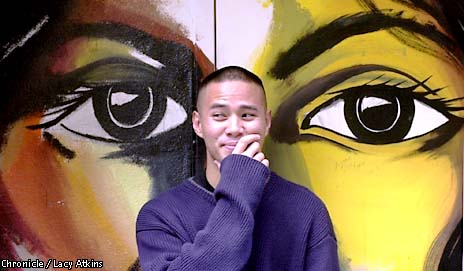
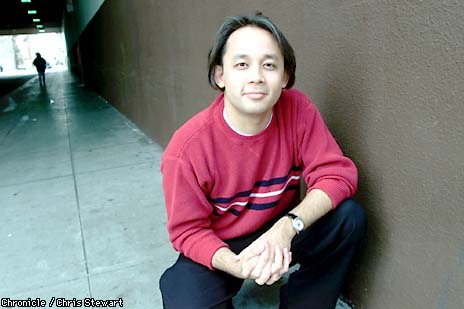
Filipino American filmmakers Rod Pulidos and Gene Cajayon: Their works
open and close the Asian American Film Festival. Chronicle photos by Lacy
Atkins
------------------------------------------------------------------------
Filipino Americans Find a Forum
Two directors bring differing visions of their culture to film festival
Bob Graham, Chronicle Senior Writer Sunday, March 4, 2001
------------------------------------------------------------------------
One of the filmmakers is 29, the other is 30. They grew up in Southern California,
where they went to different film schools but were aware of each other. Each
has spent years working on a full-length film about Filipino American life.
One Filipino American feature is a rarity. Two is amazing.
Now, one of the works will open this month's Asian American Film Festival in San Francisco, and the other will close it.
There is a family resemblance between the films, but they could hardly be more different in style.
Rod Pulido's "The Flip Side" is a cocky, upstart comedy, shot on a shoestring in black-and-white 16mm and blown up to 35mm. It premiered on the festival circuit in January at Sundance and opens the Asian American festival Thursday at the Kabuki Theater. Gene Cajayon's "The Debut," designed to be a commercial crowd-pleaser with crossover potential, closes the festival a week later and then begins an open- ended run at the Kabuki, which may determine whether it finds a theatrical distributor.
"My entire adult life, more or less, has been involved with this one movie, " says Cajayon, the 29-year-old. "Early in the project I swore to myself that I was going to complete it and see it through to the very end. And I wasn't going to abandon it no matter how hard it got. Hopefully, we're getting close to the end of the road, but you never know."
If the film doesn't find a distributor, Cajayon intends to circulate it himself from city to city.
The core audience is there. The Filipino American population in the United States is at least 2 million. In the Bay Area, it's about 400,000.
Both films deal with questions of identity, often humorously, and both deliver an emotional payoff. In "The Debut," there is also a strong streak of passion. Cajayon (pronounced ca-HA-yen) characterizes the film as a dramedy, meant to have both youth and family appeal. It stars the four Basco brothers, prominent Filipino American entertainers who grew up in the Bay Area town of Pittsburg and began their showbiz careers as break dancers. This is the first film in which they have all appeared together.
"The Debut" also features established stars from the Philippines, such as Tirso Cruz III and Eddie Garcia. Rather brazenly, Cajayon admits he and an associate talked them into making the film by going to Manila "and basically pretending to be like big-shot moviemakers."
Just give them time.
At one point, the project did include a big-shot moviemaker, Dean Devlin, producer of the 1996 blockbuster "Independence Day." Devlin is half Filipino, like Cajayon, who was born in Saigon and whose mother is French Vietnamese.
Devlin "was going through a lot of the same issues of cultural identity that are treated in 'The Debut,' " Cajayon says, "and we felt that since he was so hot" as a result of "Independence Day," that "he would use that leverage to get the film made."
It didn't work out that way. Hollywood, Cajayon found out, was interested in Devlin's clout but not in the picture.
"It's brown people on the screen," Cajayon says. "What are you going to do with that?"
Cajayon had an ace in the hole. It was the National Asian American Telecommunications Association, which awarded him the largest grant it has ever provided an independent filmmaker, $200,000. NAATA also provided completion funds for Pulido's "The Flip Side." The resource organization is the sponsor of the Asian American Film Festival.
Although the two filmmakers have diplomatically kept some distance from each other's projects, it was Pulido who introduced Cajayon to John Castro of San Jose, who became co-writer of "The Debut" and provided key elements Cajayon says his own script lacked.
Most of the action in "The Debut" takes place at a big 18th birthday party for the daughter of a Filipino American family. The characters live in a deliberately unspecified slice of California suburban sprawl. They can't afford a formal coming-out party, and the birthday party takes its place.
Dante Basco plays brother Ben, who identifies more with his white buddies than with his family. He also is a talented cartoonist who disobeys his father's wishes and turns down a medical scholarship. Darion Basco is Ben's former friend, who runs with "gangstas" and confronts Ben as a sellout.
The tone is different in "The Flip Side." The main character is a college student who returns home filled with the desire to get his family to return to its Filipino roots with sometimes -- but not always -- comic results. His parents are puzzled, and his grandfather, a survivor of the Bataan Death March, just keeps to himself. His sister sounds like a Valley Girl and his brother like a hip-hop gangsta.
It's no accident that Pulido's "The Flip Side" is in black and white, and it was not a matter of the budget, or lack of one. "What I like about shooting on a low budget is I have complete control," Pulido says.
"I know most producers wouldn't let me shoot in black and white. It was definitely an aesthetic choice. The whole theme of 'The Flip Side' is how American media just portray white and black culture. For Filipino kids, this is all that's available to them, only black and white images. A lot of them end up trying to be something they are not."
The point is made through comedy.
"I didn't want to make a movie that was preachy and knocked people over the head. I don't think narrative filmmaking should be a platform. I wanted to make a film that was entertaining. That was the challenge."
The action in "The Flip Side" takes place in the Cerritos house where he grew up and where his parents still live.
"The actors and the crew, we all slept on the floor, all of us just living under one roof for four weeks." Pulido says he grew up with hip-hop. "I love the music and I love black culture. When a certain group doesn't have a lot of role models in the media, they end up starting to hate themselves and wanting to be something that they're not. There's a difference between appreciating another culture and wanting to be somebody else."
Pulido supports his filmmaking by working as a substitute teacher. He recently married his high school sweetheart, Marifi, who is working on a doctorate in epidemiology at the University of California at Los Angeles. They live in North Hollywood.
Cajayon's family has lived in Orange County since he was a year old. He still lives nearby, and he and his wife, Mabel, have 2-year-old and 10-month- old sons. Pulido says people should not jump to the conclusion that the family portrayed in his film is exactly like his own.
"The sister is based on different people I've known," he says, and the two brothers "are me at different stages of my life."
Pulido is also looking for a distributor, but he knows a black-and-white film with no names will be a tough sell.
"I think that what makes an independent film get recognized is not the production values or the name talent. The strength is in the story. That's what the audience is looking for."