 |
|
|
|
|
|
|
|
|
|
|
|
|
|
|
|
|
|
|
|
|
|
|
|
|
|
|
|
|
|
|
|
|
|
|
|
|
|
|
|
Selma Burke,sculptor and educator |
|
|
|
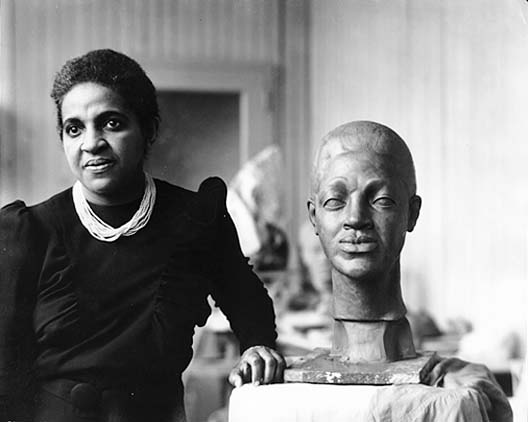
Selma Hortense Burke, seventh of ten children was born to Neal and Mary Jackson Burke on December 31, 1900 in Mooresville, North Carolina. Her minister father had been a chef on a cruise line visiting many other countries and collecting works of art. Burke's earliest works were figures shaped from the clay used to whitewash fireplaces. |
|
|
|
 |
|
|
|
|
Since Mooresville did not offer education beyond the elementary grades for black children, Selma was sent to school in Washington, D.C. When she returned to North Carolina at 14 she was tutored by the white superintendent of schools and later attended what is now Winston-Salem University and became a registered nurse in 1924. Although her artistic talents were recognized, Burke's mother insisted she become educated in something "useful". |
|
|
|
|
|
Burke worked as a nurse specializing in operating room techniques in Philadelphia and married a childhood friend, Durant Woodward in 1928. He died after eleven months of marriage. After working for the heir to the Otis elevator business and a member from the Cooper family in Cooperstown, New York, Burke developed acquaintances with many influential people, became a regular attendee at the Metropolitan Opera and Carnegie Hall, and built up a healthy nest egg. |
|
|
After winning a scholarship to Columbia University in 1935, Burke went to New York City to seriously study art. While in New York City she became acquainted with notable literary figures such as Langston Hughes, Sinclair Lewis, Claude McKay, Eugene O'Neil and James Weldon Johnson. Burke and McKay were married for a short time in the mid 30s. |
|
|
|
As part of her desire to bring art to inner city youth, Burke began the Selma Burke School for Sculpture in New York City in 1940 while in graduate school She was awarded a Master of Fine Arts from Columbia University in 1941. |
|
|
|
When World War II broke out, she joined the navy as a truck driver at the Brooklyn Navy Yard.While recuperating from a back injury, she heard of the national competition to create a profile portrait of President Franklin D. Roosevelt. Burke was awarded the commission in 1943. One condition she placed was that the president actually sit for the plaque rather than having her work from photographs. He did this in 1944. |
|
|
|
Her award winning design of Roosevelt was installed at the Recorder of Deeds Building in Washington, DC. Listed at the top of the 3 � by 2 � foot bronze plaque are the four freedoms he vowed to uphold: freedom from want, freedom from fear, freedom of worship and freedom of speech. It was unveiled by Frederick Weaver, great-grandson of Frederick Douglass after President Harry S. Truman spoke at the Sept. 24, 1945 ceremony. |
|
|
|
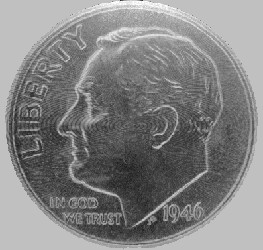
The profile used by the Bureau of the Mint of the U.S.Treasury for the Roosevelt dime is the same as the plaque Selma Burke offered in competition. The small initials below the neck bear the initials JS, James Sinnock chief engraver of the U.S. Mint. Although even the Roosevelt LIbrary attributes the design to Burke, a congressional commission in 1946 after the presdient's death was given to Sinnock which resulted in credit for the likeness. |
|
|
|
 |
|
|
|
|
Primarily a sculptor, Burke crafted figures of rugged beauty from wood, bronze, or stone in a style of almost classical realism. Her best subjects are nudes and historical figures. A committed educator, the bearer of two earned and eight honorary doctorates, Burke established two art schools while teaching at Haverford and Swarthmore Colleges. She also taught at the Solebury School and several other institutions. |
|
|
 |
|
|
|
|
|
|
Selma Burke continued creating works, taught in numerous schools, conducted sculpture workshops and art clinics. In 1949 she married architect and former Socialist candidate for lieutenant governor for New York State, Herman Kobbe, and moved to New Hope, Pennsylvania. They contributed time and money to support the arts locally and throughout the country as well as continuing their own work. Kobbe died in the early 1950's. |
|
|
|
|
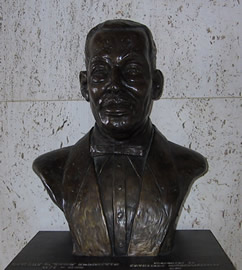
Bust of Duke Ellington |
|
|
|
|
|
|
She opened the Selma Burke Art Center in Pittsburgh which operated from 1968-1981, served as consultant to the Andrew W. Mellon Foundation, exhibited her work, and continued to teach throughout her life. Adding to her already impressive educational career, awards and honorary degrees, Selma Burke completed work and received a Doctorate in Arts and Letters at Livingstone College in Salisbury, North Carolina at the age of 70. In recognition of her contributions to the arts, the Governor of Pennsylvania proclaimed June 20, 1975 as Selma Burke Day. |
|
|
|
Her works are in the Metropolitan and Whitney museums and in many private collections. She died in 1995. There were no children from any of her marriages |
|
|
|
 |
|
|
|
|
Home |
|
|
|
|
Biographies |
|
|
|
|
|
|
|
|
To learn more about Filling in the Gaps in American History (F.I.G.A.H), biographies and reasearch on people of African Descent who don't usually appear in text books, contact us at email. |
|
|
|
|