 |
|
|
|
|
|
|
|
|
|
|
|
|
|
|
|
|
|
|
|
|
|
|
|
|
|
|
|
|
|
|
|
|
|
Nineteenth Century Photographers |
|
|
|
 |
|
|
Jules Lion 1810 -1866 |
|
|
|
|
|
|
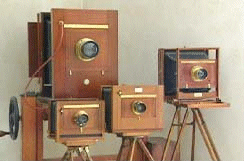
Jules Lion is the earliest named photographer of African heritage. He was born free in France and moved to Louisiana in 1837. On March 14, 1840 an ad for his work appeared in The New Orleans Bee. It specifically referred to the daguerreotype process, producing a likeness on iodized copper, invented only a year earlier in France in 1839. Art historians credit Lion with introducing the process to New Orleans. There were hundreds more daguerreotypists of African Descent whocaptured images of people at important junctures in their lives- births, marriages, professional accomplishments. Portraits of African and Native Americans, businessmen, families, politicians and recently arrived immigrants were often done by this group. |
|
|
|
Lion also worked from photographs to create lithographic compositions. A comment in Chester Higgins' introduction to Some Time Ago, (1980) states "only one photograph definitely attributed to Lion has been located. This is his 'view of Chartes Street with St. Louis Cathedral dome in 1842' taken when he was about twenty-six years old". A portrait of Ashur Moses Nathan and his son Achille, in the September 2004 exhibit at the Minneapolis Institute of Arts, Currents of Change: Art and Life Along the Mississippi River, 1850-1861 is attributed to Lion. |
|
|
Augustus Washington 1820 -1875 |
|
|
|
Augustus Washington left Dartmouth College in 1844 and traveled to Hartford, Connecticut to take charge of one of that city's two schools for Black students. He succeeded in paying off his college debts and looked forward to resuming studies at Dartmouth. But by the close of 1846, Washington had taken up daguerreotypy. |
|
|
|
On December 24, 1846 Washington advertised the services of his new daguerrean enterprise in the Charter Oak, Connecticut's antislavery newspaper. He was not the first to offer daguerreotype likenesses in the Hartford area but in 1851 he boasted that his gallery was "the oldest Daguerrian [sic] Establishment in this city." |
|
|
|
Washington's customers were among the cities' elite, middle class, working families and even the poor who may have saved for many months or years to afford a photographic likeness. The earliest known portrait of radical abolitionist John Brown dating from 1846 or 1847 was done when he was a wool broker in Springfield, MA and may be one of the earliest surviving daguerreotypes from Washington's gallery. When Augustus Washington published a notice thanking customers for their years of patronage in 1853, he announced plans to close the gallery "not from any want of further success or patronage, but for the purpose of foreign travel, and to mingle in other scenes of activity and usefulness." |
|
|
|
He traveled to Liberia where he continued taking portraits of individuals and families who emigrated there from the United States. |
|
|
James Presley Ball 1825 -1905 |
|
|
James Presley Ball was born free in Virginia and opened a one-room photographer's studio in Cincinnati, Ohio, in 1845.When he moved to Richmond, Va.in 1846, an observer wrote: ''The Virginians rushed in crowds to his room; all classes, white and black, bound and free sought to have their lineaments stamped by the artist who painted with the Sun's rays.'' The following year he became a traveling daguerreotypist, and two years later hired his brother to operate the Cincinnati business. In 1852 brother in law Alexander Thomas became a partner in the studio. Ball published a pamphlet in 1855 addressing the horrors of slavery, and opened an exhibition of enslaved people's experiences. In May 1860 the Ball and Thomas Photographic Art Gallery was destroyed by a tornado but rebuilt thanks to the generosity of the community. After the Civil War, Ball dissolved the partnership with brother in law Thomas, moved to Minneapolis and opened his own studio. In 1887 he became the official photographer of the 25th anniversary of the Emancipation Proclamation held in Minneapolis. He kept moving further west, first to Helena, Montana where he produced hundreds of photographs of black, white and Chinese immigrants. |
|
|
|
A series of three photographs speak to Balls' care for detail and desire to document the experiences of people of African heritage. The subject, William Biggerstaff, was born enslaved in Kentucky, convicted of killing a man in Helena, Montana and hanged on April 6, 1896. In the first photograph, he appears to be a man of some means, well dressed even with a fresh handkerchief in his coat pocket and flower on the lapel. The lack of a wedding ring could indicate the photo was for his bride to be. The second photo is of his hanging where he again wears the suit but a wedding ring appears as he is flanked by the sheriff and minister at the "legal hanging". In comparing the image of William Biggerstaff to those of the lynched bodies on post cards of the same period, it is evident that Ball sought to capture the individuality of the deceased. And finally he is seen in his cloth lined coffin from such an angle as to clearly show the wedding ring. J.P. Ball told a story in his photographs of a life of consequence to others. |
|
|
At the turn of the century he moved further west to Seattle, WA where he opened a studio under the name Globe Photo Studio. Ball died in 1905 in Seattle. |
|
|
|
Many of his studio portraits and photographs of public events are archived by the Montana Historical Society. |
|
|
|
John Roy Lynch 1847 - 1939 |
|
|
|
John Roy Lynch was born to an enslaved mother and a white Louisiana planter in 1847 and became free when the Emancipation Proclamation went into effect. Lynch attended night school and worked as a photographer's assistant for Hughes and Lakin in Natchez, Mississippi.He became extremely interested in photography and three months after joining the firm was promoted to the rank of printer. His job involved making contact prints and/or enlargements from glass negatives. |
|
|
Early in 1866, Lynch went to work in a studio in Natchez. By summer he had assumed full responsibilities of a studio photographer. He was active in photography after the Civil War and during the Reconstruction era. |
|
|
Lynch is best known for his life in politics; first in the state legislature serving the last year as Speaker of the House, then to the Congress from 1869-73, and temporary Chairman of the Republican National Convention at Chicago in 1884. Later he became an attorney and was appointed an officer with the Army by President McKinley during the Spanish American War. |
|
|
|
To read more about him in his own words, please see Lynch, John Roy (edited by John Hope Franklin.): Reminiscences of an Active Life: The Autobiography of John Roy Lynch |
|
|
|
Home |
|
Biographies |
|
|
For more information on Filling in the Gaps in American History (F.I.G.A.H), biograaphies and research on people of African Descent who do not usually appear in textbooks, contact us at email |
|