 |
|
|
|
|
|
|
|
|
|
|
|
|
|
|
|
|
|
|
|
|
|
|
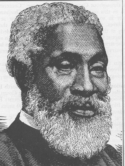
Josiah Henson |
|
|
Josiah was born enslaved in 1789 on a farm owned by Francis Newman in Charles County, Maryland and named by the man who claimed to be the master of his mother, Josiah McPherson, and an uncle of McPherson's named Henson. His mother was hired out to the Newman farm. When he was still a small child, his mother was raped by an overseer and was heard screaming for help as she struggled to get free. When his father heard the screams, he left his workplace and "sprung upon him like a tiger".The cries of his bruised wife were all that kept him from killing the overseer. With the enraged, powerfully muscled farm laborer poised over him, the overseer offered to say nothing and stood by as Henson's father took off. According to the laws of Maryland, a black person regardless of being enslaved or free, raising a hand to a white person even in defense of his wife was a crime demanding punishment. The authorities did not find him until after his supplies ran out and then dragged him to the whipping post for the prescribed 100 lashes and nailing of his ear to the post. |
|
|
 |
|
|
|
|
|
Josiah Henson 1789-1883 |
|
|
|
|
|
After the whipping, his father was sold and sent to Alabama. That was the last Josiah saw or heard of him. Josiah, his five siblings and mother were sold to settle the estate of Dr. McPherson around 1795.; His autobiography recounts the day his mother fought when her last child, Henson, was put up for auction and taken from her. He was sold at least twice more before marrying and becoming a preacher in Kentucky in 1828. He was told he could purchase his freedom for $350 when he earned additional money working for others. The money was given to his owner who kept it and raised the purchase price to $1,000. When he heard word in 1830 that he was to be sold, Henson, his wife Charlotte and four children escaped to Ohio.They traveled on to Canada by way of Buffalo, New York. Once in Dresden, Ontario Henson took up preaching again and learned to read and write |
|
|
After his experiences while traveling to freedom with the assistance of the Underground Railroad and some Native Americans, he got involved in helping others out of enslavement and became a conductor. He returned to Kentucky at least twice to lead groups to Canada. As part of his commitment to help others, he founded an institute near the Detroit River in Dawn, Ontario where formerly enslaved people could learn trades to support their new lives. Henson also built a sawmill in 1842 that shipped lumber to Boston. When the mill needed more operating capital, he went to England to raise funds and kept the business afloat a few more years. His walnut lumber was shown at the Crystal Palace Exhibition (World's Fair); in 1851 and won a bronze medal. |
|
|
|
While in England, Henson spoke out on the true nature of enslavement countering sentiments that slavery benefited "heathen" Africans. His audiences included such notables as the Archbishop of Canterbury and Prime Minister John Russell. |
|
|
 |
|
|
|
|
|
|
The Life of Josiah Henson, Formerly Slave, Now an Inhabitant of Canada, as Narrated by Himself was published in 1849 and formed the basis for Harriet Beecher Stowe's Uncle Tom's Cabin.The character that she described bears some similarity to Josiah Henson but many of the attributes her Uncle Tom displayed were not in keeping with experiences of any enslaved person in America. |
|
|
|
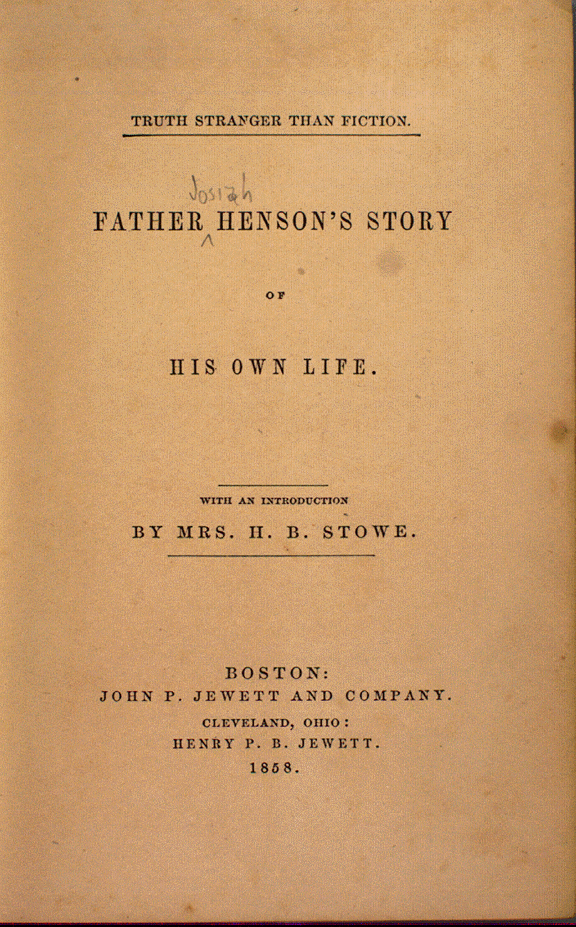
Jenson published a second, larger work, Truth Stranger than Fiction:Father Henson's Story of His Own Life in 1858 which had an introduction by Stowe. London versions were published under the title Autobiography of Josiah Henson in 1876 and 1878 and added yet more material. During his last trip to England, he had an audience with Queen Victoria at Windsor Castle, the first formerly enslaved person to do so. Upon return to the United States, he and her wife were reported to have been received by President and Mrs. Rutherford B. Hayes to address needs of the formerly enslaved. |
|
|
|
|
|
Josiah died in Dresden, Ontario May 1883. A historical marker is at the site of the former Riley plantation in Kentucky where Henson was last enslaved. Henson was the first person of African Descent to appear on a Canadian stamp and in 1999, he was honored by the Canadian government when they erected a plaque designating Josiah Henson as a Canadian of National Historical Significance. |
|
|
|
For more information on Filling in the Gaps in American History (F.I.G.A.H), biographies and research on persons of African Descent who do not usually appear in textbooks, contact us at email |
|