 |
|
|
|
|
|
|
|
|
|
|
|
|
|
|
|
|
|
|
|
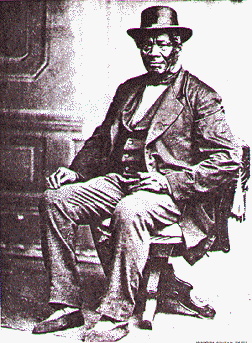
George Bonga |
|
|
|
 |
|
|
Born around the turn of the nineteenth century in what is now known as Duluth, Iowa George Bonga was considered one of the largest, strongest, and smartest men in the north woods. He is said to have portaged 700 pounds. Without a map, George could travel living off the land communicating with Native Americans. His father Pierre was employed with the Hudson Bay Company, a fur company headquartered at Fort William in Lake Superior. George was sent to Montreal at an early age and could speak English, French, and Ojibway fluently. His penmanship and level of education was far above average. His linguistics talents were utilized by Gov. Louis Cass as an interpreter at Fond du Lac. George was employed by the American Fur Company and supervised posts at Ottertail and Leech Lakes. |
|
|
|
|
|
In the winter of 1837 George Bonga hunted down accused murderer, Ghegawaskung, an Ojibway, for six days and six nights in the wilderness of northern Minnesota. He found the fleeing man and turned him over to the authorities at Fort Snelling. Threats were made upon Bonga and his family but he was not intimidated. The capture of this accused murderer became the first criminal trial 12 years before Minnesota became a territory and 21 years before it became a state. |
|
|
|
George Bonga would spend the rest of his life in the Leech Lake area. After leaving the American Fur company, he accumulated wealth as an independent trader. Bonga would always be known for his sense of fairness and hospitality. He anguished at seeing the Ojibway pushed from their lands and did what he could to help them. |
|
|
|
The descendantsof George Bonga would continue to live in northern Minnesota and be known for their powerful physiques. Most have Native American features with the the skin color and hair texture of Africans. In Cass County, the first organized township is named Bungo after George. |
|
|
|
Adapted from the Bongos of Northern Minnesota |
|
|
|
Home |
|
Biographies |
|
|
|
|
|
For more information on Filling in the Gaps in American History (F.I.G.A.H), biographies and research of people of African Descent who do not usually appear in text books, contact us at email |
|