
and Efforts to Gain Pension And Disability Allowances.

Was she mentally feeble, as her captain claimed? That is open to debate. Her illiteracy points to a dearth of education, which is far different from stupidity or mental incapacity. One fact is certain. She was bright enough, or wily enough, to conceal the fact she was female for nearly two years. Her successful imposture argues for either some mental ability on her part, or a lack of scrutiny and observation on the army's part.
In any event, in October 1868 Cathay Williams was on her own in New Mexico, far away from any relations she may have had in Missouri, and she was sick. Some regrettably sparse information is known about her life after the army. She resumed the garb and identity of a woman, in fact of herself, Cathay Williams. She traveled to Fort Union and worked as a cook for the family of a colonel in 1869 and 1870. She then traveled to Pueblo, Colorado and worked as a laundress for a Mr. Dunbar for two years. She moved on and lived in Las Animas County, Colorado for a year, again working as a laundress. She finally settled permanently in Trinidad, Colorado, making her living as a laundress. There is some evidence she may also have found work as a nurse.
Why did Cathay Williams return to the identity of a woman working in low-paying servitude? We can only guess at her reasons. She may have been tired of living as a man. Maybe concealing the fact she was a woman became too much of a burden. Perhaps she had no choice. Her bad health likely made her incapable of the generally physically demanding manual labor available to uneducated black men working for wages. She may have viewed the somewhat less physically demanding "woman's work" her only alternative in making a living.
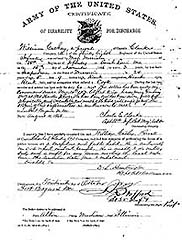
At some point in late 1889 or early 1890, Cathay Williams was hospitalized in Trinidad for nearly a year and a half. Again, no record has surfaced detailing the nature of this illness. She was probably indigent when she left the hospital, so she filed in June 1891 for an invalid pension based upon her military service. Her application brought to light the fact that an African-American woman served in the Regular Army.
Her original application for the pension, sworn before the local County Clerk (as was the procedure for all pension applications), gave her age as 41. She stated that she was one and the same with the William Cathey who served as a private in Company A, 38th U.S. Infantry for just under two full years. She claimed in her application that she was suffering deafness, contracted in the army. She also referred to her rheumatism and neuralgia. She declared eligibility for an invalid pension because she could no longer sustain herself by manual labor. We can infer she was unemployed at the time of the application.
The clerk recorded her attorneys as Charles and William King of Washington, D.C. These two men most likely were professional pension claim handlers. There is no evidence that they over-exerted themselves on behalf of their client in Colorado.
A supplemental declaration, filed the following month in Trinidad by Cathay Williams before the County Clerk, contended that she contracted small pox at St. Louis in October 1868, and that she was still recovering from the disease when she swam the Rio Grande River on the way to New Mexico. She stated that the combined effects of small pox and exposure led to her deafness.
There are obvious problems with the two declarations. Nowhere do the available records extant today indicate that she ever complained of, or exhibited signs of deafness while in the army. The Pension Bureau, a forerunner of today's Department of Veterans Affairs, claimed such documentation could not be found in 1891. If Cathay Williams suffered hearing impairment during her tour of duty, no one bothered to record the fact. Given the minimal information written down about Regular Army privates during the 19th century by their commanding officers and their doctors, this is a possibility. Since Williams was illiterate, she would not have known what they wrote about her anyway.
Her claim of suffering small- pox in October 1868 is even more puzzling. She was in New Mexico that month, and discharged on the 14th. She could not have been in St. Louis. Did the County Clerk record the wrong month and year? Was Cathay Williams suffering memory lapse 23 years after she left the army? Did she invent this illness? The attorneys for Cathay Williams apparently never noticed the discrepancies of dates in the July 1891 declaration.
Assuming an error in recording the year of her bout with small pox does not help Williams' case. If she claimed hospitalization in October 1866, then she did not have a case for a disability pension based on that disease, as it happened before her enlistment. She could not have been hospitalized in St. Louis in October 1867, because she was in New Mexico.
William Cathey was in a St. Louis hospital in February 1867, but the reason she was there was not recorded. Her illness could have been small pox. If Cathay Williams was mentally feeble, as her captain charged, then she easily could have been confused about the month when she gave her supplemental affidavit. Swimming the Rio Grande could have occurred only during the march from Fort Harker to Fort Union, which took place in the summer of 1867. If she had small pox earlier that year, she conceivably still could have been feeling its effects.
The military medical records document that William Cathey suffered rheumatism and neuralgia while in the service. The pension case of Cathay Williams would have been stronger if she had claimed disability based on those two problems. Why didn't she? One wonders if her lawyers gave her any advice at all.
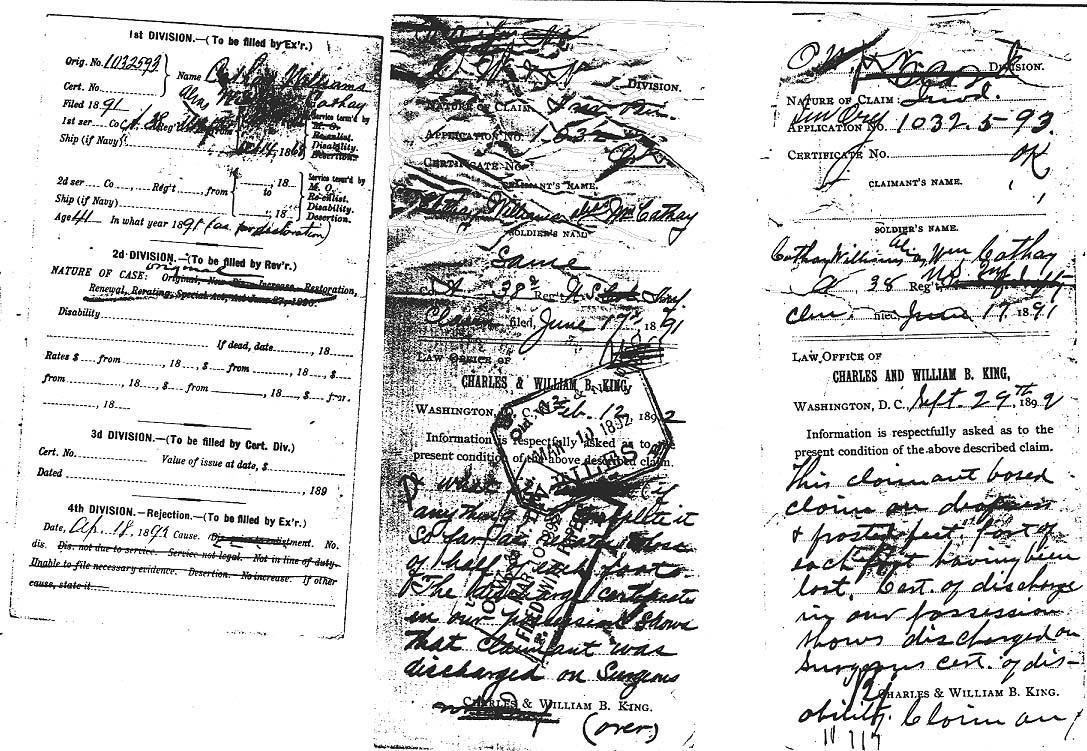
In addition to ordering the physical examination of Cathay Williams, the clerks at the Pension Bureau in charge of her case solicited information from her private doctors in Trinidad. Those men could not, or did not, provide the bureau with any information. So it is not known if she lost her toes during the Trinidad hospitalization, or why the procedure was necessary. While it is apparent the amputations happened after her military service, those severed toes are still another unexplained incident in the life of Cathay Williams.
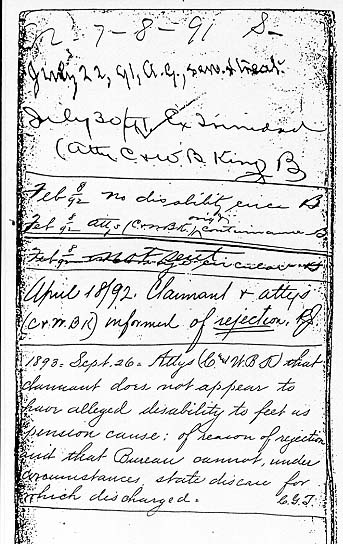
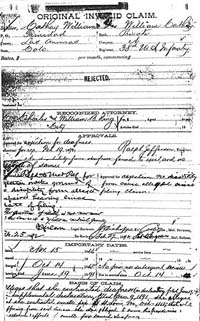
The Pension Bureau rejected her claim on medical grounds, that no disability existed. Under the existing regulations, there were five lawful grounds for denial of an invalid pension. The first reason, desertion, is not valid. The second that disability existed prior to enlistment could have been cited by the bureau, based on the surgeon's statement on her discharge certificate that the feeble condition pre-dated enlistment. The third reason that disability was not due to service -- also could have been cited by the bureau, as they could find no documentation of deafness, small pox, and presumably, frostbite during her tenure in the army. Remember, she did not claim disability due to neuralgia or rheumatism. A fourth cause of denying a pension was that the service was not legal. The Pension Bureau could have attempted that excuse immediately, because the former soldier in question was a woman who had passed herself for a man in order to join the army. Enlistment of women in the military was illegal.
There was wide room for Cathay Williams' pension case to be disputed as the initial lack of effort and the delayed activism on the part of her lawyers certainly would be grounds for legal malpractice. The pension clerks had some other compelling reasons to doubt the circumstances of the case. The inadequate documentation of Williams Cathey's illnesses while in the army raised the questoin of the government's culpability. The conflicting statements of the application and supplemental affidavit for the pension raised the issue of Cathay Williams's credibility. The September 1891 medical report by the doctor in Trinidad denied any disability. The damning sentences on her discharge papers stated that the feeble condition pre-dated the enlistment.
Was racism or sexism at work during the pension application and review process? Did those elements play a crucial role in the denial of a pension for Cathay Williams? One can argue that racism and sexism were pervasive social attitudes in the 1890's, and the Pension Bureau did not operate in a social vacuum. It should be noted, however, that nowhere in her pension application file are any written statements that can be perceived, even marginally, as racist or sexist, and there are no derogatory remarks written about the applicant herself.
Surprisingly, the Pension Bureau never questioned identity, and never appeared to doubt that William Cathey of the 38th Infantry and Cathay Williams of Trinidad, Colorado were one in the same. This is rather incredible. Granted, Cathay Williams was not the first woman to apply for a pension based upon milltary service. By 1891, the Pension Bureau had dealt with more than one woman who disguised herself as a man and served her country during the Civil War. Women who applied for pensions based upon army service usually met with resistance, not just from the pension clerks, but from the army itself.
Why was Cathay Williams' service not questioned by the pension investigators? Was it because she produced the original discharge papers of William Cathey on demand? Was it because the alias was disingenuous, a simple switch of her first and last names, and therefore credible? Was it because her skill as a soldier was never tested on the battlefield? Or was it because she was black? The pension clerks might have found it less troubling to believe a black woman could pass as a man and do soldier duty, and more difficult to accept that white women did the same during the Civil War.
Maybe a small and brief notation in Cathay Williams' pension file fully sums it up. A clerk wrote in the margins that the question of identity was never raised, as the claim was rejected for medical reasons. This one sentence leaves open the probability that her service may have been questioned had there been no recourse to deny her claim on strictly medical grounds.(5)
It is unfortunate that so little is known of Cathay Williams. The information in her pension file together with the scattered references to her in military records is all that exists. The fragmentary references to her physical condition, however, provide some clues as to what may have caused some of her various ailments during the course of her adult life. It is entirely possible that Cathay Williams suffered from mild diabetes, the form that is non-insulin-dependent and not immediately life-threatening.
Untreated, mild diabetes increases the individual's susceptibility to viruses. Cathay Williams may have contracted small pox. And another virus later in life may have caused her to be hard of hearing. If she easily caught whatever bugs were going around the camp or the fort, this would explain why the Fort Bayard surgeon labeled her of feeble habit. Untreated non-insulin-dependent diabetes can also affect the peripheral nerves, causing pain. We know that Cathay Williams suffered unexplained pain in the nerves, or neuralgia. Another symptom is loss of deep tendon reflexes and general muscle weakness and soreness. This could be what she and the Fort Cummings doctors diagnosed as rheumatism. The doctor in Trinidad would not have noticed any physical changes in her muscles or tendons if her pain was caused by diabetes. If Cathay Williams was a diabetic, then the Fort Bayard surgeon was right -- her illness did pre-date enlistment.
Mild diabetes, especially in younger patients, can be controlled with diet and exercise. We can assume that Cathay Williams did not know the cause of her medical problems any more than the variety of doctors who treated her. We can also assume that she did not have the proper diet for a diabetic. But it is interesting to note that she was healthiest when Company A was on the move, marching frequently to different posts between June 1867 and January 1868. She was getting daily exercise, which was good for a diabetic condition.
A major, and one of the final, complications of untreated diabetes is gangrene. Gangrene of the toes would explain the amputations. If the theory that Williams was diabetic is correct, then she did not have long to live after her toes were amputated.(6)
Nothing definite is known of Cathay Williams after the Pension Bureau rejected her claim. Where she lived, how she survived, her quality of life, and the date and place of her death are undetermined. She was born in anonymity, and so she died.
The 1900 federal census schedule for Trinidad, Colorado does not list Cathay Williams, nor cite any black woman with a similar name. From this we ca deduce that she either left Trinidad sometime after 1892, or she died prior to the arrival of the census-takers. (Unfortunately, the state-wide census for Colorado is not indexed.) Given her handicap, and the assumption she was in financial straits when she applied for the pension, it seems unlikely she relocated. It is more probable that she died sometime between late 1892 and 1900. This is especially likely if the diabetes theory is correct, as the amputations illustrate she was in the final stages of the disease.
All theorizing aside, the central and most significant fact of the life of Cathay WiIliams is that this African-American woman set a precedent. She did it without fanfare, and in all probability, without intention. After all, she did not enter the army to prove a point, nor did she reveal the fact she was a woman from any social or political motivations. She probably entered the army to make a living, and when she filed for a pension she very likely was destitute.
Cathay Williams is an improbable pioneer, which makes her life even more significant. Her army service was not brilliant. It was short-lived, but then, she was mustered out of the army essentially through no fault of her own -- she was unhealthy. Further, she was uneducated, possibly suffering a long-term debilitating disease, in lowly circumstance, and perhaps unintelligent. What little is known about her life suggests it was difficult. The importance of Cathay Williams does not lie just in the recognition that she is the only documented black woman who served in the Regular Army infantry during the 19th century. She set a precedent against the odds.
Historically, she prevailed, despite whatever illness, hardship, discrimination, and anonymity she faced during the course of her life. She carved a small, but symbolically important place in the history of American women, in the history of African-Americans, and in the history of the United States Army.(7)
ENDNOTES
1. A search of the 1860 federal census schedule for the state of Missouri for information about Cathay Williams' origins was unsuccessful.
2. John K. Mahon and Romana Danysh, Infantry, Part 1: Regular Army, Army Lineage Series (Washington: U.S. Army, 1972) p. 31; and Record Group (RG) 94, Records of the Adjutant General's Office (AGO), returns from Regular Army units, 38th Infantry, 1866-1869, National Archives and Records Administration (NARA).
3. Richard J. Dunglison, M.D., A Dictionary of Medical Science (Philadelphia: Henry C. Lea, 1874), p. 559.
4. Dunglison, p. 698.
5. The following sources were consulted in piecing together the life and military service of Cathay Williams: RG 15, Records of the Veterans Administration, pension application file SO 1032593, Cathay Williams, NARA RG 94, AGO, carded medical records, Regular Army, 1821-1884, six cards relating to William Cathey, NARA RG 94, AGO, enlistment papers, US. Army, 1798-July 1894, papers for William Cathey, NARA; and RG 94, AGO, Regular Army muster rolls, Company A, 38th Infantry, December 1866-October 1868, NARA.
When no evidence existed in the records relating to a particular aspect of Cathay Williams' life, the questions put forth and possibilities offered are strictly the speculations of the author.
6. Sylvia A. Price and Lorraine M. Wilson, Pathophysiology. Clinical Concepts of Disease Processes (New York: McGraw-Hill, 1986), pp.887-893. This textbook provided the clinical information about diabetes, and formed the basis of the author's theory that Cathay Williams was a non insulin-dependent diabetic.
7. Special thanks to my former and present colleagues, Michael Knapp and Michael Musick, of the National Archives, Military Reference Branch, for their initial investigations into the existence of a black woman soldier.
Special thanks also to Rebecca C. Young, BS.N., who provided research assistance into the subject of diabetes, and to Marc Wolfe, friend and colleague, who proved a thoughtful sounding-board and editor.The Minerva Centerr
MINERVA: Quarterly Report on Women and the Military, Vol. X, Nos. 3. & 4, Fall/Winter, 1992, pp. 1-12.
Source Credits: Documents courtesy of National Archives and Administration, Mary Williams- Fort Davis NHS and Vicki Hagen, Fort Sill, Oklahoma