|
The daily repetoire of music had to be approved by the Drum Major, who in turn had to have it approved by the commander. The appointed hour of Reveille and other duties, as well as whether or not the band should accompany the men onto the field of battle came from him. Pretty much all major decisions regarding the band came from him. If the band was not to take the field, it was attached to the ambulance corps to assist with the hospital, and several bandsmen would be assigned as couriers for the adjutant.
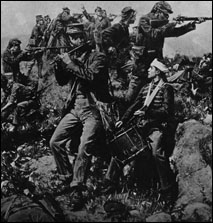
Several bands took the field, serving as a great morale booster to the men. At the Battle of Williamsburg, a retreat was beat from a Federal unit, and some of General Heintzelman's men, believing the order was for them, began to make a hasty skedaddle. He drew his sword, waved it above his head, ordering the men to halt. He caught eye of a band nearby, and shouted, "Halt there! Halt! Give us Yankee Doddle, or some other - doodle!"
|