
Inca History and Culture
Once upon a time conditions were bad and the people of the earth did not know how to live -- they were disorganized and didn't know how to cultivate the land. The Sun God upon seeing them suffer felt pity. To help them, he sent his children Manco Capac, the first Inca, and Mama Ocllo to the earth from the foam of Lake Titicaca. They were siblings as well as man and wife. They were instructed to build a city wherever Manco Capac's gold wand would enter the earth. They traveled very far before they reached the Huanacauri mountain, in the valley of Cusco, where the gold wand finally entered the earth. There they founded the capital and the Temple of the Sun in honor of their Father the Sun.
Manco Capac was recognized as the king and Inca of the valley. His mission was to teach men to work metals, make tools, plow and sow the earth, make their houses and defend their families, and Mama Occlo's mission was to teach women to cook, raise children and make beautiful textiles and clothing. They lived happily many years in their new kingdom. When Manco Capac died his son Sinchi Roca became his successor. There were fourteen Incas in total. When the natives saw the Europeans they welcomed them because they thought they were gods. This marked the end the Inca empire.
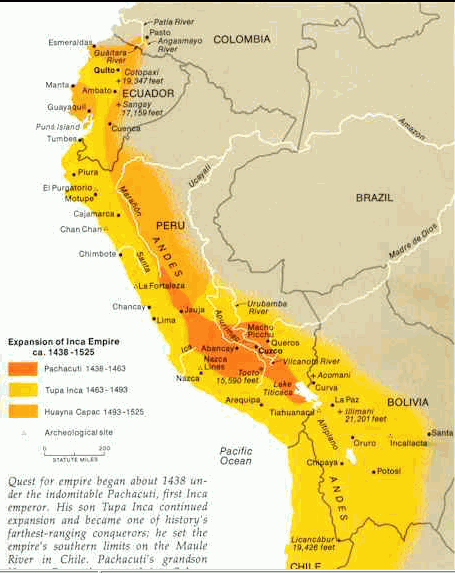
How big was the Inca Empire?
WERE THE INCAS A BAND OF POOR INDIANS? EVIDENCE SUGGESTS THE INCAS WERE AS RICH AS ANY OR MORE SO THAN ANY CROWN IN EUROPE.
Quechua Monarchs:
I Manco Capac (XI and XII century) - founder of the Incari; raised the
Inticancha (Temple of the Sun)
II Sinchi Roca - first sovereign to use a mascapaicha (headdress or crown)
III Lloque Yupanqui - conquered neighboring territories
IV Mayta Capac - known for his Herculean strength; prepared the first military
expedition to conquer the faraway land of the Condesuyos but died without
realizing the conquest
V Capac Yupanqui - was attacked by the Condesuyos but succeeded in vanquishing
them; conquered new territories and on returning to Cusco after his victories
was assassinated by the partisans of Inca Roca
VI Inca Roca - crushed the remaining partisans of Capac Yupanqui; abandoned the
Inticancha in the Hurin Cusco y (or lower Cusco) and constructed his own palace
in the Hana Cusco (or lower Cusco)
VII Yahuar Huacac - stolen as a child by the Ayarmacas; legend has it that he
cried tears of blood which frightened his captors who then returned him safe and
sound to Cusco; was assassinated by the Condesuyos
VIII Yahuar Inca
IX Huiracocha - fled with his son, the prince Inca Urco, when the Chancas
marched upon Cusco; his other son, Cusi Yupanki, personally fought and killed
the leader of the Chancas and put his decapitated head at the top of a lance,
thus frightening the remaining Chancas away; victory secured, Huiracocha put his
protected son Inca Urco to lead the victory parade. Enraged, Cusi Yupanki
murdered his brother, became prince and from then on was given his new name:
Pachacutec
X Pachacutec (1438-1471) - a political genius, perhaps "the greatest man
the aboriginal race of America ever produced"; went from being a king to
becoming an Emperor, and transformed his reign into an Empire; creator of the
Empire of the Tahuantinsuyo; edified Sacsahuaman; fathered 300 sons and
daughters
XI Tupac Yupanqui (1471-1493) - military genius; realized all of his fathers
conquests when General of his armies; invited reign by and with his father for a
while; completed Sacsahuaman
XII Huayna Capac (1493-1528) - fought back revolts in Chile, Tucuman, Chacnorth
of Chile and the south of Peru) and Yunga (on the coast)
The Language: all the towns had their own language, however, the Incas imposed Quechua or Runa-Simi ("mouth of man") so that all might understand one another - thus uniting a peoplenever anyone's property. It belonged to the Sun, to the Inca and to the ayllu or community. Capital did not exist, for there was no currency. However, everything had an exchange value. (5 potatoes = 1 corn; 5 corns = 25 potatoes). Work was general, obligatory, and preferably collective. One of the Commandments was: "Do not be lazy" - beggars did not exist.
Commodities: food, housing and clothing
The principal foods: corn, potato, sweet potato, oca, quinua and countless other vegetables of high nutritional value; dried and salted meat or fish; everything spiced with salt (cachi) or hot pepper (uchu); sweets were almost nonexistent
Houses in the mountains were built of stone and had roofs with to sides to them, one door and sometimes no windows. On the coast houses were made of mud bricks, had flat roofs made of bamboo and mud, and had several doors and windows.
Clothing was uniform, fashion did not exist, and children use the exact same clothing.
The Chasquis - a perfect postal service
The chasquis lived in chucllas, little huts on the side of the road, and while one chasqui slept, the other waited attentively the arrival of a possible messenger.
Two chasquis per chuclla and two chucllas per post office was the principle of the organization. The chasquis ran 200 meters per minute and never a distance greater than 2 kilometers.
The Principal Gods
Huiracocha: maker of the Universe
The Sun, Inti: the ancestor of the Incas, the very first father of the Incas -
henceforth the Incas call themselves the Children of the Sun
The Villac Umo: the Supreme Priest of the Sun; a brother or uncle of the Inca
encharged in making prophecies; supervisor of all the priests in the empire;
great political authority
The Acllas: the Virgins of the Sun - women given by conquered regions in tribute
to the cult of the Sun
Other gods of the Incari:
The Moon (Mama Quilla) considered to be the sister and wife of the Sun and
also the mother of the Incas
The Stars (Coillur) whose unit formed beautiful constellations, sed wind
instruments were: the quena, the pincullo, the antara and the pututo. Some of
the percussion instruments included the tambor (one of which was very large with
the rim made of gold, and another which was from wars - made with human skins of
vanquished enemies) and shakers (cascabeles de palo) which were fastened at the
knees and ankles.
Dance was preferably for magical-religious or ceremonial purposes, but were also used for the purpose of wars, harvests and diversion. Men participated in all dances, but women were prohibited to take part in war dances as well as many magical-religious dances. Dances had a collective or choral character.
The Incas cultivated all the styles of Poetry (lyric, epic and dramatic). The Haravicus (poets) enjoyed great respect in the Empire.
Conquering South America's western edge, the Incas ruled three distintic geographic regions that Spanish soldier-chronicler Pedro Cieza de León termed uninhabitable : rainless coastal deserts, mountain ranges towering more than 22,000 feet, and steamy rain forests. On slopes rising four vertical miles, climates in the empires varied from tropical to polar. In scattered areas on this slopes, at both high and low elevation, the Incas terraced and irrigated the land and produced abundant food for the twelve million or more subjects. A 10,000-mile network of roads, some as wide as 24 feet, knitted together the Incas' domain. Paralel trunk lines-connected by lateral roads tracing river valleys-followed coast and highlands. Four main highways entered Cuzco, the heart of the empire.
GOLD, to the Incas, was "the sweat of the sun," and SILVER " the tears of the moon."
Their love for precious metals was esthetic, for neither Incas nor their subjects needed to buy anything. Twelvw million or more worshipful people rendered abundant tribute to the Incas and paid their taxes in work: a billion man-hours a year to build temples, fortresses, agricultural terraces, and roads- all for the grandeur of the realm.
" The riches that were gathered in the city of Cuzco alone, as capital and court of the Empire, were amazing and incredible," a priest penned more than four centuries ago, " for therein were many big gold houses and enormous palaces of dead kings with all the inmaginable treasure that each amased in life; and he who began to reign did not touch the state and wealth of his predecessor but... built a new palace and acquired for himself silver and gold and all the rest...."
Cuzco became the richest city in the New World. Chiefs and governors , made presents to the Inca, when they visited his court and when he went to their lands, while touring his kingdom. This wealth grew daily, for provinces were many and others were continually being brought to obedience.
It was prohibited to remove silver and gold from Cuzco. " Nor was it spent, in things that are consumed with use," but for idols, goblets, and ornaments for the temples, the king, and great nobles. As money did not exist, rulers paid their retainers in clothing and food. Author William H. Prescott's account of imperial splendor ,persuad us, that life among the Incas - even to taking a bath - was the epitome of pleasure.
The Incas, "loved to retreat, and solace themselves with the society of their favorite concubines, wandering amidst groves and airy gardens, that shed around their soft, intoxicating odors and lulled the senses to voluptuous repose. Here, too, they loved to indulge in the luxury of their baths, replenished by streams of crystal water which were conducted through subterraneous silver channels into basins of gold."
 GOLD:
fiery metal esteemed by the Incas for its beauty and sought by the Spaniards for
its worth. Exciting the greed of conquistadors, it brought an empire to ruin. To
Incas, gold was "the sweat of the sun ," and it reflected the glory of
their Sun God who, they believed, had entrusted them with its safekeeping. Gold
took on value only when crafted into ceremonial articles - vessels, jewelry,
figurines - or adornments for tombs and temples,. By law, all gold and silver of
the realm belonged to the emperor, who used it to bedeck his palace,beautify
temples, and reward loyalty. Most gold - in the form of nuggets and flakes -
came from mountain rivers; Incas smelted the ore with charcoal and bellows. They
learned much of the craft from artisans of the Chimu Kingdom, who created
countless vessels and ornaments. Spaniards reduced such works of art into
ingots, easy to transport and exchange.
GOLD:
fiery metal esteemed by the Incas for its beauty and sought by the Spaniards for
its worth. Exciting the greed of conquistadors, it brought an empire to ruin. To
Incas, gold was "the sweat of the sun ," and it reflected the glory of
their Sun God who, they believed, had entrusted them with its safekeeping. Gold
took on value only when crafted into ceremonial articles - vessels, jewelry,
figurines - or adornments for tombs and temples,. By law, all gold and silver of
the realm belonged to the emperor, who used it to bedeck his palace,beautify
temples, and reward loyalty. Most gold - in the form of nuggets and flakes -
came from mountain rivers; Incas smelted the ore with charcoal and bellows. They
learned much of the craft from artisans of the Chimu Kingdom, who created
countless vessels and ornaments. Spaniards reduced such works of art into
ingots, easy to transport and exchange.
From the left and down: a) Deer adorn, a Chimu religious vessel. b) Inca jug, possibly held holy drink. c) Chimu necklace, of gold and pearl. d) Rare Inca solid gold figurine - 11 inches high. e) Gold hand and arms sheathed Chimu mummy.
CONQUEST OF PARADISE
 About
1438, the ninth Inca, Pachacuti, set forth to conquer on a scale never before
attempted in aboriginal America. By the time Columbus crossed the ocean sea in
quest of Indies, Pachacuti and his son, Tupac Inca, tenth Inca, had forged an
empire nearly as far reaching and well organized as Caesar's Rome. They Called
it Tahuantinsuyu, Quechua for the " Four Quarters of the
World ".
About
1438, the ninth Inca, Pachacuti, set forth to conquer on a scale never before
attempted in aboriginal America. By the time Columbus crossed the ocean sea in
quest of Indies, Pachacuti and his son, Tupac Inca, tenth Inca, had forged an
empire nearly as far reaching and well organized as Caesar's Rome. They Called
it Tahuantinsuyu, Quechua for the " Four Quarters of the
World ".
Huayna Capac - Valiant Youth - surely visited Machu Picchu after he succeeded Tupac Inca in 1493, for he devoted years to a grand tour of his inherited Four Quarters of the World. Seeking new worlds to conquer, the eleventh Inca marched north beyond Ecuador to the land of Pasto in Colombia to attack rich goldsmithing cultures. Then, up risings in Ecuador pulled him back in anger and massacred 12,000 Quitus and Cannaris indians (including women and Children), the blood of this people reddened the waters of a beautiful lake. Today, they call this lake Yaguarcocha, Quechua for " bloody lake ".
Huayna Capac settled down in Ecuador with his hundreds of wives and concubines, occupying a sumptuous palace of which no trace remains. Today natives, reminders of the brief lnca occupation of Ecuador are Quechua-speaking Indian communities of diverse tribal origins-some from distant Bolivia- found along the Pan American Highway.
 The
emperor's warrior son, Atahuallpa, became a favorite of the battle-tested armies
that carried on the northern border campaigns. Meanwhile premonitions of doom
haunted Huayna Capac. Chasquis, post runners who carried quipus along the royal
roads, delivered many a dire message to Ecuador. One from the oracle at the
Apurimac River bridge, 1,000 miles away, warned that bearded beings would
subvert the empire. A chasqui from the coast reported that such men had appeared
on floating houses but soon sailed out of sight. Then many runners warned that
pestilence was sweeping the realm-the first of many mortal blows that weakened
the empire on the eve of the holocaust to come.
The
emperor's warrior son, Atahuallpa, became a favorite of the battle-tested armies
that carried on the northern border campaigns. Meanwhile premonitions of doom
haunted Huayna Capac. Chasquis, post runners who carried quipus along the royal
roads, delivered many a dire message to Ecuador. One from the oracle at the
Apurimac River bridge, 1,000 miles away, warned that bearded beings would
subvert the empire. A chasqui from the coast reported that such men had appeared
on floating houses but soon sailed out of sight. Then many runners warned that
pestilence was sweeping the realm-the first of many mortal blows that weakened
the empire on the eve of the holocaust to come.
About 1525 Huayna Capac was stricken possibly by smallpox introduced into the continent by Europeans probing its coastline. Twice he named an heir and twice his priests, hurriedly performing the calpa ceremony divination by examining llama viscera-predicted dire reigns for his choices. Before he could choose again, he died. In Cuzco the high priest conferred the royal fringe on Huascar, a son of Huayna Capac and his sister wife the queen. But Atahuallpa, Huascar's half brother, governor of Quito, reportedly refused to accompany his father's mummy to Cuzco and render homage. His generals, veterans of Ecuadorean wars, backed his insurgency, and civil war flared.
Huascar sent a huge inexperienced army against Atahuallpa, but it perished in battle near Ambato, Ecuador. The chronicler Cieza, who saw the skeleton-strewn battlefield twenty years later, wrote that the body count of 25 or 26 thousand was an underestimate.
Huascar conscripted army after army, including peasants from as far away as Argentina. Thousands who had escaped the plague now fell under the northerner's onslaughts. Perhaps 200,000 men fought in the final battle near Cuzco. The unthinkable occurred: Atahuallpa's generals tumbled Huascar from his golden litter. Cuzco's defenders fled in terror. The Son of the Sun had fallen.
The generals dressed the emperor in women's clothes. They forced him to eat excrement in Cuzco's streets and watch the extermination of his multitudinous family and courtiers.
Bitterness engendered by the war between the brothers persists to this day. "Bad blood between Peru and Ecuador began with Inca politics and culminated in our 1941 border war, a neighbor declared when I visited Cuzco, between Huascar and Atahualpa streets. "Ecuadoreans call Atahuallpa an emperor, but in my history book he was just a bastard usurper".
ATAHUALLPA had left Quito to make triumphal entry into Cuzco when he got word of his generals' victory. But at this moment coastal chiefs warned him of Pizarro's approach. A mere 62 cavalrymen and 106 foot soldiers, armed with Toledo blades and a few guns and crossbows, were winding slowly into the mountains of northern Peru.
 Curious to see the strangers, their beasts, and their magic staves that
commanded the lightning, Atahuallpa broke his journey at Cajamarca, 600 miles
northwest of Cuzco. He ordered the town evacuated, sent gifts to Pizarro, and
waited at nearby thermal baths, attended by his wives and nobles. Tents of his
army blanketed surrounding hills, although his best troops were pillaging
Cuzco. He had consulted the oracles, and they had reassured him of his
invincibility.
Curious to see the strangers, their beasts, and their magic staves that
commanded the lightning, Atahuallpa broke his journey at Cajamarca, 600 miles
northwest of Cuzco. He ordered the town evacuated, sent gifts to Pizarro, and
waited at nearby thermal baths, attended by his wives and nobles. Tents of his
army blanketed surrounding hills, although his best troops were pillaging
Cuzco. He had consulted the oracles, and they had reassured him of his
invincibility.
Meanwhile, the citizens of faraway Cuzco had found new hope. They thought Pizarro was coming in answer to their prayers to the supreme being, Viracocha, for deliverance from Atahuallpa. After the creation, Viracocha had set off across the Pacific walking on the waters. People believed he would re appear in times of crises. Surely the bearded saviors were sent by Viracocha!
Ironically, the white man inherited the god's name.
From the heights where Fizarro first sighted Atahuallpa's camp, I looked down one frosty morning on the green fields of Cajamarca, where scalding overflow from the Inca's Bath still wends through lush grass and fills the valley with vapor. As the sun rose, it lifted the mist from the stage of one of the most dramatic confrontations in history.
Pizarro sent an interpreter and 15 riders under Hernando de Soto (who later discovered the Mississippi River) to offer his services in arms and to ask the emperor to dine next day. The seated Inca offered ceremonial chicha, accepted the invitation, and told his guests to occupy the town plaza. Before leaving, De Soto galloped up to Atahuallpa and reared his charger. Nobles flinched. The Inca sat unmoved on the royal stool.
That night Atahuallpa executed the cowardly nobles. The Spaniards prayed till dawn.
Pizarro set the trap that the Inca bad unwittingly provided him. In the great triangular plaza, with an entrance at its apex, he laid an ambush. He hid his forces inside buildings that had doorways, high enough for horse and rider, facing into the walled plaza.
On Saturday, November 16, 1532, the Inca delayed his social call until sundown, sup posing horses to be of no use after dark, and bemused by reports that the bearded men were hiding in fear. Then be capped his spate of bad decisions by going unarmed to sup and spend the night in town.
Preceded by hundreds of sweepers, whose cries of triumph, said one of the conquistadors, "sounded like the songs of hell," the Inca entered the plaza on his golden litter, at tended by richly dressed nobles and "five or six thousand menials." The only Spaniard in sight, a Dominican friar, came forward with a prayer book and read aloud. Atahuallpa examined the book, but as it failed to talk to him he threw it down.
Suddenly bugles blew, guns belched thun der, and the old Spanish war cry rang out, " Santiago (St. James) ! And at them ! "
Hoofed monsters charged out of trape zoidal doorways and trampled Indian flesh. Toledo blades turned crimson. Panic seized the courtiers; in their surge to escape, they demolished a chunk of the plaza wall.
Then, for the second time that year, a golden litter capsized and a Son of the Sun fell to earth. Within minutes Pizarro had plucked the Inca from the midst of his armies without the loss of a man. Spaniards pursued Indians into the night, killing, they reported, more than 8,000.
Pizarro's dreams came true, the audacity of a handful adventurers brought to a shattering end the glory of the Inca Empire and its immense wealths ever dreamed for a human being. The paradise was his, and It was now in his hands.
To this day the fabled wealth of that lost empire lures latter-day Pizarros--plunderers who for centuries have ravaged pre-Columbian graveyards. Their obsession: to eke a last few ounces of treasure from this golden chapter of South Americas's history.
THE PRIZE
ATAHUALLPA'S RANSOM : 24 TONS OF GOLD.
After the Spaniards - misused the Orejones' daughters and burst into state convents to violate the women there - captured Atahuallpa, he ruled for eight months from a prison compound in the triangular plaza, keeping his lordly mien, his authority unquestioned by any subject of the empire. Female attendants dressed him in robes of vampire-bat fur, held food to his mouth, and ceremonially burned everything he discarded. Great chiefs trembled in his presence.
To secure his release, Atahuallpa decreed that the realm be ransacked to fill a 18-by-22-foot room once with gold, as high as he could reach, and twice with silver. Totally unaware that Pizarro's men spearheaded a massive European invasion of the Tahuantinsuyu, he presumed the bearded ones would go away once they had received their booty.
Yet the young man’s life still hung by a thread .Shortly after the ransom compact was made between him and Pizarro. the captive learned that the Captain-General -- as Pizarro was now often called -- intended to have Huascar brought to Cajamarca. Afraid of what problems Huascar’s arrival in Cajamarca might cause him, Atahuallpa gave secret orders to have his brother killed.
The arrival of Almagro (Together with Pizarro and Luque, were the three partners of the conquest) in Cajamarca in February of 1533, with one hundred fifty infantry- and fifty cavalry, provided an additional threat to Atahuallpa's life. Until then, Pizarro could not advance on Cuzco. He needed Almagro’s reinforcements and help. Now he was ready, and Almagro, astonished to see such treasure, was eager to press on to get his share of the spoils. Only two things prevented such a move: one was the necessity of deciding what to do with Atahuallpa, and the other was to complete the collection of his ransom. Once the latter had been accomplish, some hinted, Atahuallpa's death would be the only realistic solution to the former problem.
In addition, the tense and quarrelsome relationship that had grown up between Hernando Pizarro – Francisco’s brother - and Almagro made it imperative that Francisco do something soon. But all Francisco's persuasive powers could riot repair the unpleasantness that existed between the two men, and he feared that the success of the whole enterprise was endangered by his brother's difficult nature. Once the treasure was disposed of, he decided, Hernando could be charged with delivering Charles V's share to Spain. Then peace could be kept with Almagro. Still, another darker and less honorable motive also may have led Pizarro to this decision. Hernando was known to be the friend of Atahualpa, and he might have interfered with the Captain-General's plans for dealing with the Inca.
Although the line drawn some months earlier had not yet been reached, the gold came almost to the mark. Pizarro decided to wait no longer before determining each man's share. All sorts of objects were involved-plates, goblets, ewers, salvers, many of such delicate craftsmanship that Pizarro planned to send them intact to Charles V.

By July 1533 more than 24 tons of exquisite treasure had been collected: idols and chalices, necklaces and nuggets, accumulated through centuries of placer mining. Though this was only a fraction of the plunder that awaited the Spaniards elsewhere in the Four Quarters of the World, Atahuallpa's ransom, as duly recorded in the Spanish archives, was worth at least 267 million dollars at today's bullion values for gold ($315 ounce-Nov/02/1997-) and silver.
Nine forges worked for months to reduce the creations of master craftsmen to lumps of gleaming metal. Each horseman's share was 90 pounds of gold and 180 of silver; a foot-soldier got half as much. Pizarro refrained from melting down many magnificent pieces and sent them to Spain as part of the king's share, the " royal fifth," but the king promptly turned them into coin. Not a relic remains of that fabulous roomful, not even the 280 pound golden litter Pizarro saved for himself. It's anyone's guess whether it eventually became a bag of barnacled ingots calcified into a Caribbean reef, a bar in a Swiss bank, or the protective sheath of a space probe.
After a selection had been made, the rest was melted down into standard-size gold bars, and each bar was weighed in the presence of the royal inspectors. The silver was treated in the same way. In both cases, Indian smiths were forced to destroy their own handiwork.
The distribution of this vast amount of plunder, estimated by modern authorities to be worth $266'671,370. was solely in Pizarro's hands. Having assembled the Spaniards and solemnly prayed to Heaven for guidance and wisdom, he made known his awards, refusing, as he did so, to recognize the claims of Almagro's men to share equally in the prize. In the end, they reluctantly agreed to accept a much smaller sum of 20,000 pesos de oro (or about $ 3'924,000). Although disappointed. they contented themselves with the thought of future spoils in Cuzco.
When Pizarro announced the rewards for those who had marched with him to Cajamarca, there was a breathless hush. For himself he set aside 57,222 pesos de oro (about $11'212,401); the Lord Inca's golden throne, worth 25.000 pesos ($4'905,000), and 2,350 marks of silver (or about $307,380). Hernando received 31,080 pesos ($6'097,896) and 2,350 marks of silver ($307,380); and De Soto, 17,740 pesos ($3'480,588) and 724 marks of silver ($94,699). Most of the sixty horsemen received 8,880 pesos ($1'742,256) and 362 marks of silver ($47,350) each, and about twenty of the infantry were allotted half that amount, while the remainder received shares three-eighths the size of the cavalry's share. Some 15,000 pesos ($2'943,000) was set aside for the garrison at San Miguel, and 2,220 ($435,564) for "the first Christian temple in Peru." No mention is made of the sums Pizarro paid to Almagro or set aside for Luque's estate. Unhappily, Luque had died before Almagro left Panama and never knew of the success of this great venture.
Only one obstacle remained -Atahua1pa. The treasure divided, he demanded his freedom and was supported in his demands by De Soto and other cavaliers. But Pizarro refused to honor his pledge. While formally acknowledging that the Inca had paid his ransom, he declared that reasons of state necessitated his being kept under guard.
The Captain-General and Almagro were in a quandary. They were afraid that Atahuallpa might be rescued if they took him on the difficult march to Cuzco and felt that if they freed him, he might rally his armies and seek revenge.
Again rumors of an impending attack by hostile Indian armies spread through the camp. Most contemporary chroniclers blame Felipillo for the malicious tales. From the moment that Atahuallpa had demanded the young interpreter's death for violating one of the royal concubines --a just punishment under Inca law-- Felipillo had evidenced a vicious hatred for the emperor. Since Felipillo wis indispensable to the Spaniards, he was spared, and after that he missed no opportunity to under-mine the Lord Inca.
By this time, Atahuallpa's most influential friend. Hernando Pizarro, had been sent to Spain, and De Soto. with a few cavalrymen, was selected to reconnoiter the area where the armies supposedly were massing. With both men out of the way, Pizarro suddenly yielded to the insistent demands of Almagro, the royal officials, and most of the troops. The Inca was brought to trial.
That expediency, rather than justice, was the reason for this decision is made clear bv the charges. Only one-- that Atahuallpa had attempted to raise a revolt against the Spaniards-- made any sense at all, and even that charge turned out to be unfounded. The rest of the charges accused the Inca of such crimes as murdering his brother Huascar, having more than one wife, and squandering public funds.

The last of the Inca emperors was not freed but sentenced to death for treason against the strangers within his own realm.
To avoid the horror of being burned alive as a heretic and thus deprived of mummification, Atahuallpa accepted Christian baptism and took Pizarro's Christian name: Francisco- Then the Spaniards garroted Francisco Atahuallpa, thirteenth Inca, and marched down the royal road to Cuzco.
C U Z C O
Cuzco, the capital of Cuzco department in southern Peru, was the capital of the INCA empire from its beginnings in the 14th century until the Spanish conquest in 1533. A tourist attraction, the city is known for its Inca ruins and Spanish colonial architecture. Situated at an altitude of 3,416 m (11,207 ft) in a broad valley of the Andes, it is the busy hub of a thickly populated agricultural region where sheep are raised and cereals and tobacco are grown. The population of 275,000 (1990 est.) is predominantly Indian, and the city, with its open markets, adobe houses, and narrow, winding cobblestone streets, is Indian in character.

Quechua, the Inca language, is still widely spoken. The climate is cool, with temperatures averaging about 10.9 degrees C (51.6 degrees F). Annual precipitation is 750 mm (29.5 in). The area is subject to earthquakes, the most damaging having occurred in 1650 and 1950.Inca tribes are believed to have come to Cuzco from the Lake Titicaca region in about the 11th century. The legendary founder of the city was MANCO CAPAC, first of the Inca rulers. The name Cuzco is Quechua for "navel," and the city was considered the center of the Inca world, the place where the four parts of the empire came together. It was the hub from which the famous Inca road network radiated.
Inca Cuzco was different in concept and plan from European cities. It was designed in the form of a puma, with the 15th-century fortress of SACSAHUAMAN as the head. The confluence of the Huatanay and Tullumayo rivers was canalized and straightened to form the tail. The core of the city contained official and ceremonial buildings and residences of ruling officials. Many other buildings and residences were dispersed at a considerable distance in the countryside surrounding the core, but they were defined as part of the capital.
The Inca capital is especially known for its architecture of enormous cut-stone blocks fitted so perfectly that no mortar was needed. Coricancha, the temple of the sun, and the fortress of Sacsahuaman are the most outstanding examples of this type of construction.

Inside The Cathedral of Cuzco we find this magnificent Colonial Painting worked in a remarkable Baroque style and framed with "pure gold".
From all parts of the Inca empire a wealth of silver and gold poured into Cuzco, filling the temples and palaces. These treasures were plundered by Francisco PIZARRO in 1533, and the city was destroyed. The Spaniards built a new city on the ruins of the old, adorning the magnificent edifices of their churches with the looted wealth. Under Spanish rule Cuzco flourished as an art center, home of the renowned Cuzqueno school of painting.
Cuzco, The " Archeological Capital of America", was the capital of the fabled Inca Empire. Most striking in Cuzco is the superimposition and intermingling of the three cultures: the native Quechua Indian, the conquering colonial Spanish and the moderm Mixed or "Cholos". A visit to Cuzco without a pilgrimage to legendary Machu Picchu is unthinkable.

Machu Picchu - The End of a Legend ?
There are plans to develop the area of Machu Picchu in the very near future. The plans include a 6 story hotel full of tourist shops and tram, in hopes to quadruple the daily tourists. We feel this development would greatly alter Machu Picchu's impact on the spiritual pilgrim and even the unaware tourist who thinks he is just visiting an archeological site and returns home changed. We feel this will set a precedent for development of other sacred sites around the world and destroy the lives on hundreds of local people who count on tourism to survive. If you love Machu Picchu and sacred sites in general, PLEASE.... Help with the protest against development of Machu Picchu. All information can be found at :
http://www.flinet.com/~labyrinthina/unesco.htm
A visit to Machu Picchu exposes us to pure wondrous, wordless
energies of the ancients and nature, but this could all change. At present,
Machu Picchu has only one quiet hotel with only 33 rooms and a slow and bumpy
switch back road on which to ascend to the site.  This
has limited how many can visit Machu Picchu in a day. The site is quite serene.
There are no vendors rushing you to by an alpaca sweater as vendors are not
allowed on site. Tourists happily spend their money down in at Agua Calenties.
These heart centered local people count on tourist support to survive. The
economic balance between the rich corporations and the local people is very,
very fragile.
This
has limited how many can visit Machu Picchu in a day. The site is quite serene.
There are no vendors rushing you to by an alpaca sweater as vendors are not
allowed on site. Tourists happily spend their money down in at Agua Calenties.
These heart centered local people count on tourist support to survive. The
economic balance between the rich corporations and the local people is very,
very fragile.
The sacred sites of the world were build by the ancients to be
worked with in a sacred way, but more and more, the sacred sites of the Americas
are becoming Americanized, losing their spiritual impact along with their
beautiful cultures and traditions.  I
truly believe that one of the reasons these damaging events can happen in sacred
sites is because the energy has been depleted unknowing tourists to the point
that the site itself losses its protection from exploitation. Also what is
allowed to happen in Machu Picchu will not only harm it's natural peace filled
beauty and frequencies, but could impact every other sacred site in the world.
If Machu Picchu's development project goes though with success, other sacred
sites in the world could follow suit. It makes me grieve to think that many will
never experience Machu Picchu as we have in the past.
I
truly believe that one of the reasons these damaging events can happen in sacred
sites is because the energy has been depleted unknowing tourists to the point
that the site itself losses its protection from exploitation. Also what is
allowed to happen in Machu Picchu will not only harm it's natural peace filled
beauty and frequencies, but could impact every other sacred site in the world.
If Machu Picchu's development project goes though with success, other sacred
sites in the world could follow suit. It makes me grieve to think that many will
never experience Machu Picchu as we have in the past.
For further info on how you can help, please visit www.mpicchu.org