
ask you this, "Is there a differance between Situation Awareness and Situation Assessment? I have come to the conclusion that to merely use "SA" for both applications is erronous. I think the Air Combat Flight Sims Community
terminology should include "SAw" (Situation Awareness) and "SAs" ( Situation Assessment). Hencefore when I am talking about the word Situation Awareness I will refer to it as "SAw" and for Situation Assessment I will refer to it as "SAs".
Some of you are thinking that :SAw" and "SAs" are the same. Just consider this. How often do you die without having seen the threat before the tracers start flying overhead and you start taking hits? How often do you die bby exploding before you can ever react to an unkown attacker? How often do you die and wonder, "man", I know I'm a better Pilot
than this! Why does the other guy always seem to have the advantage on me?
It might be because you are not excercising "SAw" and "SAs" as well as the other guy". Air Combat is like a 3 Dimensional Chess Game. The moves you make early in the engagement determine whether you will have the advantage
or not. In my opinion, it is only the TOP CAMBAT FLIGHT SIMER ( NO MATTER WHAT COMBAT FLIGHT SIM IT IS) PILOT that can take a poistion of Disadvantage and reverse it. Unfortunately, I am not one of them, so I cheat.
I "CHEAT" by using "SAw" and "SAs" better then the average pilot. "OK", so you cheat. Help me to cheat, too" you
say?" All right, think about this.
Definition: SITUATION AWARENESS- THE PROCESS AND METHOD OF OBSERVING SPACE AND OBJECTS IN A THREE DIMENSIONAL EVIRONMENT. "Well,Duhhh! Like I'm not already lookin around! You'r thinking to your-self?
But are you excercising a Process and Method of Observation? Just looking from time to time don't hack it. How often
do you check your own 6? Every 60 seconds, every 30 seconds, every 10 seconds? How often do you truly do a 360 scan?
What are you looking for? Icons or Dots? Flashing through a bunch of Hat Views as fast as you can and reacting only to Icons? You are DEAD!!
Program a variety of Hat Views that allow you to scan your evironmant with as little trouble as possible. Take the time to Roll over a bit to look around. Burn a little Energy to roll, pull, look up, and back to check your 6. What's your choice? Burn a little Energy now and live to Fight or Die at the hands of unseen Foe with "ALL" that Energy you saved
(and never got to use).
You heard this statement before, but it has Merits Repeating; "DON'T GET TARGET FIXATION"! Even if you're actively tracking and shooting at a Bandit, continue to Check Your VIEWS to See What's going on around you. "PULL OFF YOUR PREY" "BEFORE" You become disadvantaged by incoming BOGEYS/BANDITS!!!! Give up the Kill to save
your LIFE. You'll be in the air longer, and you will have other opportunities. Plus you may have damaged your Prey
sufficiently to be credited with the Kill later when someone else finishes him off or if he crashes due to damage.
Don't flash through your Hat Views looking foe and reacting to only ICON'S. Pause on each View and look for "DOT'S". This is a Skill you'll need to LEARN when flying in LIMITED or NO ICON FLIGHTS.
Also remember this is a CHESS Game. The "EARLIER YOU CAN ACT ( rather then REACT)" the more likely you are
to have the Adventage when the Engagement starts.
"SAw" also includes "Aircraft Indentification". One of the Skills you must Develop; is the ability to Indentify the Enemy
and with that knowladge, and the knowladge of how his aircraft compares to yours. Plan how to over come him by using
your adventage against his disadventages.
Here is a great way for you to learn what I am talking about. Try this Practice Exercise off-line. First there are a Few things we must get Set Up for this Execise. Start up the game, once the game has open up, go to your CONTROLS and click on it. Once that has open up scoll down till you see and find "TOGGLE ICON TYPES: When you find this,
go to the right of the "TOGGLE ICON TYPES: and click there till you see a box open up. Now click ALT+Q, it should
read like this: Now click Apply and close that window down. What we have done here is to make it so you can open and close the AIRCRAFT ICONS by hitting the Alt+Q keys together. We wanted to able to do this for this Practice Exercise.
As you will see later when you are about to start the Exercise and what it will be used for.
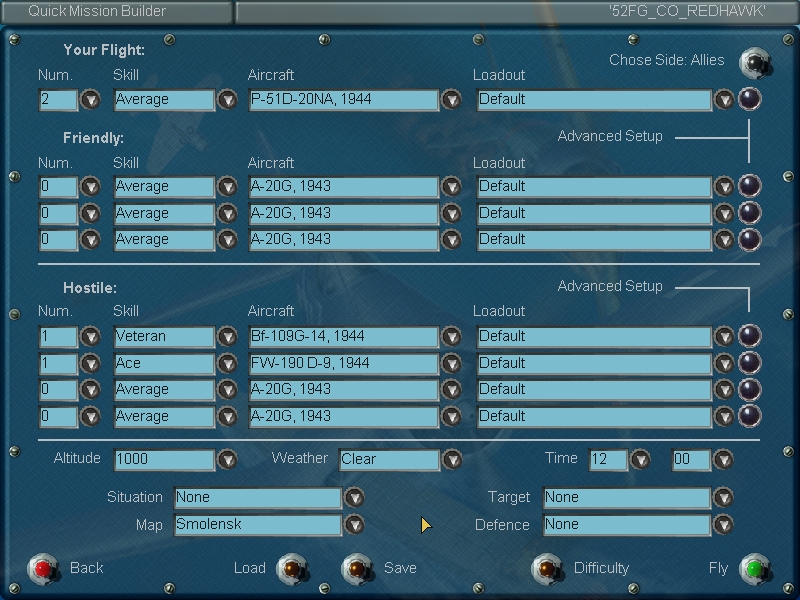
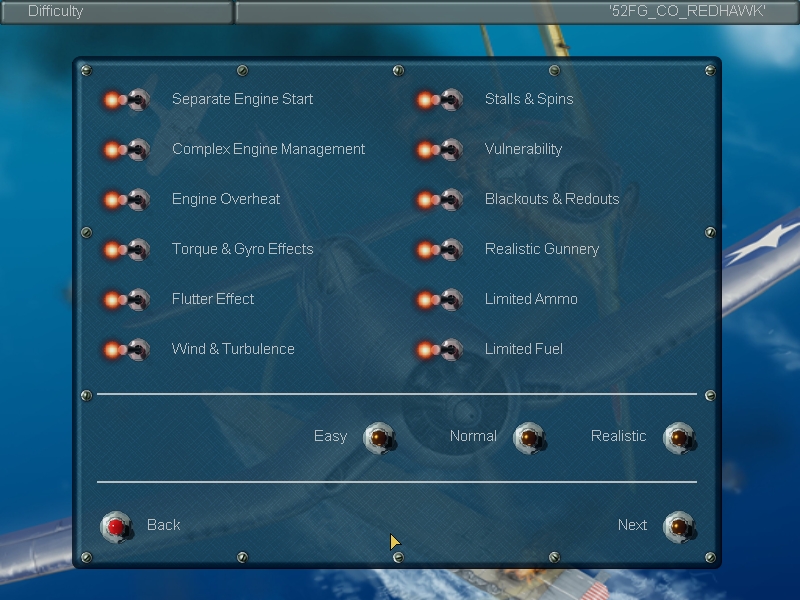
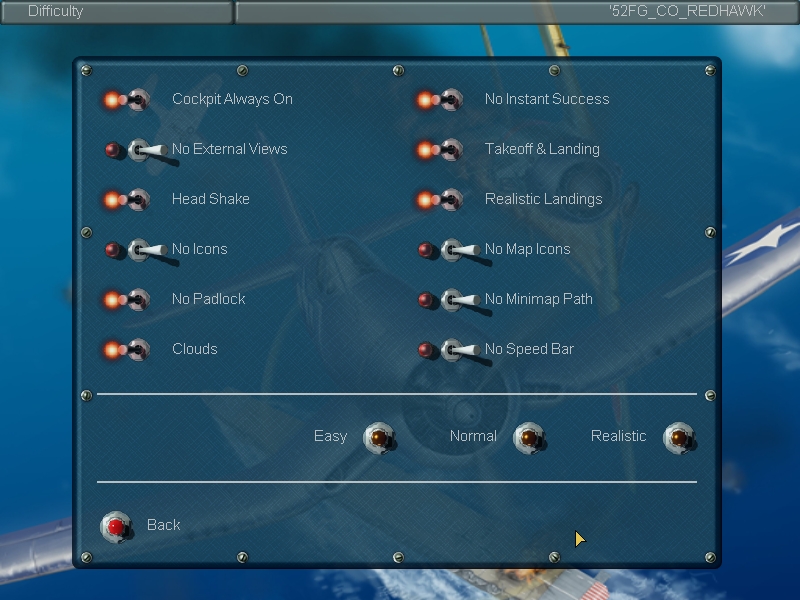
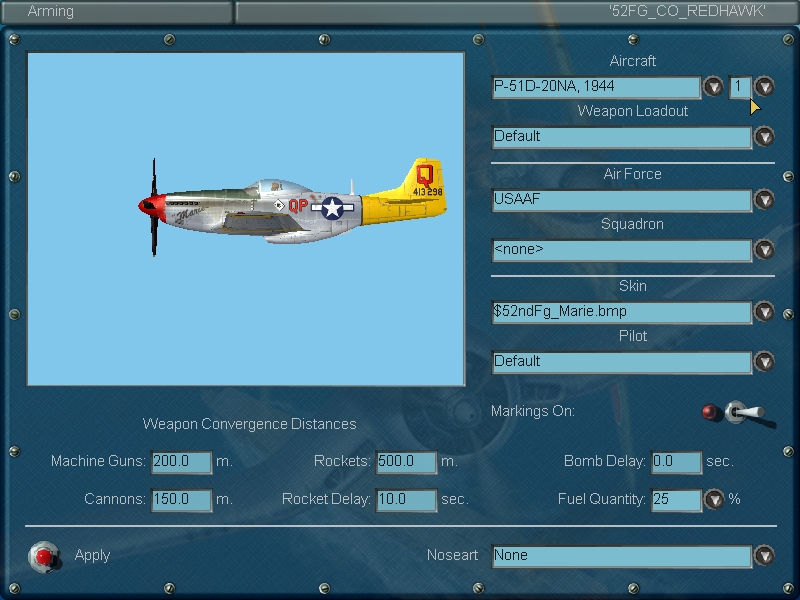
and another window will open up, there you will see an oblong box, type in TRAINING1, and then click on save, then click DONE. Now this Training Mission is saved and you can use it over again.
Now you can click on FLY. When the Flight starts up Remember what this Exercise is for, To Build your Situation
Awareness and Situation Assessment Skills up and to learn by looking for "DOTS" and not for "ICONS". Fly around turning the ICONS off by hitting the ALT+Q key off and on to see how many types you can identify accurately. Not just the model but the variation. That is, you may know the Bandit is a FW-190, but can you tell which variant it is?
Makes a difference in how you combat him. Some variants are easy to discern, some are not. As you learn them you'll
develop a general plan that is modified as you get close engough to tell what you are up against.
The same Exercise can be done but with distance the variable. Turn ICONS OFF, guess the distance of the Bandit, turn
ICONS on to see how close you are. This is another SKILL you need to learn. This is helpful when in a COOP Mission,
you can pay more attention to identifying the variant by looking at the plane rather than monitoring the ICON to see what range he is at. Since timing is everything in Air Combat, if you develop the ability to quickly "SEE AND RE-
COGNIZE" what you are looking at you will have more time to do Situation Assessment.
Situation Awareness is a still picture, a snap shot, a millisecond of time frozen in your view. Situation Awareness is a three dimensional subject, the x,y,z axes of spatial relationships among objects. Good Situation Awareness requires developing a method and process for surveying the environment around you and the knowledge to understand what you see.
Situation Assessment adds the Fourth Dimension (t) to the x,y,z axes. Can you define (t)?
You now have information about your environment having exercised the principles of SAw. This information about yourself and other objects in your environment includes:
1) POSITION
2) ALTITUDE
3) VECTOR (Direction of travel)
4) ASPECT (Direction the object is pointing)
5) SPEED
6)ACCELERATION/DECELERATION RATE
7) THE CONDITION OF THE OBJECT
a) FUEL
b) ORDNANCE
c) AMMO
d) INTACT/SHOT UP
e) TYPE OF WEAPONS
8) THE TYPE OF OBJECT (Aircraft-model and variant, ground object, ship,etc...)
9) WINGMAN (Yes or No)
10) Squadron Flight (Yes or No)
11) INTENTIONS/AGENDA/MISSION
12) PROXIMITY OF FRIENDLY BASES
13) PROXIMITY OF ENEMY BASES
I'm sure I am missing something important in this list above, but you get the ideal. The above attributes are evaluated for yourself and for all of the objects both friendly and enemy that are in your sight and within your knowledge yet out of view. In order to evaluate some ofthese conditions, you must observe for an uninterrupted period of time, or you must be able to take several still pictures as you move quickly from one view to another, remember the previous view and base your evaluation on the change between one viewing and the next.
Most of the characteristics listed above are obviously important in assessing your environment. Some, such as acceleration/deceleration and speed are more diffcult to assess without close scrutiny. The crux of assessment is to take all this information and evaluate the relationships between all of the objects, including yourself, in matter of a few seconds or less. Accurate evaluation of the relationships between all of the objects is heavily dependent on your ability to project the images in your three dimensional still picture into the future using your best estimate of how the fourth dimension, the (t) factor, TIME, will affect these relationships.Now, that sounds really complicated, right? Well, consider the additional complexity that all of these objects have the ability to alter many of the most important characteristics listed above. Virtually none of the objects will continue for any period of time with the same charactistics. Speed,victor,accelleration,altitude.....etc, rather than constant are continually changing. That's right. Number 11 above implies intelligence or programming, goals and a plan which varies from indifference to you to a desire to see you vaporize.
Consider the task I've described above. Now imagine you are entering a Combat Zone with 15 enemy planes and 15 friendly planes. They are all mixed at different energy states and altitudes and aircraft and speeds and vectors and,and,and.....etc, well,you've been there. Can anyone truly assess every variable in that environment accurately? I don't think so, but, there are those who have the ability to sort the information, avoid overload and prosper.
The key is to sort the objects into classes that determine their priority of attention. If someone marched you out to the edge of a river and commanded you to build a bridge it would be an impossible venture if you tried to immediately solve every possible "puzzle" from what type of concrete to use for the foundation to the stress classification of the bolts required to hold the beams in place. You would have to gather information about the objects in the envirronment and assess which issues had to be addressed first in order to accomplish your goal. You then work through a logical progression of activities, making additional assessments as you go.
In Air Combat environment you must make an assessment of the objects confronting you and start sorting them so you will handle them in a logical order. The classic form of sorting starts by categorizing the enemy objects that are in your sphere of influence by degree of threat and opportunity. The simplistic view would sort enemy objects as either threat or opportunity. However, each enemy object should represent a value of threat "and" opportunity.
Some examples of how two enemy objects would be valued in terms of Threat/Opportunity:
1) A FW-190-D-9 is 3K above you traveling opposite your direction at 3 O'Clock and laterally to your side bby 1000 yards. Using your right/up view you notice his right wing dipping toward you and back level a couple of times. Your view of him is blocked (You are in a P-51B) as he continues flying the opposite direction. His wing dip is a tip off that he was watching you, so you know he knows you arew there. I'd rate the Threat potentiaal as very HIGH, say 95 on a scale of 1 to 100. The opportunity potential I'd rate as about 15 on the same scale of 1 to 100.
2) You are 2K above a BF-109K-14 that is chasing a friendly on a vector 90 degrees off your victor. The Bandit is at your 11 O'Clock. You are in a P-51D. I'd rate the potentials threat 5, opportunity 90.
3) You see a FW-190A-8 approaching your 12 O'Clock and coaltitude. You are in a P-47D. I'd rate this as a 50/50 potential.
Obviously, I/m leaving out a lot of detail, but hope you can see the point. You can't think of enemy objects as merely threats"or" opportunities. The potential is there for them to become either a threat -or-an opportunity regardless of your initial assessment.
You sort by threat/opportunity is influenced by all of the characteristics you observed through SAw, that is aircraft
model,speed,altitude,etc. You blend into your assessment the (t) factor,TIME, to priortize the clsest objects. You may have a huge threat potentil 4 minutes away on the horizon and an equally huge opportunity 30 seconds in front of you.
Plan an escape, grab the opportunity and then hual for home. Set a time limit for yourself, though, and if you don't capitalize on the opportunity before your time expires, pull off and execute your extraction strategy.
This sounds easy enough in an uncluttered environment. However, the work load gets to be overbearing when you're in a crowd.That's why you must continually update SAw and SAs with your head on a swivel. By taking small bites out of the total picture and handling what will be in your face in the next tow (2) minutes for instance, you can begin to juggle objects only as you need to rather than juggle them all at one time. Cut here, take a shot, look around (SAw) make a judgment (SAs), kick some butt, roll out,(SAw) (SAs) dive in,(SAw) (SAs), make a gun pass,(SAw) (SAs) pull up,(SAw) (SAs). You can relax the process based on the environment but as soon as you do, someone will blind side you. Either that or you don't see an incoming Bandit in time to set yourself up with an advantage and you have to work a lot harder.
Your natural talent for SAw and SAs is an enormous influence on your early success or failure in any Air Combat Flight Sims. I think it is important that you undersatnd that statement and agree with it. Otherwise, you will hit an invisible wall that will prevent you from progressing beyond a certain level of achievement. Because the force that is holding you
back is unknown or misunderstood factor, it is easy to become discouraged and give up. Your natural talent for SAw and SAs will determine how quickly you progress towards success in IL2FB/AEP/PF or any other Air Combat Flight Sims. Like any other talent, we all have it in varying drgrees. If you have a large potential latent talent, these skills seem to develop themselves without a lot of work on your part. If you don't, you can still develop the skills, but it takes more work and practice. Most people with a moderate amount of talent will succeed in most Air Combat flight Sims, with experience and conscious study and a lot of hard Practice.
"So", you might ask, "if I've been flying for 3 monthss and my Kill/Death ratio is 1/40, does that mean I don't have the "the gift" for good SAw and SAs? No, there are many other factors that contribute to your early period of growth that are more influential. Gunnery skills, comprehension of energy states, basic Air Combat Manuvers, stick control and many other subjects that are off topic here. It is important,though, to be aware of SAw and SAs and study and practice those principles as you learn the other fundamentals.
For those who have flown for a year or more and are having trouble getting past the 1/1 Kill/Death ratio I sugguest your primary field of study should be improving SAw and SAs. You probably have the basic skills required to overcome most enemies "if" you enter the engagement from a posture of advantage. If you are constantly finding yourself on equal footing or at a disadvantage with your foe, then most likely the fault will be found in your SAw and Sas skills. Patience is required. Patience to set up your sortie to promote succees. Patience in how you engage the enemy.
Most people who fly in any Air Combat Sims don't have the patience, the time or the inclination to invest in what it takes to become even an average pilot. If you are one of the few that is prepared to exercise the patience and the hard practices required to become average: SAw and SAs skills will be the difference between getting stuck at a low level of success or being able to progress to a level of achievemnt that you can be proud of.
Remember the skills of SAw and SAs depends on how hard you want it. The best way to learn these skills is by a lot of hard work and a lot of hard practices. So PRACTICE,PRACTICE,PRACTICE!!!!!!!!
Now on to the next subject: "SITUATION AWARENESS!!!!

