
Full restoration of the instrument (requiring 28,000 hours)
pipes, pressures, tuning etc. Back to the CD
notes!
In 1937 his close friend Widor died, and in the same year during his
1750th recital at Notre Dame, Vierne had a massive
stroke and collapsed and died at the organ console. Beside him was one
of his students, Maurice Duruflé, with whom he
had
been sharing that evening�s programme. Vierne witnessed much tragedy
throughout his life, reflected in many of his
compositions. His sister, Henriette, died at the age of three from
pulmonary congestion. Both his brother René, himself
a talented organist and composer, and one of his sons, Jacques, were
both killed in combat in the First World War. He
divorced his wife after discovering an affair with Charles Mutin, the
famous organ builder and a supposed friend, and his
other son, André, died of tuberculosis. The death of his close friend
Guilmant prompted Vierne to say � �I shared with this
excellent man a friendship which never once in fifteen years saw a
cloudy
sky�. As an organist he was renowned for his
improvisatory skills and counted among his pupils Bonnet, Dupré and
Duruflé. His compositional output is mainly for the
organ and includes the �Six Symphonies�, �24 Pièces en Style Libre�, and
the �24 Pièces de Fantaisie�. Apart from
the �Triptych� on this recording he wrote other music for voice, for
piano, for chamber music combinations, for orchestra
and chorus and sacred choral music, one of which, his �Messe Solennelle
�, is also heard on this disc.

Louis Vierne (1870-1937)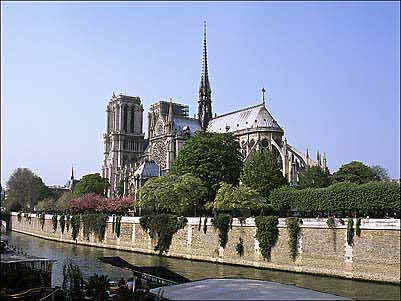
Cathedral of Our Lady, Paris
Louis Victor Jules Vierne was born on 8 October 1870 in Poitiers, France,
where his father, Henri, a man of strong
Bonapartist sympathies, was the editor of the newspaper Journal de la
Vienne. Vierne was born nearly blind, but after
an operation in 1877 enough of his sight was restored to enable him to
read large print and move around without help.
Nevertheless he learned Braille and attended a school for the blind. As a
boy he had piano lessons with Henri Specht,
who, incidentally, was blind. In 1889 César Franck invited Vierne to
become one of his pupils at the Paris Conservatory
and in the same year he attended the first performance of Franck�s �Three
Chorales for Organ� (played on the piano) with
the composer at the keyboard. In 1892 Vierne became Charles Widor�s
assistant at the Church of St Sulpice in Paris. Indeed
the two became great friends with Widor playing the organ at Vierne�s
wedding to Arlette Taskin in St Sulpice in 1899.
After a spell as Widor�s teaching assistant Vierne was appointed organiste
titulaire at the Cathedral of Notre Dame, Paris,
in 1900, the successful candidate out of fifty applicants.
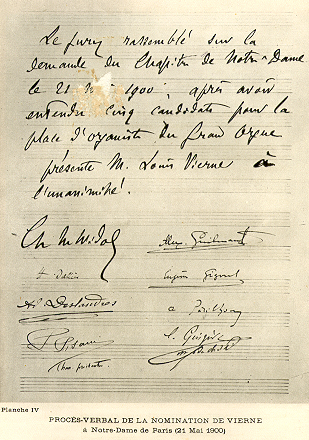
"The jury,
assembled at the request of the Chapter of Notre-Dame,
21 May, 1900, after
having heard five candidates [finalists] for the position of organist of
the Grande Orgue, unanimously select Mr
Louis Vierne!"
[The signatures of Widor, Guilmant and Gigout are at the
top of the letter.]
In 1906 he had a serious fall which resulted in a broken right
leg and ankle and doctors only just decided to avoid amputation.
Alexandre Guilmant resigned as organ tutor at the Paris
Conservatory in 1911 and he passed his pupils over to Vierne who spent
several years in the post until he took up an
appointment at the Schola Cantorum, later to become the �Ecole
César
Franck�. Vierne�s eyesight was by now beginning
to
deteriorate, and after an unsuccessful operation to cure glaucoma and
secondary cataracts he became virtually blind.
Spending the years of the First World War in Switzerland and the Savoie
region of France Vierne returned to Paris in 1920,
financially ruined and a broken man psychologically and physically,
suffering from neuritis in the right arm, rendering it
useless. He was also distraught to find that the organ at Notre Dame was
in an alarming condition and in desperate need of
restoration. He met Madeleine Richepin, a well-known soprano of the day
who befriended him and gradually encouraged and
supported him and helped to rebuild his life and career. In 1925 he gave a
concert tour of Ireland and Scotland to raise
funds for the restoration of the organ in Notre Dame, and in 1927 he
toured America and Canada to universal critical
acclaim. After much hard work the organ at Notre Dame was completely
restored in 1932 at a cost of 270,000
French francs.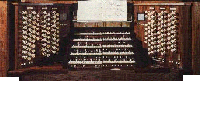
The Cavaillé-Coll
Organ at Notre Dame,
post 1932. 7800 pipes, (900 classed as historic), 109 stops, 5 56-key
manuals, 32-key pedalboard.
A brief
digression.
Restoration Work Since 1993
An innovative computer and local area network (LAN) system:
computers ... everywhere but hidden.
You can just see 2 colour displays inserted in the console.
Key commands via 300 magnetic switches.
No more problems with dust, candle-smoke or oxidisation caused by
12 million breathing visitors a year!
Controls of manuals and stops are digitalized by a synchronous
LAN in less than 1 ms.
Controls flow from the LAN console to LAN pipes by a twin 16 MBPS
LAN optical fibre token ring on 500 metres of
cable (not kilometres this time !)
To ... 800 valves opening engines controlled by a synchronous LAN.
The air is blown by bellows made of sheep leather, needing 1000 (!)
new sheep skins!
And ... besides all that a MIDI gateway !!! with a midi input plug
and a midi output plug. (The
internal architecture is not midi.)
The ENCORE � score software could be used to have a copy of the
improvisations.
All this was designed and created by SYNAPTEL �, a French
engineering company controlled under the direction of the
Ministere de l'Education Nationale et de la Culture.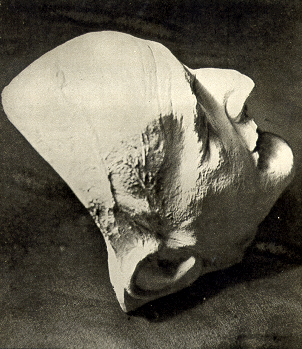
Louis Vierne (1870-1937) ~ His Death Mask
Messe Solennelle
Vierne�s Messe Solennelle, dedicated to the organist Théodore Dubois, was
first performed at the church of Sainte-Sulpice
in Paris in 1901 with Widor at the organ. As the piece is written for
choir and two organs, it is likely that Widor played
the Grand Orgue, being the organiste titulaire, and Vierne
played the
accompanying choir organ. The canonic vocal entries
in the Kyrie are preceded by a majestic introduction on the organ with a
pedal figure which will return sporadically
throughout the movement. The majority of the Kyrie, apart from the opening
entries and a cantabile tenor melody, employs
homophonic vocal writing. The final unison Kyries bring the movement to a
dramatic end. The brisk opening of the Gloria is
followed by a sedate, melancholic section at the words Domine Deus. A
haunting motif on the organ penetrates the single
vocal lines. From now on the movement builds to a thrilling climax using
material from the opening bars to give the
feeling of a very loose ABA form. The strident organ beginning to the
Sanctussets the mood for what will be a very
exciting and dynamic movement. This is reinforced by the ff unison singing
at the words Pleni sunt coeli, accompanied
by loud, punchy quaver chords on the organ. Calm is restored in the
Benedictus before the inevitable storm with the
return of the Hosanna with Vierne adhering to tradition using the same
material presented at the same place in the
Sanctus. The lilting rhythm of the Agnus Dei gives the work a breath of
fresh air and brings the Mass to a serene
close. Highlights of the movement are the imploring soprano and tenor
lines at the words miserere nobis. Apart from the
odd single melodies and canonic entries for the chorus, Vierne at no
point enters into any extended fugal writing.
Les Angélus
The Angelus is a devotional exercise commemorating the incarnation of
Christ and celebrated by members of the Roman
Catholic church. It consists of several short, set verses, three
recitations of the �Hail Mary� and a brief concluding
prayer. Traditionally accompanied by the ringing of the Angelus bell,
which reminds the faithful to recite the prayer,
it
is said three times daily, morning, noon and evening. The devotion takes
its name from the first word of the Latin
version (Angelus Domini nuntiavit Mariae). It was the subject of a famous
painting by the French artist Jean Millet,
and depicts farmers pausing in their fields to pray.
Les Angélus would be properly regarded as a brief song-cycle but is titled
by Vierne as a �Triptych for voice and
organ�, also stating that a version for voice and orchestra exists. The
Triptych obviously alludes to the three
Angelus prayer sessions. The work is dedicated to Vierne�s close friend,
the soprano Madeleine Richepin. It was written
while Vierne was staying at the Château de La Basse Bouchetière (Maine et
Loire) and was completed in April, 1929. The
first performance was given by Madeleine Richepin and Vierne at the church
of St Sernin in Toulouse on 2 February 1932.
The songs are a musical expression of the Angelus prayer and chiming of
the Angelus bell at morning, noon and evening
respectively.
1. Au Matin (Molto adagio)
In this first song a single chiming is heard beneath slow, ethereal organ
chords, heralding the dawn, before the voice
enters. The vocal line is extremely mellifluous and the notes rarely move
by more than one step at a time, perhaps
suggesting the leisurely beginning to the day. A leaping figure in the
right hand of the organ part, whilst not technically
mirroring the single chime of the Angelus bell, creates a �bell-like�
effect and precedes the single chime which returns
this time above a tonic pedal towards the end of the song. The mood of
the music, both in the voice and the organ,
perfectly depicts the relaxed start to a busy day for artisans, farmers
and peasants alike.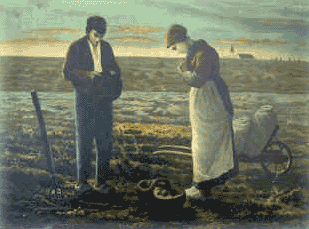
The Angelus (1859), by Jean Francois MILLET (1819-1875)
2. À Midi (Andante con moto)
This pivotal song has a pastoral atmosphere, much in keeping with the
imagery in Millet�s painting. It presents
another �bell-like� figure in the opening six bars of the organ part.
For the duration of the rest of the song the organ
manuals play continuous undulating semiquavers with the bell figure
appearing in a variety of guises and keys. The voice
sings a more relaxed line strengthening the pastoral lilt of the song
and the incessant semiquaver movement brings the
piece to an end. Midday and its naturally increased activity is well
reflected here.
3. Au Soir (Andante moderato)
Tranquility returns in the final song with the evening chimes being
rung out in unison on the organ over a syncopated
motivic figure. The sustained vocal line sits on top of the opening
organ material before the mood becomes slightly more
agitated. The right hand of the organ part plays a rocking two-part
crotchet and quaver figure while the voice joins in
this passage of mild chromatic activity. The rocking figure seems to
almost have the feel of a lullaby, underlining the
atmosphere of welcoming sleep, sunset and above all the end of a busy,
tiresome day. The opening chimes return and the
song draws to a pensive, sedate close with the chime being transferred,
as if being put to bed, to the organ pedal as
a solo, underpinning a lush final few chord clusters for manuals.
Throughout the three songs Vierne manages to capture perfectly the
different moods of the day, and the distant chiming of
the Angelus bell pervades the music subtly and unobtrusively, yet forms
the backbone of the triptych.
Jean Langlais (1907-1991)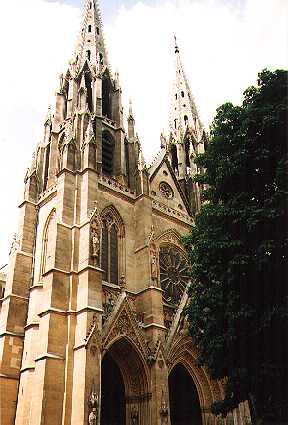
Basilica of St Clotilde, Paris
Jean Marie Hyacinthe Langlais was born on 15 February 1907 in the village of La Fontenelle in Brittany. His father was a
stonecutter and his mother was a seamstress. He was not born blind as is commonly thought, but by the age of three his
vision had gone and he had no memory of sight. When he was ten years old his uncle persuaded Langlais� parents to send him
to Paris to learn to read and write in Braille at the Blind School (Institut de Jeunes Aveugles). Langlais started learning
the violin but after hearing the older students practicing on the three
Cavaillé-Coll organs in the school he decided that
he wanted to become an organist. At the age of sixteen he began organ
lessons with the blind organist, André Marchal. It
was with Marchal that he learned to harmonise Gregorian chant and
improvise on plainsong melodies. In 1927 Langlais entered
the Paris Conservatory as an organ student, where he was a contemporary
of
such musical giants as Alain, Malherbé, Duruflé
and Messiaen. He received the premier prix d�orgue in 1930 and in the same
year he began improvisation lessons with Charles
Tournemire, the organiste titulaire of the Church of Sainte-Clotilde, in
Paris. By now Langlais was composing more and more
and commenced lessons with Paul Dukas who taught him the art of orchestration. Dukas said of Langlais � �You are a born
composer�. After holding several organist�s positions in Paris he was
appointed organiste titulaire of Sainte-Clotilde in
1945, a post he held until the age of eighty-seven. He toured America
extensively and began a love affair with the
country, giving countless recitals (nearly three hundred), workshops and
masterclasses. Recital programmes at this time
tended to include mostly French composers and Bach. His compositional
technique is interesting - he worked out a piece
mentally, wrote it out in Braille and then had to name every note and its
rhythmic value to a scribe. Despite this
laborious process he composed very quickly - he said that he thought about
the Messe Solenelle for twelve years and wrote
it in thirteen days. Many of Langlais� works were commissions. He refused
to have a guide dog and consequently accidents
befell him and included a broken leg, a broken arm and catching his hand
in a car door. In 1973 he had a heart attack and
in 1984 he suffered a stroke which left him with partial brain damage. He
recovered sufficiently in order to begin giving
organ recitals again but admitted to frustrating bouts of memory loss. At
the age of seventy-nine in 1986 he gave a
well-acclaimed recital in Notre Dame. Langlais had lamented the demise of
the role of the organ, Gregorian chant and
singing in Latin in Paris churches, particularly taking issue with the
Second Vatican Council of 1962 which left the
musical content of the Services to the discretion of the clergy. He
recounted one occasion when, at Sainte-Clotilde, � �a
member of the clergy switched off the organ ten seconds before the end of
Franck�s Pastorale�. Things did improve but not
entirely to Langlais� liking and certainly not to the status quo that existed before 1960. His musical tastes were manifold
and ranged from Léonin and Machaut to Stravinsky and musique
concrète. He was particularly fond of Bréton folksong
and of
course, Gregorian chant. Honoured many times throughout his long career, he held many accolades, including several
honorary doctorates and the Légion d�honneur, France�s highest
civilian award. His first wife, Jeanette, died from a
heart attack in 1979, and in the same year he married his second wife,
Marie-Louise, one of his former organ students.
In 1980 at the age of seventy-three he fathered a daughter, Caroline.
Langlais was a prolific composer and his compositions
include pieces for many different combinations of instruments and voices,
although the organ works dominate his oeuvre. He
died in Paris on 8 May 1991. Langlais always said that he could �see� � he
said that he could sense the size of a mediaeval nave by it's aura.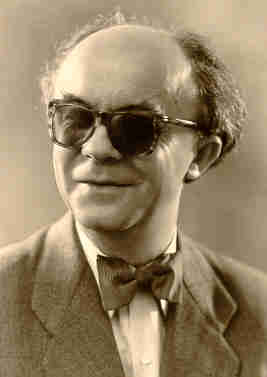
Jean Langlais (1907-1991)
Trois oraisons
Trois oraisons (Three prayers), a setting of three Latin prayers, is dedicated to Claude Dubois-Guyot, published in 1974,
and is scored for solo voice, or unison voices, organ and flute or violin. It is heard on this recording with solo voice
and violin. The organ accompaniment has no pedal part and is written for manuals only. The vocal writing throughout is
straightforward with the most taxing lines being in the first movement. Towards the end of his composing career Langlais
experimented with atonal ideas and this is very much in evidence in the first prayer, Salve Regina, particularly in the
violin part, although a sense of �key� still exists just below the surface. This first prayer is by far the most
adventurous and chromatic of the three, with the voice and violin forming a dialogue above a slow-moving, lugubrious
rgan accompaniment. The second prayer, Jam sol recedit igneus, gives the voice a more flowing plainsong-like melody and
is treated strophically. The violin and organ have all the interest with their mildly chromatic accompanying lines, almost
at loggerheads with the strict diatonic soprano chant. In the final prayer, Jesu dulcis memoria, Langlais returns without
apology to his first love, Gregorian chant. Again the voice is allocated a plainsong theme, without variation in each of
the five verses. No more is the influence of Gregorian chant in evidence than in the third verse of the prayer, with the
organ�s accompanying organum figure. The violin occupies an obbligato role with the organ supplying an almost Baroque-like
ccompaniment. In the fourth verse the voice and violin are in canon at pitch while in the final verse they are again in
canon but this time a fifth apart. Indeed it would be difficult, on a first hearing, to realise that the first and third
prayers were written by the same composer, so completely different are the harmonic idioms. Langlais, while dabbling with
atonal ideas, is most at home working with plainchant, and so it proves in this work.
Messe Solennelle
Langlais conceived this mass very much in the style of the traditional French Organ Mass, in that organ interludes and
choral sections alternate (alternatum), although the organ continues to accompany most of the choral sections. In most of
the movements the organ occupies a joint role � that of soloist and that of accompanist. The opening undulating figure sung
by the tenors in the Kyrie is almost a leitmotif for the rest of the movement and penetrates the harmony virtually
throughout. The opening fugal section of the Gloria is a predominant feature of the movement and again organ interspersions
announce its importance as more than an accompanying instrument. Canon and imitation abound and the organ brings the
movement comes to a triumphant conclusion. A rising misterioso organ passage precedes declamatory chords from the chorus
in the Sanctus. Much use is made of unison passages for choir in this unusually bravura setting of the movement. A more
sedate Benedictus follows with a soft falling figure on the organ creating the mood of the whole. The angular line and
texture of the sustained unison soprano and alto phrases help add to the tranquil atmosphere, which is soon broken with
the arrival of the Hosanna, repeating material used for this section in the Sanctus. Another falling figure on the organ
introduces the Agnus Dei and this is followed by a rising imitative section from the chorus. The movement uses canonic,
homophonic and unison phrases to create variety and interest within the repeated text and towards the end of the piece the
opening meandering tenor material of the Kyrie returns. If you like, the Mass has come full circle. Langlais has
successfully managed to fuse the form of the ancient Alternatum Mass with his own particular twentieth century harmonic
style.