 |
 |
 |
 |
 |
 |
 |
| Far Eastern University-Dr.Nicanor Reyes Medical Foundation,Philippines |
| FEU-NRMF CLIMBERS |
 |
| MOUNTAIN CLIMBING ESSENTIALS |
| Mountain climbing is a very physically and emotionally demanding activity. Detailed planning and careful preparation are needed for a very rewarding experience because nature can be your friend or a foe when you hit the trails. It really depends to your pre-climb preps and planning. |
| The following sections are for general info designed for beginners. Please take note that some of the facts are based from our knowledge and experience as a climber and do not serve as a standard reference. Different climbers...different preferences. But the Creed: "Take nothing but pictures, leave nothing but footprints, kill nothing but time." is applicable to all those who love the mountains. |
|
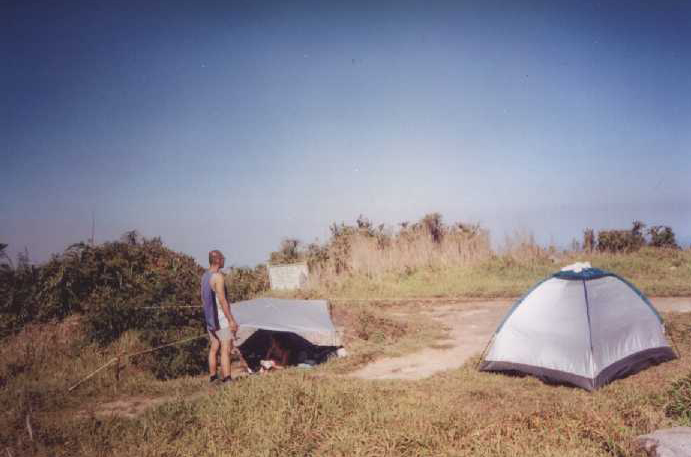
| Before you go mountain climbing, having and knowing the proper equipments are most important. Be very familiar with these essentials because these are the basic things that you will need to have a comfortable stay with nature. Backpack Two types: Internal and External Frames A good backpack that fits the needs of a mountain climber is the one that is versatile and strong enough to manage the shear and stress of a heavy load. This usually is made up of tough materials, has a sternal strap and hip belt (for weight distribution) and with enough pockets/panels for convenience. In most of the situations, we use the internal frame packs for it is stable enough in small off-trail climbs. This kind of pack is usually smaller than the body width and closer to the body, thus more stable. The issue of stability also depends on how you pack. Heavy loads should be placed near the body and frames. Boots/Sandals Hiking boots are a necessity for any climber for these serve as a protection for your feet. Choose a pair of boots that is ankle high which protects you against any ankle strain and sprain. Also look for good traction. Sandals can be used in short hikes but it offers little protection. Usually sandals are used in campsites or in rivers/streams for the material dries immediately. Good traction for sandals is also a must. Clothing The length of the stay in the mountains dictates the amount of clothing to bring. Prepare two sets of clothes if you're planning to have a two day climb or just consider the amount of space of your pack. We recommend underwears,shirts,shorts,jackets,socks and pants. Cotton materials for warm trips and nylons for for cold and rainy climbs. Gears against rain are also recommended like ponchos or rainproof jackets. Protective gloves, warmers,sunglasses and bonnets are optional. Tents A tent is your home when your out in the wilderness. So invest a little more when choosing one. There are many types of tents like the A frame, Tunnel, Dome and a variation of the Dome, the Geodesic. Here in our country, the most popular is the Dome type. It consists of two poles (usually shock-corded fiberglass) forming a dome and another pole for the rainfly. The room is ample. If you're a beginner, it's a safe choice but choose one with large meshed/screened windows and doors (for protection against insects), provided with vents on the roof (for ventilation), with large pockets/panels inside (for storage) and a large rainfly which covers most of the tent for maximum protection against heavy downpour. Also consider a seamless waterproof P.E. floor. Tarp It can be used for a very easy set-up of shelter against rain or the sun but protection is very minimal. Sleeping Bags Choose something made up of light materials like foam, polyester and cotton. it should be light and compact enough to carry it around. Camp Kits -Headlights/flashlights -Stoves -Water purifier -Earth pad/mat -Toiletries -Lamp -Ground sheet -First-Aid Kits Survival Kits -Whistle (it's better to use this than to shout for help in case of emergency) -Safety pins -Thin wires -Candles -Waterproof matches -Needles, thread and buttons -magnifying glass -Salt (in case of body salt depletion due to excessive sweating) -Plastic bag -Swiss Army Knife (a must) -Water sterilizing tablets (Puritabs) -Small mirror -Jelly Ace (Duuuuh?) |
| Equipments |
|
| Trail and Camp Etiquettes |
| When you belong to a group, make sure you move in a single line for the reason of lessening the impact of your presence in the trail. The trailmaster/leadman is the one who knows the trail and make the decision along the route, followed by the other members and then the sweeper which is usually the strongest among the group. He is responsible mainly for bringing up the rear. Do not throw anything along the trail as well as attempting to make a new route. Move quietly and disturb nothing. Be courteous to the locals. Also don't take anything as a souvenir, whether these are plants or animals. In using the rivers/streams, try to avoid using soap and brush your teeth away from these water sources.Bonfires are not recommended, use the stove instead for cooking. And please do not use your stoves inside the tent with little ventilation as a light or heat source to avoid Physical Fitness Be physically fit if your planning to climb. Many beginners tend to ignore this, thus a very unpleasant experience results. Involve your self in any aerobic, endurance and strengthening exercises. Equipment Packing When packing, aim for the lightest load possible without compromising the essential equipments. An ideal load for climbers should not exceed 1/3 of the body weight. Clothing should be wrapped in plastics which are sealed. No packs are waterproof. So to protect it against moisture, the inner linings should be waterproofed by placing a plastic in it. A backpack cover is also needed to achieve this. For stability reasons, things that are heavy should be placed near the body or the frames and light ones placed away. Those that are needed more often are placed in a more accessible pockets/panels for obvious reasons. Selecting A Safe Campsite For safety reasons, choose a campsite well. A good one should satisfy the following: -the site should have enough protection against strong winds. Do take advantage of natural windbreakers like trees, boulders and bushes. -Be careful not to pitch your tent directly below a tree for it can cause accidents. You don't want you P5,000 Coleman tent to be crushed or ripped by a coconut or a tree branch. Well...that's the good news, what if your head is directly beneath that tent? -Site must be near from a water source but be careful not to stay along the river during rainy seasons to avoid flashfloods. -Provide a cushion beneath your tent, the site should be covered with grass or leaves for a comfortable stay. Also try to check for pointed objects to avoid damaging the floor of your tent. Providing a ground sheet will also help.The groundsheet must have a smaller surface area compared to the floor of the tent to avoid water accumulation. -site must have a panoramic view of the place to appreciate it. -to achieve low impact camping, choose a site that was already used by other climbers. -choose a site with sloping terrain to achieve good drainage in case of heavy downpour. -place your tent in a place that will facilitate good traffic for incoming climbers, be considerate. -avoid overhangs, dangerous plants and stray animals. |
| DONE |
|
|
|
 |
 |
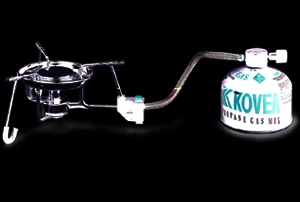 |
| Stove |
 |
| Lamp |
 |
 |
| Internal Frame Backpack |
| Dome Tent |