
Our Review In The December 1999 Issue of RANGEFINDER® Magazine
Reprinted with permission from RANGEFINDER® Magazine
Profile: Mike Ferra
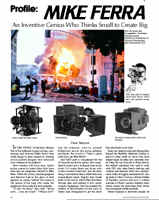
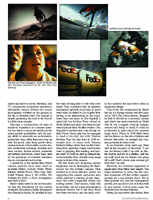
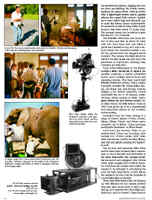
An Inventive Genius Who Thinks Small to Create Big Most readers will have seen classic action scenes in major films that have been shot on equipment created by Mike Ferra. While the actors, cinematographers and directors bask in the glory of what appears on screen, behind the scenes is the genius of the man who made the equipment that made the shots possible. “It can’t be done,” they said. “You’re nuts… outa yer mind.” “Wanna bet?” was the response. And so, around Hollywood, and in the movie industry anywhere, the word is: “Want a great crash shot; get Mike Ferra!” And that’s quite a compliment for the 65-year-old inventive genius who maintains he hasn’t got a technical bone in his body. Of course there are those who would contend otherwise, that far from being a mechanical dunce, Mike Ferra has extraordinary vision. Rightly, they would point to the way in which Ferra has taken vintage gear and refined it into small, compact equipment that has enabled the makers of blockbuster movies such as Titanic and Armageddon to get the shots they absolutely must have. Ferra, the creative mind and driving force behind the FerraFlex MiniCam System, is quick to heap credit on those who have helped shape his ideas into cinematic reality. Near the top of his list is Norm Brown, the brilliant machinist who used to work with CBS, who takes Ferra’s sketches and outlines and fashions them into sophisticated works of rugged, mechanical art. Also up there is Oliver Conway, a former builder of Panaflex systems and now a valued member of Ferra’s camera building team which creates the prototypes from which the commercial models emanate. Ferra’s business is relatively simple: he makes and rents to movie, television, and TV commercial companies miniature, affordable camera systems for action photography, whether on the ground, in the air, or beneath water. The concept is simple; producing the tools to do the job is a little more complex. Through a combination of years of hands-on experience as a camera operator, the vision to see in his mind’s eye the action-packed possibilities, and the people skills to assemble an enthusiastic production team, Mike Ferra has come up with the goods. And those goods—from camera mounts, 35mm reflex movie cameras, underwater housings, shoulder and chest mounts, bicycle mounts, miniature car systems and more—have been used by the producers of countless television shows, commercials and movies. A partial list of the feature films Ferra’s camera systems have been used on includes Titanic, Con-Air, Water World, Batman, Batman Forever, Under Siege, Heat, Lethal Weapon, Speed 2, The X-Files, The Postman, For Richer or Poorer, Armageddon, and Mask of Zorro. Ferra’s varied career in the movie industry laid the foundation for his current enterprise. His parents, Italian immigrants who farmed in Shaler, PA, a small suburb of Pittsburgh,PA instilled in him the value of being able to work with one’s hands. That, combined with an inherent mechanical aptitude stood him in good stead when he drifted to Los Angeles after serving as an infantryman in the Army. Spare time was spent at The Ragdoll, a nightclub his brother Tony owned in North Hollywood and it was there he met various people from the film studios. One thing led to another and, even though he didn’t know what a grip was, he managed to land a two-day job with Warner Brothers That two-day stint in 1968 extended into 16 years with Warner Brothers during which time he did everything from operating a large construction crane to gripping, film loading, and camera work. It could be said he learned the movie industry from virtually every angle except in front of the camera. His first foray into designing camera equipment was in developing the Ferramount for the Arriflex camera. This resulted in a more efficient system for supporting the camera and zoom lens which allowed a number of new functions that were compatible within the existing system. That mount, while still in use today, was not a real commercial or financial success. But it did show Ferra that there was room, and the need, within the industry for innovative ideas in equipment design. One of the key components in Ferra’s line-up is a vintage camera that first came out in 1925. The 35mm Eyemo, designed by Bell & Howell as a newsreel camera and which was used extensively in World War II, was a rugged, wind-up military camera and being so small it could be positioned in tight places for unusual angle shots. When in 1968 Mike Ferra saw the Eyemo on the sets of Mannix and Mission Impossible, he realized this camera’s potential for stunt work. In an interview some years ago, Ferra said of this moment of discovery. “I got one (an Eyemo) built it up with an electric motor, and all of a sudden, half the car stuff you’d see on Mannix was going off a cliff. That’s where crash cameras got their start,” he said. However, not everyone supported or appreciated what Ferra had created. The major limitation to some was the camera’s maximum 100 feet of film capacity, enough for a one minute shoot. But as Ferra pointed out, and has subsequently proved, you can shoot a lot of action stuff in one minute. And in most cases, the doubters have become believers. Taking his innovative idea further, Ferra has retrofitted the Eyemo, stripping the camera down and refitting the shutter system, replacing the spring driven, wind-up system with a lightweight motor, and in general refining the rugged little camera’s capabilities to meet today’s high-tech demands. And to make the Eyemo almost indestructible, it’s encased in a crash housing made of quarter-inch steel that’s about 11 inches high. The compact system can be sited in a space less than 12 x 12 x 12 inches. The Ferraflex MiniCam has stood the test of time and trial: in about 30 years only two have been lost: one when a gravel truck landed on top of it, and a second, which was mounted outside a car, hit the ground and was dragged across concrete. The camera was filed almost in half but the film inside was still okay. The producers of Swift Justice (starring Sean Connery) got their shot. Some other refinements to the Eyemo include a reflex viewfinder (to replace the parallax original), a crystal controlled motor, and a wireless remote focus and operating feature. The basic hand-held FerraFlex MiniCam system, which weighs 9 pounds, contains the 35mm reflex camera, the frame rate and footage counter display, a low battery indicator, crystal controlled (for six to 60 frames), reflex viewing, either optical or video, and a quick release top and bottom mount. So, in other words, the little Eyemo—born in 1925—has grown up to be a sophisticated and important player in the modern movie making. Included with the basic system is a range of Canon lenses—17mm, 20mm, 24mm, 28mm, 35mm, and 50mm and a complete set of filters. Other packages incorporate Panavision or Nikon lenses. And that’s for starters. Want to go underwater? There are housings that include two 50-foot cables, with video assist and remote control, for deep diving, and surf and splash housings for shallower work. The mounts and harnesses Mike Ferra and his team have invented allow cameramen to shoot forward and backwards at the same time—with two cameras shoulder-mounted and equipped with virtual vision space goggles and a built-in monitor. And there are mounts that enable the camera to be attached to and facing the actor for tight head shots; or that allows the camera to be shot over the shoulder of a motorbike rider or bicyclist. These days Mike Ferra is flat out keeping up with demand for his camera systems (they rent from about $185 to $450 a day and up, not expensive for big budget productions) and he doesn’t spend much times on sets. Occasionally, for a really special and complex set up—such as on the set of Batman Forever—he will go into the field as a consultant. But whichever you look at it, for a guy who about 39 years ago didn’t know a grip from a matte box, Mike Ferra’s made a big impact on film and television. As they say in Hollywood: “You want to shoot a crash; get Mike Ferra.” Ask Aaron Spelling—he wanted to see a Porsche broadsided with all the drama of close-up action and impact. Ferra delivered. And it was a take. One noted movie director of photography who raves about the Eyemo is John Schwartzman ASC, the DP on blockbusters such as The Rock and Armageddon. And in the same breath, Schwartzman praises the genius of Mike Ferra for taking existing technology and retrofitting it to create rugged, versatile equipment that can be used for contemporary applications and meet the demands for even more explosive and spectacular movie imagery. “We owe a lot to guys like Mike,” was the essence of his praise. He said that on the set of Armageddon he carried three Eyemos with him all the time. It was invaluable in really tight places, such as in the Russian space station, and one of the best sequences of a Space Shuttle launch was made with the Eyemo fitted with a 50mm lens and mounted on the top of a building overlooking the launch site. Even though there were 15 other more sophisticated (and infinitely more expensive cameras) located all around the site, the little Eyemo came up with the best shots. “It’s unbelievable that this little camera can come up with the million dollar shots,” said Schwartzman. Durable, small, reliable, and having reflex capability are all features praised by John Schwartzman. He added that even though he has put the Eyemo in some very destructive situations during high speed stunts, he has yet to destroy one. “We’ve dinged a couple,” he admitted, “but they’ve always survived the shot.” And another talented director/cinematographer who has become enamored with the FerraFlex camera system is Austin Smithard, principal of Electric Avenue Films [http://home.earthlink.net/~chief brody] Marina Del Rey, CA. This English-born director and cinematographer of high-end commercials for clients such as Mercedes, Jaguar, Amtrak, the New York Stock Exchange and Hughes Aerospace, made a wry observation when comparing the minute size of the FerraFlex with the industry standard, the venerable PanaFlex. “I’d love to be buried with a PanaFlex, but there just wouldn’t be enough room for the two of us.” In the less-than-a-year in which Smithard has used the FerraFlex he has found it a time and resource saving piece of equipment whose uses extend far beyond that of a stunt camera. He likens its compactness, lightweight, and ease of use as the 35mm motion picture equivalent of using a 35mm still camera. And he admits he was skeptical at first about the FerraFlex’s capabilities, conceding it’s been a radical change for him to use such a small camera. “I thought it was purely for stunt work but quickly realized that this camera suddenly gave 35mm cinematography the ease of 8mm. You can grab this camera and be ready shoot in a few seconds. I think it’s the smartest thing anyone has done with 35mm movie equipment in years,” he said. Smithard said there are situations which traditionally would require a large crew to shoot that can be handled by one or two people with ease. He cited one recent assignment for Jaguar when time was running out, he had to get to the top of a sand dune to get the shot he wanted and there was no way to get more than 100 pounds of movie gear—the camera with lens, filters, large magazines and stands—up the dune in time. Grabbing a FerraFlex, he raced up the dune, used some sandbags as support and got the shots. Nor does quality suffer. Smithard said he’s very picky about each frame and when the film shot with the FerraFlex is edited with other film, no difference is visible. “Here I am shooting high-end motion picture commercials for someone like Hughes Aerospace in the 21st century using a piece of equipment that was designed for World War II. That’s pretty amazing,” he said. “I can think of dozens of situations over the last 10 years where this camera would have been perfect.” Not one to sit still and wait for things to happen, Mike Ferra’s always coming up with ideas. Some work, others don’t. But that inventive mind keeps ticking over. By the time this article is in print, there could be another Ferra innovation in the works. You don’t think so. Wanna bet? Information on the FerraFlex MiniCam Systems can
be obtained from Mike Ferra, Writer/photographer Peter Skinner is based in Anacortes, Wash. He is communications director for the American Society of Media Photographers, ASMP. Posted with permission from Rangefinder Magazine, December 1999 issue Captions
|
