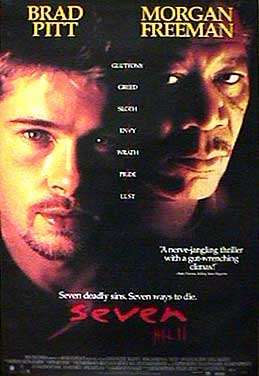
 Sadly mistaken for simply "just-another-horror-flick," Se7en has been done a grave dishonor by the majority of the viewing public who neither have the empathy nor the intuition to understand the deep message it carries. Comparing this poetic and cautionary masterpiece to "The Silence of the Lambs" is a terrible misconception. The Silence of the Lambs was an excellent film about the innerworkings of investigative profiling and the psychopathic personality (although only partly represented and definitely not generalizable to the psychopathic population of today) through Dr. Hannibal Lecter. Se7en on the surface may seem similar - a film consisting of a plot about two cops "hunting" down a "mad" (another misconception) psychopathic serial killer.
However, under the skin, these two films are entirely different in contextual substance.
In The Silence of the Lambs, the plot is as deep as it goes. The relationships and interactions between the characters are the core of the story. Sentiments are decided based on the events that occur in result of another's actions. That is as deep as it goes.
Rather than being "plot-based" entertainment, the themes in Se7en are theological, philosophical, moral, and cultural. The entire film is based around the dialogue between Somerset (Morgan Freeman) and Mills (very well-portrayed by Brad Pitt), and the philosophy and motivation behind John Doe (Kevin Spacey in his best performance). Within the film is the continuing philosophical dialogue between Mills and Somerset, two contrasting characters that happen to be working on the same side. Mills' nature is impulsive, passionate, yet plagued with inexperience and naivete, while Somerset is weathered, subdued, with polished character, lore, logic and practicality, with a touch of lost hope. Neither men are able to get much anywhere with the investigation (at least without a little bribery - another testament to why this movie is NOT about investigative profiling or techniques), as Somerset replied to Mills when Mills asked him what 'they were really doing if they weren't investigating,' "just picking up the pieces."
It is the weakness of Mills that leads him to be devoured by the wrath of John Doe in the end, a man, neither psychotic or equivalent to the Devil (yet seemingly so), but calculate, methodical, and patient. On the same token, it is Somerset's experience and venerability that keeps him from being targeted by Doe.
"If we caught John Doe and he were the devil, if he were actually satan, that might live up to our expectations. But, this is not the devil. It's just a man," admonishes Somerset.
One of the most haunting ironies I find in Walker's script well portrayed by Fincher's cast is the uncanny similarities between John Doe, the antagonist and Somerset, the protagonist. If you watch that one scene in the car, you will realize that Somerset agrees with Doe, yet although realizing that their consensus does not justify Doe's irrational, yet seemingly rational killings. With Doe's philosophy explaining his intolerance for the prevalence and trivialization of the deadly sins, Somerset's continuous argument that we are becoming too apathetic of a society, only motivated by such things such as our temptations and self-indulgence, there is admittedly a strong parallex that exists between the two characters. Yet, they stand opposed to one another, because while Somerset, although discouraged, managed to keep his faith in mankind, Doe did not, and could not tolerate the injustice any longer.
With the current decline in the immaterial and spiritual life, and the ascending obsessional mindset of psychological egoism, existentialism, atheism, and hedonism, there is no message needed more than the one represented in this fine film by Fincher. We as a people must return back to faith, lest we become tyrants and slaves to our sins that will devour us in the end.
Back to Main
Back to Movies