Ancient Chinese combs were often fabricated in precious materials, like the gold, the silver, the ivory, the Rhinoceros frontal bones, the crystal, the hawk's-bill turtle, the tin, the jade, and so on. Combs are called "Zhi" in old times, including combs and kames: the difference lies mainly in the teeth shapes -- the combs' teeth are thicker and sparse, the kames' thinner and dense. The "Shuowen Jiezi" (Articals and Words) by XU Shen in Han Dynasty had such description: "Zhi, collective of combs and kames."
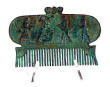
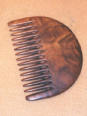
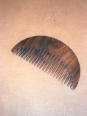
From ancient till now, Chinese combs had more than 6,000 years' history, during this long period, the construction has greatly changed. From some unearthed and folk handed-down examples, combs were differently shaped in the Han (206B.C. - 220), Tang (618 - 907) and Song (960 - 1279) Dynasties: the Han Dynasty assumes a longer U-shape, with generally a utensil decorative design, together with birds and beasts in-between; the Tang Dynasty assumes the U-shape, but with a slightly extended lower part; the Song Dynasty is the crescent moon.
The combs and kames were one among the eight principle hair decorations in ancient China, women often inserted a fine-arted comb in their hair buns, as a beauty fashion. In history, the famous comb-fabricators are Changzhou "Palace Combs", Fuzhou "Cow and Goat Combs", as well as Guilin "Bamboo Combs". The treatment for keeping in good health by combing the hair has long existed, thus there exists a fine alias for the combs: "Pearl in wood teeth". |