Broadband or high-speed Internet access is provided by a series
of technologies that give users the ability to send and receive data at
volumes and speeds far greater than current Internet access over traditional
telephone lines. In addition to offering speed, broadband access provides
a continuous, "always on" connection (no need to dial-up) and a "two-way"
capability, that is, the ability to both receive (download) and transmit
(upload) data at high speeds. Broadband access, along with the content
and services it might enable, has the potential to transform the Internet:
both what it offers and how it is used. It is likely that many of the future
applications that will best exploit the technological capabilities of broadband
have yet to be developed.
There are multiple transmission media or technologies that can be used
to provide broadband access. These include cable, an enhanced telephone
service called digital subscriber line (DSL), satellite, fixed wireless,
and others. While many (though not all) offices and businesses now have
Internet broadband access, a remaining challenge is providing broadband
over "the last mile" to consumers in their homes. Currently, a number of
competing telecommunications companies are developing, deploying, and marketing
specific technologies and services that provide residential broadband access.
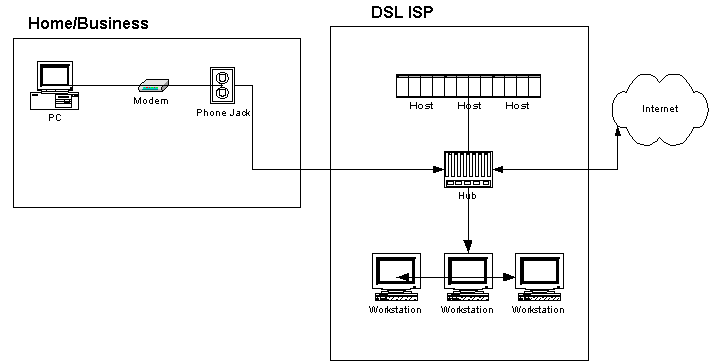
DSL is a technology for providing high speed net access to businesses
and residences over ordinary copper telephone wires. There are multiple
flavors of DSL, such as ADSL, SDSL, HDSL, VDSL, IDSL1. For ADSL
(the A is for asymmetric), in which upload speeds are slower than downloads;
SDSL (the S is for symmetric), where upstream and downstream speeds are
the same; and IDSL (the I stands for ISDN), which overlays a DSL connection
on ISDN. DSL can theoretically deliver data at speeds up to 6 Mbits per
second. Typical connections, however provide speeds from 512 Kbps to 1.5Mbps
downstream and 128 Kbps upstream. The user is constantly connected over
DSL and a DSL line carries both voice and data, enabling that user to remain
connected while speaking on the phone.
DSL users may connect via a DSL modem, or directly to their phone
switch(router). If the provider requires a modem to connect, the user will
need to dial-up to the DSL server in order to use the service.
Current DSL technology enhances existing voice telephone technology
to provide high speed net access. The most popular implementation of DSL
currently is ADSL (Asynchronous DSL).
An ADSL circuit works by connecting an ADSL modem on each end of a
twisted-pair telephone line, creating three information channels -- a high
speed downstream channel (to your home), a medium speed upstream channel
(from your home), and a POTS (Plain Old Telephone Service) voice channel.
(Note that analog transmission uses only a narrow band of the available
frequencies of the copper telephone wire). Thus the modem multiplexes the
telephone line bandwidth. The up and downstream data channels are each
100 kHz - 1 MHz while the POTS is from 0-4 kHz.
ADSL modems multiplex the available bandwidth of a telephone line in one of two ways -- Frequency Division Multiplexing (FDM) or Echo Cancellation. FDM is more common because it is less complicated. FDM assigns one band for upstream data and another band for downstream data. The downstream path is then divided by time division multiplexing (TDM) into one or more high speed channels and one or more low speed channels. The upstream path is also multiplexed into corresponding low speed channels. In Echo cancellation, the up and downstream signals are sent on the wire at the SAME frequencies, i.e. they overlap and it separates the two by means of local echo cancellation, a technique well know in V.32 and V.34 modems. With either technique, ADSL splits off a 4 kHz region for POTS at the DC end of the band.
The cable company acts as its own ISP. It establishes a connection
with the Internet through a router, which receives data over a 1.5-mbps
T1 line or 45-mbps T3 line leased from the local telephone company. The
router links to the head-end controller (the part of the cable system
that transmits TV broadcasts and satellite signals) via fast Ethernet,
at rates of up to 100 mbps. The IP packets are converted into signals that
can be transmitted, like television broadcasts, over coaxial cable.
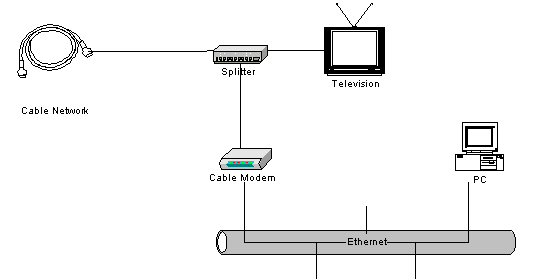
A cable splitter in each subscriber's home sends one cable to the TV set
and another cable to the computer's cable modem. The cable modem then demodulates
these downstream signals back to IP packets which are sent via 10baseT
through an RJ-45 cable connected to the computer's ethernet card.
Head-End Controller
A cable system's head end receives TV signals via satellite and local
broadcast and converts them to signals that can be sent over coaxial cable
to subscribers.
To deliver digital data, the head-end controller is needed to modulate
IP packets--encode them as a digital signal--and broadcasts the signal
down the cable on an unused channel.
The controller interprets the data it receives from individual customers
and keeps track of the services offered to each of them. Some head-end
controllers let the cable company create different service packages depending
on customers' bandwidth needs.
Cable modem
The cable modem demodulates the incoming signal and translates it back
into IP packets the computer can understand. The cable modem also sends
data upstream to the Internet through the cable system, on a 5- to 40-MHz
band. Since all subscribers share this relatively narrow band, the cable
modem must be able to transmit data on any 2-MHz channels allocated on
the upstream band. The head-end controller instructs the cable modem when
to send data upstream and which channel to use. Until the industry adopts
standards, the head-end controller and the cable modem in each system most
likely must be made by the same manufacturer.
In the case of cable modems also, is that the cable line is shared with
others in your area, which makes it easy for a neighbor to snoop ip packets
destined for your computer. However, a lot of companies are now encrypting
the data stream as it enters the network.
Typical cable modem service costs $39.95-49.95 per month depending upon whether the subscriber already has cable service, with installation costs ranging from $69-$99 depending upon whether a network interface card has to be installed as well. Many companies frequently have marketing deals when they offer free installations in a bid to gain more customers
Typical DSL service costs between $40 and $80 for home users depending
upon the provider, and $80 to $500 for business users. The installation
costs range between $100 and $200 which include a network card and DSL
modem.
Cable modems are generally regarded as being easier to setup than
DSL. There have been well-documented horror stories in the media about
the problems involved in getting DSL up and running for new subscribers.
This is probably due to the lack of experience of the phone companies in
this area. Two years ago, cable took months to install. The problems with
installation of DSL have to do with the interplay between the phone company,
the DSL provider, and (often) the ISP used for service.
As DSL use becomes more widespread and popular, these problems should
be alleviated. The
Cable performance is affected by the number of people connected on a
particular line. Since it is a shared line, the more local subscribers
there are, the slower the connection. Most cable providers set a limit
on how many customers are connected to a particular line so they can guarantee
a minimum download/upload speed.
| Cable | DSL | |
|---|---|---|
| Security | Potentially less secure than DSL | Better security |
| Cost | Generally cheaper; price break if use gets cable service as well | More expensive; for business users, higher speeds get pricey. |
| Setup | Setup can be difficult | Easier to setup |
| Performance | Line shared with others in neighborhood; speeds vary accordingly | Depends on location from central switching office |
| Technology | Dec. 1999 | June 2000 | % Change |
|---|---|---|---|
| ADSL | 185,950 | 325,901 | +75 |
| Cable ( Coaxial) | 879,671 | 1,434,237 | +63 |
| Cable (Fiber) | 307,315 | 301,551 | n.m |
According to a Dept. of Commerce survey(endnote), 4.5 % of U.S. households (10.7% of online households) had broadband access. Kinetic Strategies states that by Sept. 2000, there were about 3.8 million cable-modem subscribers in North America and projects that this number will increase to 20 million by 2004. According to TeleChoice, there were about 1.7 million DSL lines in service by Sept. 2000, and it projects that this number will grow to about 9.6 million by 2004.
It is hard to make predictions about which broadband technology
will come to dominate the marketplace. In addition to cable and DSL, other
technologies are now becoming available to the mass-market consumer, such
as satellite, fixed wireless, albeit at a lower rate. These technologies
will see growth in areas where cable and DSL are not readily available
, or prohibitively expensive to deploy (rural areas in the developing world
come to mind).
In the U.S., however, it is safe to say that the two main ways for consumers to gain access to the broadband info-super highway will be cable and DSL. Cable will likely stay dominant in the residential marketplace for a while, where cable infrastructure is firmly in place, as long as the cable companies continue their aggressive rollout of services. The AOL-Time Warner merger, ATT &T's purchase of TCI and MediaOne (http://news.cnet.com/news/0-1004-200-4878620.html) seem to assure a bright future for cable modem access. For example, the AOL Time-Warner merger makes it possible to provide cable modem service to the 25 million or so AOL subscribers through Time Warner's RoadRunner cable modem service. AT&T is also poised to offer broadband cable access as part of an all-in-one communications package for the residential consumers consisting of telephone and Internet access.
DSL companies are not sitting on their heels either. In the business
market , DSL will likely dominate. This is because business operators will
probably not look to cable companies to provide service as the infrastructure
is not already in place. Phone companies who offer DSL will also aggressively
market it as part of an all-in-one package of telephone, Internet and wireless
service.